

I heard the mattress springs before I heard her voice. It was a Tuesday in February, a little before seven, and my mother was sitting on the edge of her bed with both palms flat on the quilt, pushing herself up and not quite getting there. She tried twice. The second try came with a small sound I had not heard from her before. By the time I reached the doorway she was standing, and she was waving me off, and I let her wave me off, because at eighty-seven she has earned that. Then I went back upstairs and wrote two words on the back of an envelope: bed rail.
Fourteen months later the Medline bed assist bar is still attached to the side of that bed, and it is the only piece of equipment in this house my mother has never once complained about. Not the rollator, which she tolerates. Not the tub transfer bench, which she calls the boat. This one. That still surprises me, because the Medline bar is the least elegant object we own and the one she was most suspicious of on the day it arrived. I am a retired clinic nurse, thirty-one years in an outpatient office, and I have watched plenty of people refuse a piece of safety equipment because it made them feel old. So I paid attention to why this one was different.
The Quick Verdict
A plain, steady handhold that let my mother get out of bed without an audience again. Not pretty, not portable, and not for an adjustable bed, but at fourteen months it is the least regretted thing I have bought for her.
Amazon Check Today's Price →The handhold that ended the six a.m. struggle
Height adjustable, fits a non-articulating twin, full or queen, weighs 6.4 pounds, and comes with a nylon pocket that has held my mother's glasses every single night since February.
Amazon Check Today's Price on Amazon →How I've Used It
The bed is a queen in what used to be the downstairs guest room and is now her room. The bar went on in about fifteen minutes on a Sunday afternoon, most of that spent reading the directions twice because I did not want to be the nurse who installed something backwards. The whole thing weighs 6.4 pounds, so I carried it up from the front hall in one hand with a coffee in the other. The frame sits along the side of the mattress and the bar comes up right where her hand naturally lands when she swings her legs over. I tightened everything, shook it hard, and heard nothing move. Then I made her get in and out of bed three times while I watched.
Height adjustment is a matter of setting the bar so the top of it meets her hand at roughly mattress height, maybe a touch above. Too low and she has to bend to reach it, which defeats the whole point. Too high and she has to reach up, which is worse and puts a pull on the shoulder. It took two tries over two mornings to land in the right spot, and I marked the setting with a pencil line on the frame so I could find it again if anything ever loosened. Fourteen months on, nothing has.
How she actually uses it: she rolls to her side, pushes down on the mattress with her left hand, takes the bar with her right, sits up, and then holds it while she swings both feet to the floor. She keeps hold of it while she pushes her feet into her slippers. That is the entire routine. It is a handhold, not a hoist. She does not pull herself up on it, and I would not want her to. I said that out loud in the first week and she informed me she had been getting out of bed for eighty-seven years, thank you.
The other thing I did not expect is that it changed the evenings. She reads in bed now, which she had stopped doing, because getting up to turn off the lamp had become a production. With the bar there she sits up, swings over, stands, and does it without thinking. Small thing. It gave her back a habit she liked. Nobody sells that on the box.
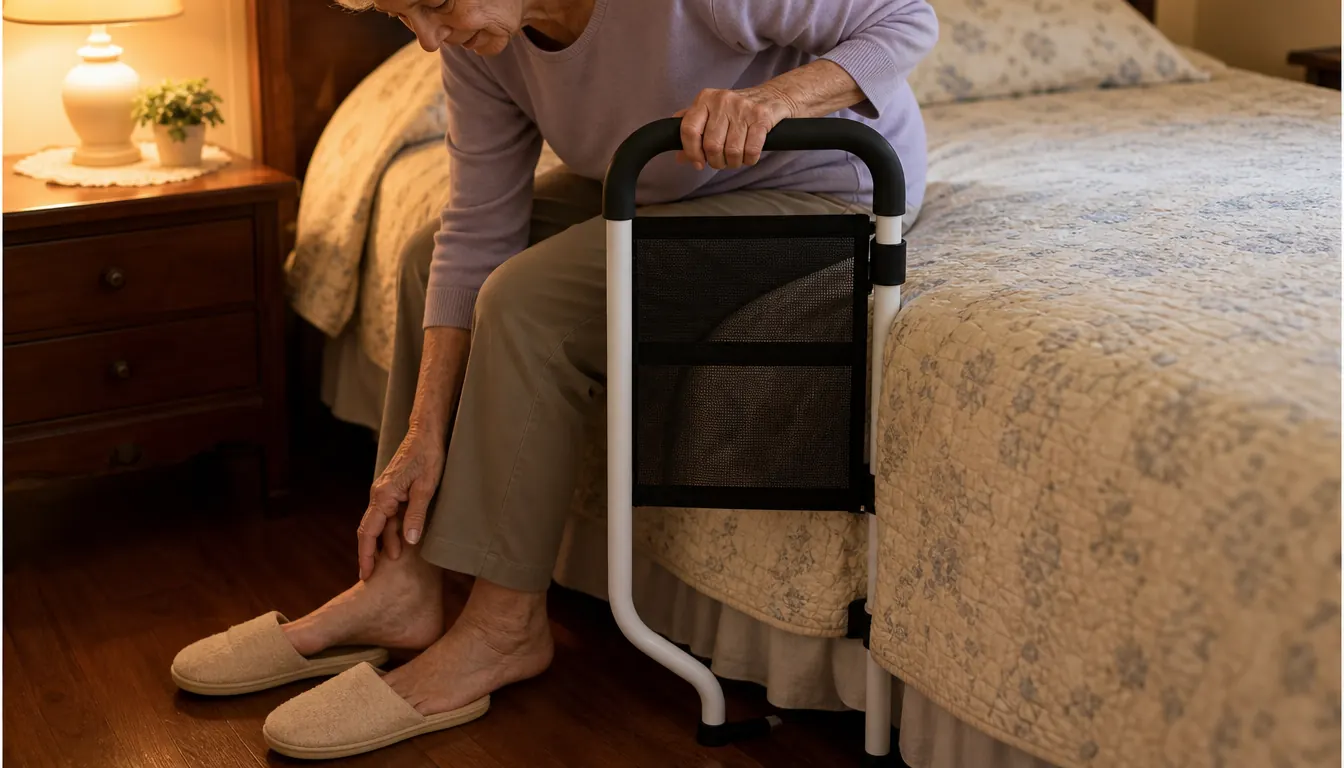
The Height Adjustment Is the Whole Job
The single most useful feature is the part that adjusts, and it is also the part people get wrong. A range on a spec sheet is not the point. The point is that the top of the bar has to sit where her hand is when her arm hangs down beside the mattress, and that spot depends on the mattress, the box spring, and how thick any topper is. Ours is a firm mattress with a two inch topper on it, and the bar ended up a hand's width above the mattress top. On a different bed it would end up somewhere else. That is not a flaw. It is just the nature of the thing.
We got it wrong the first night. I set it level with the mattress because level looked tidy, and the next morning she said she had to reach down for it. We raised it one setting. She still reached. We raised it again and that was the one, and she has not mentioned it since. What I would tell anyone staring at the same instructions: set it, let them sleep on it, then adjust it in the morning while the person is actually in the bed with their feet on the floor. Installing it perfectly on an empty bed is guesswork, and guesswork is how these end up in a closet.
One thing worth knowing before you buy. This bar is meant for a non-articulating bed, which is the plain way of saying a bed that does not bend. Twin, full or queen. If your parent sleeps on an adjustable base, or on a bed that raises the head, this is not the product for that bed and you should not try to make it one. I would rather you read that here than find it out on a Saturday night.
Fourteen Months of Daily Wear
Everything on it is still tight. I check the fittings about once a month with my hand and a shake, and nothing has worked loose. The finish picked up a couple of scuffs where her rings catch it, which I expected. The care instructions say to wipe it with a damp cloth and that is all we have ever done, maybe once a week. It has not rusted or discolored and it has not developed the small wobble that makes a person stop trusting a handhold. The nylon pocket has not torn, though it has softened and gone a bit shapeless the way nylon does after a year of being leaned on.
The honest limitations. The bar is cold in January. She noticed that the first winter and now drapes a folded washcloth over it at night and takes it off in the morning, which is her solution, not mine, and it works. It also makes making the bed slightly fiddlier on that side, because there is now a bar exactly where your hand wants to go when you tuck the sheet. Thirty extra seconds. I stopped noticing around month two.
Nothing has broken. Nothing has been taken off and put back on. There has been no fall, before or since, and I am aware that a bar did not cause that. But I do think the two tries at six in the morning are down to one, and one is a much better number than two when you are eighty-seven and it is February in Massachusetts.
It is a handhold, not a hoist. She does not pull herself up on it and I would not want her to. That distinction is the whole reason it still works at fourteen months.
What the Storage Pocket Actually Holds
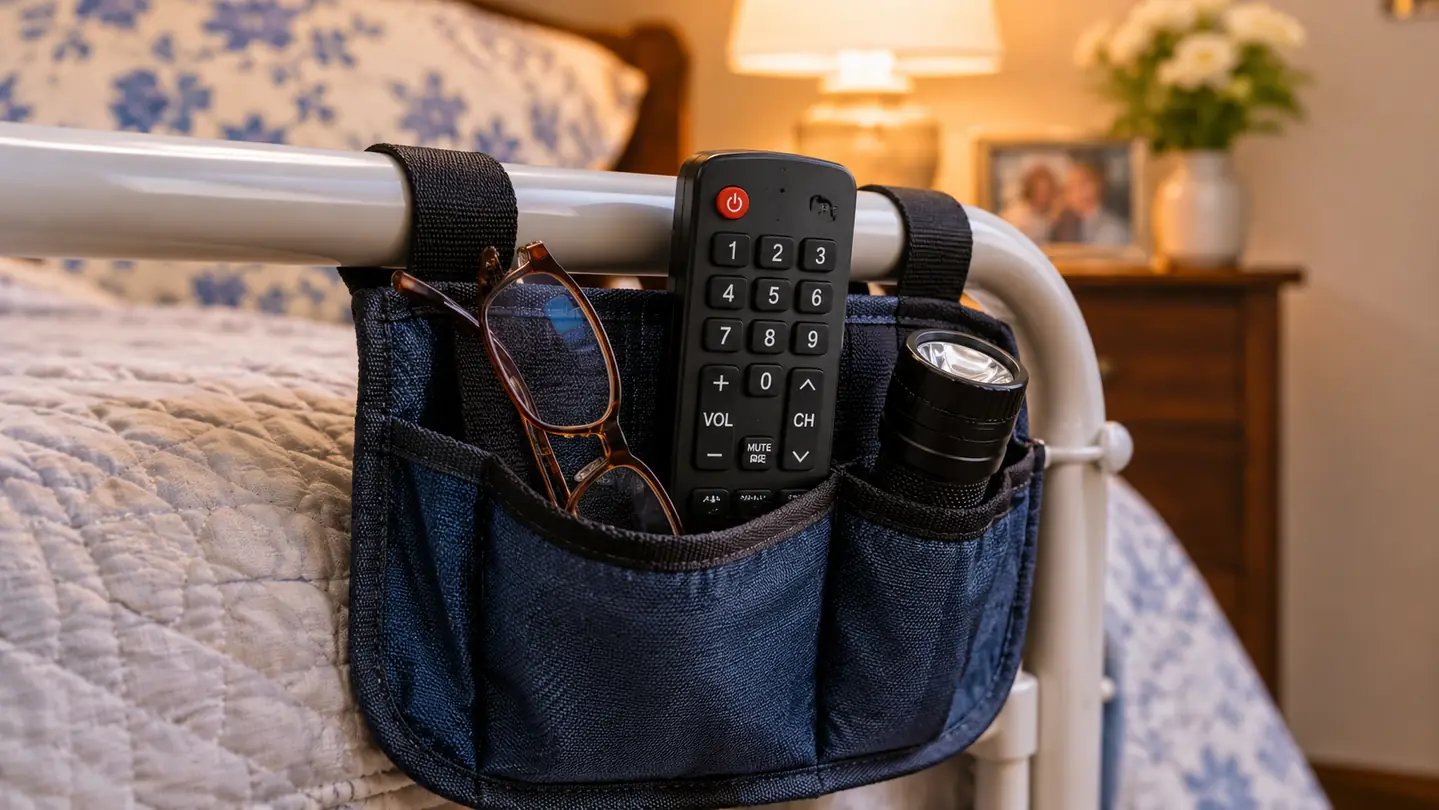
The nylon pocket hangs at the near end and it has quietly become her nightstand. Glasses go in it every night. The television remote. A small flashlight I put there after an October power cut, which she has kept, and which she has used once. Her phone stays on the mattress beside her rather than in the pocket, because she says it is too far to reach in the dark, and she is right.
I want to be clear that the pocket is not a reason to buy this on its own. It is a good extra. But small things matter at this stage, and before the bar her glasses lived on the floor beside the bed in their case. There were two mornings she could not find them and one where she came close to stepping on them in the dark. That stopped. If you are weighing this against a plainer bar with nowhere to put anything, weigh the pocket.
Where It Falls Short
It does one job. It helps a person sit up and stand from the side of a bed. It does not help with a low chair or the couch, and it does not help with the toilet, which is a different product that lives in a different room in our house. It is not a hospital bed rail and it is not designed to keep a person from rolling out of bed. If your situation involves confusion at night, wandering, or a real risk of falling out of bed, this is not enough equipment. That is a conversation with your doctor or an occupational therapist about a proper bed system, not a purchase you make from a search results page.
It also takes up the side of the bed, which makes it the wrong answer for a couple sharing one. My mother sleeps alone in that room, so it has never mattered here. In a shared bed it would be in somebody's way every night. And it does not travel. We looked at taking it to my brother's house for a long weekend and decided it was not worth uninstalling and reinstalling for two nights. If you were hoping to move it between rooms, plan on leaving it where it goes.
What I Liked
- Height adjusts so the top meets the hand at mattress level, which is the difference between a bar that gets used and one that gets ignored
- Still tight at fourteen months with a monthly hand check, no wobble and no rust
- Weighs 6.4 pounds and goes on in about fifteen minutes with no drilling and no holes in the wall
- The nylon pocket holds glasses, a remote and a flashlight, and ended the morning search on the floor
- Fits a non-articulating twin, full or queen
Where It Falls Short
- Cold to the touch in winter, which is a real complaint from a real person
- Not for adjustable beds, and not something you should try to adapt
- One side of the bed only, so it is awkward in a shared bed
- Not portable; taking it off and putting it back on for a trip is not worth the effort
- Makes tucking a fitted sheet on that side slightly slower
What I Compared Before Buying
I looked at three other options before I ordered this one. The first was a bed rail with legs that stands on the floor beside the bed, which is sturdier in some ways and is also a thing to trip over in the dark, and her room is not large. The second was a grab bar screwed into the wall studs, which is excellent if you own the house and know exactly where the studs are, and is a permanent hole in the plaster if you get it wrong. The third was a floor to ceiling pole, which works well for some people and requires a ceiling you are confident about and a person who is confident on their feet.
The Medline bar won because it attached to the bed and nothing else about the room changed. No new footprint on the floor. Nothing screwed into a 1950s colonial that has enough holes in it already. I am not loyal to a brand. I am loyal to whatever my mother will actually use without being reminded, and she used this from the first week without a single reminder. That settled it. If it had sat in the corner for a month, I would have written you a very different piece.
Who This Is For
This is for the person who can stand and walk but has started to struggle with the first ten seconds of the day. The sit up. The swing over. The push to standing. My mother was exactly that shape of problem: steady on her feet once upright, wobbly getting there, and absolutely unwilling to be helped out of bed in the morning. If that describes your parent, this is the least disruptive change you can make to that room. It is also for the person who has refused a hospital bed and refused a night aide, because it gives back the privacy of getting up alone. Have your own doctor or physical therapist check the height and the setup before you rely on it. A bar set at the wrong height is worse than no bar, and that is not a small statement.
Who Should Skip It
Skip it if the bed is adjustable. Skip it if the person rolls out of bed, is confused at night, or has already fallen while getting up, because those are situations that call for an assessment rather than a purchase. Skip it if the bed is shared. Skip it if the mattress or frame is unusual, at least until you have checked with the manufacturer, since the listing is specific about which non-articulating sizes it fits. And skip it if what you actually need is help standing from a chair, the couch or the toilet. That is a different piece of equipment, and buying this one will not solve it.
Two tries at six in the morning became one, and that is the whole review
Fourteen months, one monthly check with a hand and a shake, and no complaints from the person who complains about everything else. If the morning is the hard part of your parent's day, start here.
Amazon Check Today's Price on Amazon →