

Short answer first, because you probably arrived here with a bed and a person and not much time. A bed assist bar that slides between the mattress and the box spring is the better fit for most homes. Nothing sits on the floor, nothing gets kicked in the dark, and it lifts out of the way in seconds when you change the sheets. A floor-braced rail is the better fit when the person needs a longer handhold, a taller grab point, or a rail that feels planted rather than pressed into a mattress. Everything below is how I worked that out on one bed, in one house, with one very determined 87 year old.
Fourteen months ago my mother, Samira, had a slow, wobbly morning getting up and sitting on the edge of the bed. She had a hip replacement two years ago, she is sharp and stubborn about her independence, and she did not want her bedroom to look like a hospital room. I put the Medline Bed Assist Bar on her side of the bed that week and it has not moved since. Before I bought it I spent a whole weekend reading about floor-braced rails, measuring her bed frame, and crawling around on the hardwood with a tape measure. So this is not a comparison written off a spec sheet. It is what I found, and where I think the other design genuinely does the job better.
| Medline Bed Assist Bar | Floor-Braced Bed Rail | |
|---|---|---|
| What holds it in place | Slides between the mattress and box spring and is held by the weight of the mattress | Legs reach the floor, with a flat base that sits under the mattress |
| Floor space beside the bed | Nothing on the floor. Nothing to step around at two in the morning | Two legs and a base sit on the floor right where feet land |
| Bed types it fits | Non-articulating twin, full or queen beds, per the manufacturer | Usually sold in a wider spread of sizes, including larger and thicker mattresses |
| How long a handhold you get | A compact U-shaped bar, 14 inches wide, at mattress height | A longer rail, so there is something to hold further down the bed |
| Height adjustment | Adjustable to match the mattress height | Also adjustable, and usually with a taller top setting |
| How planted it feels | Firm, because the mattress is holding it. A very soft topper adds a little rock | Firm in a different way, because the floor is holding it |
| Changing the sheets | I lift it out and lean it against the wall, then slide it back | The base has to stay under the mattress while you work around it |
| Moving it to another room or into a car | 6.4 pounds, one piece, carries like a suitcase | Legs and base come apart, and it is a bigger job |
| Keeping things at hand overnight | Nylon storage bag holds glasses, the remote and a small flashlight | Usually no pocket unless you add one yourself |
| Cleaning | Wipe with a damp cloth, per the care instructions. No fabric to launder | More frame and more joints to wipe down |
| Sharing the bed | Sits on one side, low and narrow, and stays out of the other person's way | The base can run under the mattress toward the middle of the bed |
| Best for | A standard bed, a small room, and someone who mostly needs help sitting up and standing | A taller bed, a bigger person, or someone who needs a long hold while turning and pushing |
Where the Medline Bed Assist Bar Wins
The first thing it wins is floor space, and that matters more than it sounds. Samira's bedroom is the old downstairs guest room, which means a bed, a dresser, a lamp and about two feet of walking room. A rail with legs would have put two feet of frame right where she swings her own feet out at two in the morning. The Medline bar lives entirely between the mattress and the box spring, so the floor stays clear and bare feet stay clear of it. On a hardwood floor with one old area rug, that is the difference between a rail she uses without thinking and a rail she has to remember to step around.
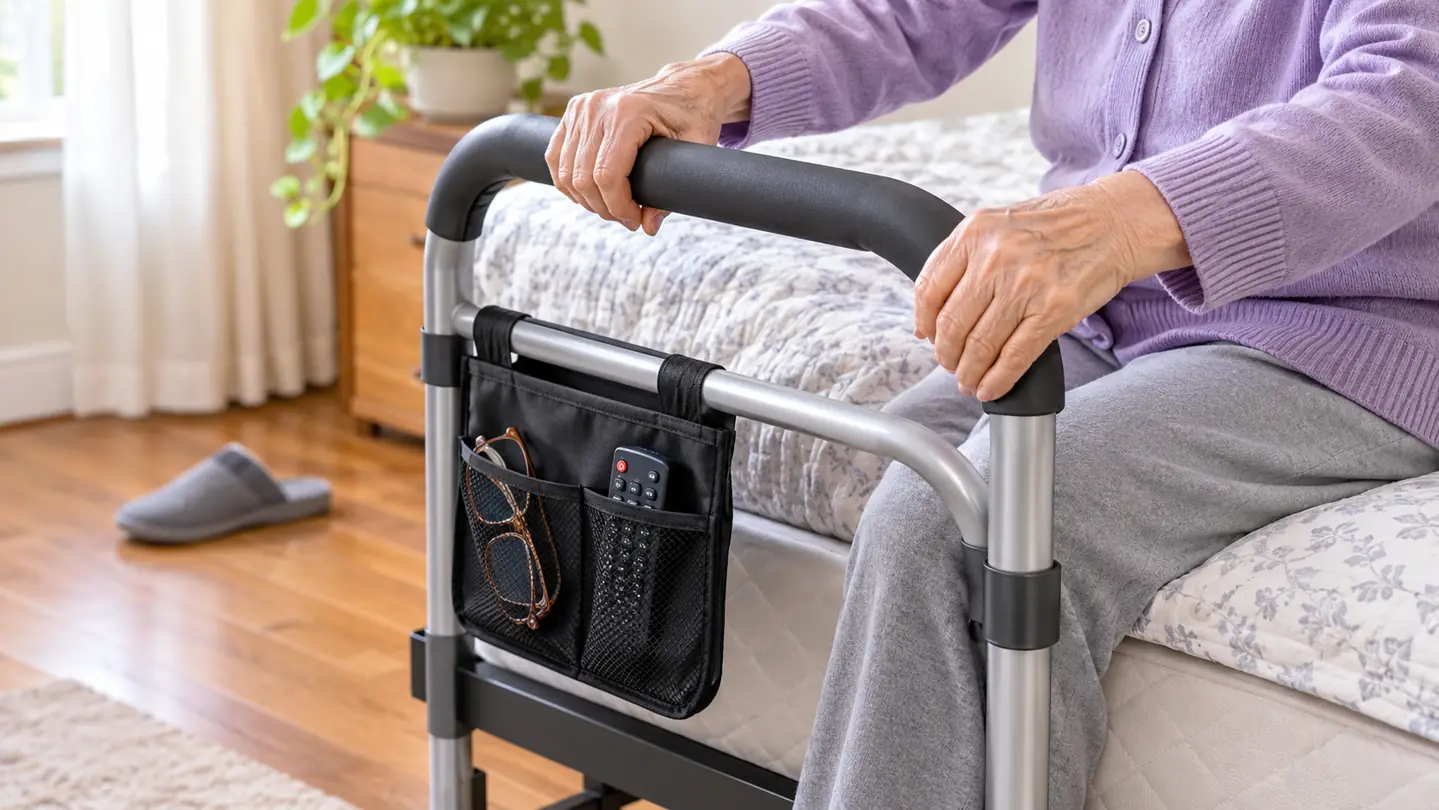
The second thing it wins is the small stuff, which is most of what living with an aid actually is. The bar weighs 6.4 pounds, so when I change the sheets I lift it out and lean it against the wall, then slide it back. A nylon storage bag hangs on the side and holds her reading glasses, the television remote and a small flashlight, which means she is not reaching across a nightstand in the dark to find any of it. When my brother Karim visits on Sundays and we move things around to vacuum, the bar comes off and goes back without either of us rereading instructions. Nothing about it needs a second person, and nothing about it announces itself when you walk into the room.
Where a Floor-Braced Bed Rail Wins
Now the honest part. There are beds and bodies where the floor-braced design is simply the better tool, and I would not talk anyone out of it. A floor-braced rail gives you a longer handhold that runs further down the bed, which helps someone who does not just sit up and stand, but turns, scoots and pushes off with one arm. It also tends to offer a taller top setting, which matters on a tall mattress or for a taller person. And because the legs are standing on the floor, the rail does not give you the small rocking motion that shows up when a very soft mattress or a thick foam topper is doing the holding.
It also wins on bed variety. The Medline bar is meant for non-articulating twin, full and queen beds, and the listing says so plainly. Floor-braced rails are usually sold in a wider spread of sizes, and some are built with thicker mattresses or larger beds in mind. If your mother sleeps in a king, or the mattress is deep and pillow-topped, that is worth checking carefully before you buy either design. The trade is the legs. You get a planted, floor-held feel, and in exchange you get something on the floor beside the bed and a base that lives under the mattress while you are trying to fit a sheet over the corner.
The rail did not make my mother stronger. It made the two seconds between sitting and standing less frightening, and that turned out to be the part she actually needed.
How the Medline Bar Sits on a Real Bed
Ours went on a standard queen, non-articulating, slid in between the mattress and the box spring. I set the height so the top of the bar sits a few inches above the mattress, which is where her hand lands without her having to look for it. The manufacturer lists the bar as height adjustable, and that adjustment is the whole job. Too low and you are reaching down for it. Too high and you are pulling yourself up on something above your shoulder, which is worse than no rail at all. The U shape gives her two places to hold, one straight ahead when she pushes up and one to the side when she is working a slipper onto her foot.
The listing gives 27.5 by 14 by 43.75 inches and 6.4 pounds. I never checked those numbers against a tape measure, because the number that mattered to me was whether her hand found the bar in the dark on the first try. What I will tell you is that on a firm mattress it does not move at all, and on the foam topper we tried for two weeks it rocked a little. We took the topper off for other reasons and the rocking went with it. If the mattress in question is very soft, that is the one thing I would want you to feel for yourself before deciding.
Care is a damp cloth, which is the entire maintenance routine. The bar is not meant for an adjustable bed, so if the head of the bed goes up and down, stop here and look at a floor-braced rail instead. And one thing I will say plainly: I am a retired clinic nurse, not your mother's physical therapist. Ask her doctor or physical therapist whether a rail is appropriate and where it should sit before you install anything. A rail helps a person who can stand. It is not a substitute for someone who cannot.
For a Standard Bed and a Tight Floor, This Is the One I Would Buy Again
The Medline Bed Assist Bar slides between the mattress and box spring, adjusts to mattress height, and keeps her glasses, the remote and a flashlight in the side bag. Fourteen months in, it has not shifted.
Amazon Check Today's Price on Amazon →
What Changed in the First Month
Week one, she used it only to sit up. She would roll to the edge, take the bar with her right hand, and pause there before standing, which is exactly what the physical therapist described to us. Week three, she started putting her slippers on while holding it instead of bracing on the nightstand. By the end of the month the flashlight was living in the bag and she was checking the clock on the remote without turning on the lamp. None of that is dramatic. It is the ordinary business of a bedroom working again, and it happened without her admitting that anything had changed.
What it does not do is just as important. It does not help her walk. It does not replace the quad cane she uses in the hallway or the rollator she takes to the end of the street and back. It does not stop her from needing a hand on the banister when she climbs the stairs once a day to bathe. If you are hoping a bed rail will keep someone safe who is unsteady on their feet in the middle of the night, that is a conversation for a doctor or a physical therapist, not a purchase. A rail solves one specific problem, and it solves it well.
What to Check Before You Buy Either One
Measure the mattress height from the floor, and measure the gap between the mattress and the box spring if there is one. Check whether the bed is adjustable, because that alone decides this for you. Look at how much clear floor sits on the side where the person gets out, and be honest about whether a leg and a base would live comfortably there or become something to trip over. Check the weight limit in the listing for whichever rail you are considering, since that number varies and it is not the place to guess.
Then watch how the person actually gets up, once, without helping. Some people sit, pause, and stand straight up. Others turn, plant a hand behind them, and push sideways off the mattress. The first group does fine with a compact bar at mattress height. The second group usually wants the longer run of a floor-braced rail. Also think about who changes the sheets and who vacuums, because a rail that is a nuisance to move gets left in place, and a rail left in the wrong place is worse than one that comes off in five seconds.
Who Should Buy Which
Buy the Medline Bed Assist Bar if the bed is a standard non-articulating twin, full or queen, the room is small, and the floor beside the bed needs to stay clear. Buy it if the person sits up, pauses and stands, and if you are the one changing the sheets and want something you can lift out with one hand. Buy it if you want a place for glasses and a remote to live so nobody is hunting for them at three in the morning. That is our house, and after fourteen months I would buy it again without looking at anything else.
Buy a floor-braced rail if the bed is larger or thicker than a standard queen, if the mattress is adjustable, or if the person is tall, heavy, or needs a long hold while turning and pushing rather than a single point to pull on. Buy it if the floor beside the bed is genuinely open and a leg will not be in anybody's way. And buy it if you have already tried a mattress-held bar and found it moved more than you liked. Neither design is safer in the abstract. The one that fits the bed and the body is the safer one, and that is a question for you, your tape measure and your mother's physical therapist.
Fourteen Months In, It Is Still on Her Side of the Bed
Height adjustable, 6.4 pounds, with a nylon storage bag for glasses, the remote and a flashlight. If your bed is a standard non-articulating twin, full or queen, this is the simpler answer.
Amazon Check Today's Price on Amazon →