

My mother moved in with me two years ago after her hip replacement, and for the first ten days she crossed the living room with the two-wheel walker the hospital sent home with her. It did the job it was designed for. It also made her furious. Out on the sidewalk it moved one careful lift and set at a time, she had to pick it up and put it down with every step, and when her hip started complaining halfway to the corner there was nothing to do but turn around and come back. About twenty months ago we bought the Drive Medical Rollator Walker with Seat, and it is still the thing that comes out of the front hall every single morning.
I spent 31 years as a nurse in an outpatient clinic, working beside physical therapists, not as one. I do not fit equipment for people I have never met, and I would tell you to have your own therapist or doctor check the handle height on anything you buy before you rely on it. What I can tell you is what twenty months of real use looks like in one house. How it holds up. Where it gets in the way. What I would want to know if I were the one spending the money.
The Quick Verdict
Twenty months of twice-daily sidewalk use, still folding square, still steady under an 87 year old who trusts it more than she trusts me. The seat is the reason she still makes the walk at all.
Amazon Check Today's Price →The walker that gets her to the corner and back
Steel frame rated to 350 pounds, 7.5 inch wheels, and a seat that turns one long block into two short ones. It is the aid that leaves our front hall every morning.
Amazon Check Today's Price on Amazon →How I've Used It
We bought it about twenty months ago, a few months after the surgery, when it became obvious that the hospital walker was holding my mother back instead of helping her. She is 87. She is sharp, she is stubborn about doing things herself, and she had one clear requirement: whatever we bought could not look like a piece of hospital equipment sitting in her hallway. The Drive Medical rollator at least looks like something from a catalog rather than a ward.
Her use is very specific, and I think that is what makes this a fair test. Every morning she walks to the end of the street and back. Twice a week it goes to the pharmacy and once a week to church. The seat is where she rests halfway, and sometimes it is where she rests twice. My brother Karim takes her out on Sundays, so it gets folded and lifted into a car more often than it would in a house with no visitors.
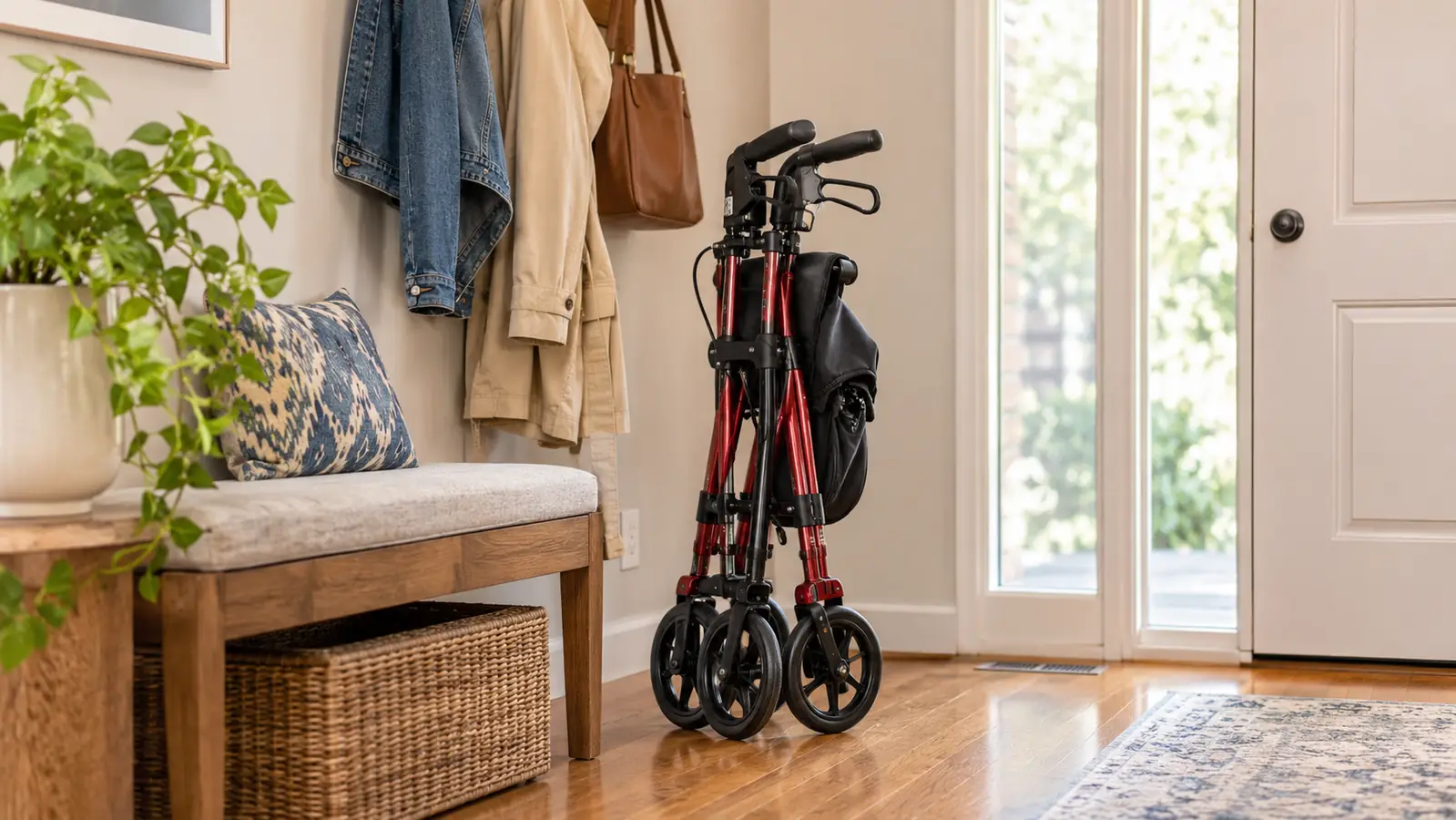
Indoors she does not use it. Our hallway is tight and the thing turns into furniture in about four feet of space, so inside the house she uses a quad cane and the rollator lives folded in the front hall, upright by the door with the coat hooks. That folding and unfolding happens twice a day. It is the single part of this walker that gets the most wear, and it is where cheaper equipment usually fails first.
What the Listing Numbers Actually Mean
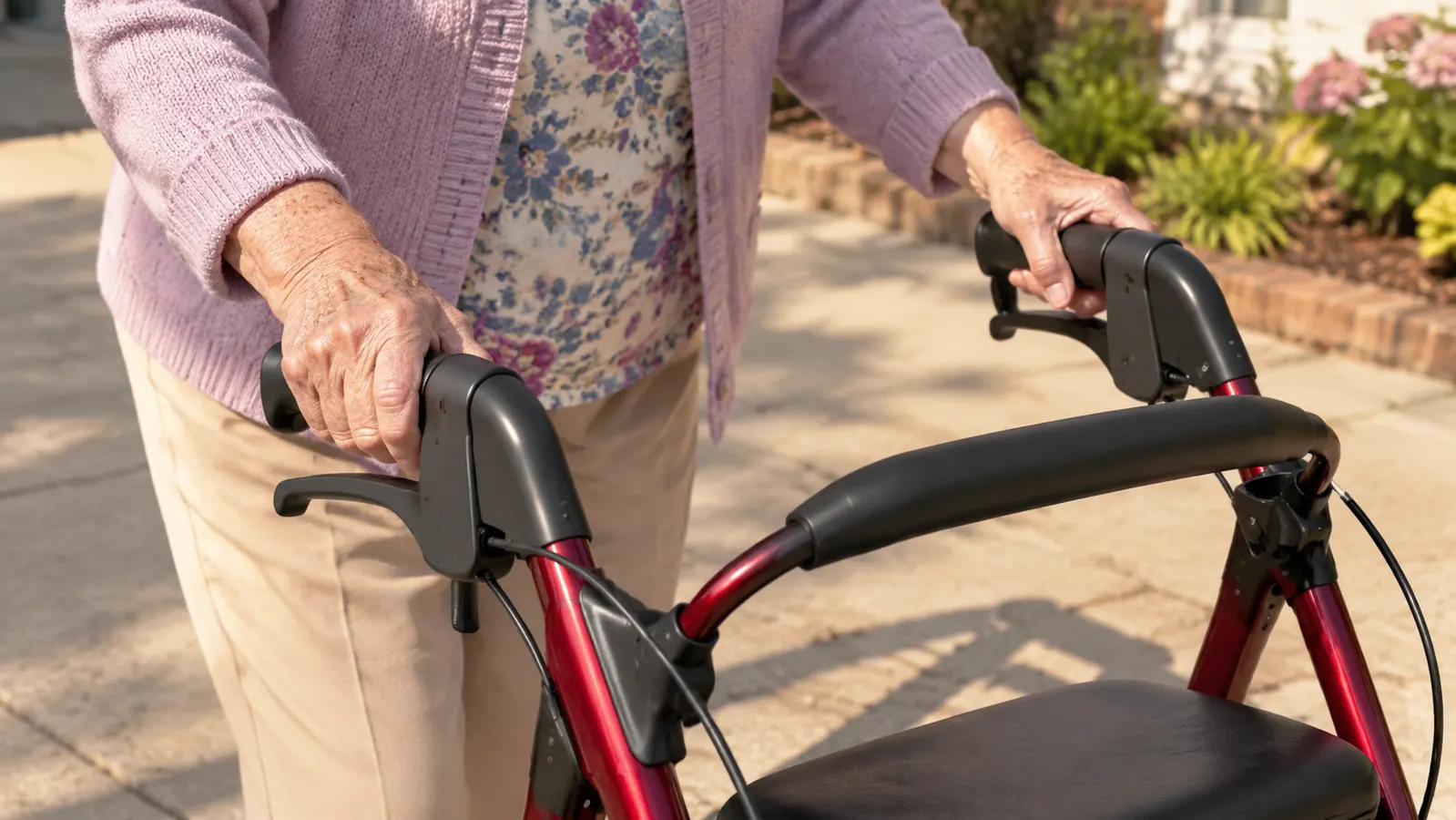
The listing reads like a spec sheet from a supplier, so let me translate the parts that matter to a person standing in a hallway. The frame is alloy steel and the whole thing weighs 20 pounds. The rated weight capacity is 350 pounds, which is the number to check against whoever will actually be leaning on it. The warranty is a limited lifetime one. And the wheels are 7.5 inch, which sounds like a small detail and turns out to be one of the two or three things you feel every day.
The height is where most buyers get caught. There is a height adjustment lever on the frame, and the maximum handle height is 35 inches. The listing also gives a minimum height recommendation of 59 inches for the person using it. Read that the right way around: it is a warning about the low end, not the high end. If the person who needs it is well under five feet tall, the handles may not come down far enough for a safe, upright posture, and no amount of adjusting will fix that.
Then there are two separate dimension lines in the listing, 25.5 by 21.5 by 34 inches and 31.5 by 24.5 by 10.75 inches. My reading is that one is the footprint when it is standing ready to use and the other is closer to how it travels folded. Either way, the number that decides whether this works in your house is the 21.5 inches of width. Measure your narrowest doorway and the gap between the kitchen island and the wall before you order. Ours is fine outdoors and hopeless in the back hallway, and that is a house problem, not a product problem.
Fit Comes Before Anything Else
Here is the thing I would say to any family member reading this on behalf of a parent. Handle height is not a comfort setting. It is a safety setting. If the handles are too low, the person walks bent forward with their shoulders rolled in, and that posture is harder to balance in, not easier. Roughly, the grips should land near the crease of the wrist when the arms hang at the sides, and a physical therapist can check that in about two minutes. Do not guess it from a photograph of someone else.
The height adjustment lever on this Drive Medical rollator made that easy to correct over twenty months, because my mother's comfortable height changed as she recovered and then changed again as her arthritis settled in. We moved it twice. Another thing worth saying plainly: the back support folds up and can be removed entirely. My mother wanted it up at first, when she was less steady. These days it stays up anyway because the seat is more comfortable with it, but the option is there if a therapist tells you to take it off.
The wheels deserve their own paragraph. At 7.5 inches they clear a hardwood floor seam, the lip of our old area rug, a door threshold and a curb cut without any lifting. That is exactly what a two-wheel walker cannot do, and it is the reason the rollator feels faster to her. What they do not clear comfortably is a cracked sidewalk slab with an inch of lift, or loose gravel. On those, the front catches and the whole thing stops short. Same walk, different surface, completely different experience.
Out on the Sidewalk, and Getting It Into the Car
We have three front steps. She does not carry the rollator up or down them, I do, and I want to be honest that 20 pounds carried at an awkward angle on a wet morning is not nothing. It folds to a fairly flat package and goes into the cargo area of our Forester without a struggle, and the same is true when Karim lifts it into his car on Sundays. If nobody in the house can lift 20 pounds, this is the wrong category of aid for you, and a transport chair or a lighter rollator is the conversation to have instead.
For the actual walk, the change has been bigger than I expected. She is faster on the sidewalk than she was with the two-wheel walker, and she is less tired at the end, because she is not lifting and placing the frame with every step. She steers it with both hands and the four wheels keep it from tipping sideways, which matters on the slight slope at the end of our street where the pavement drops toward the storm drain. On ice and snow we do not take it out at all. That is a judgment call, not a product limitation, and I would make the same call with anything on wheels.
One habit worth building: check the folding latch before every walk, not just the first one. Ours has never come loose, but the check takes a second and a rollator that folds while someone is leaning on it is a fall waiting to happen. Same for the back support. Make sure it is clicked into place before weight goes on the seat.
The Seat Is the Whole Point
If you take the seat out of the equation, this is a fine four-wheel walker and nothing more. With the seat, it changed what my mother was willing to attempt. Before, a walk had to be short enough that she could get back without stopping, which meant the end of the street was the limit on a good day and the mailbox on a bad one. Now she sits at the corner, catches her breath, and comes home. She does the same thing in the pharmacy line and in the church vestibule before the service starts.
She sits down by backing up to the seat and lowering herself with both hands on the frame, and she stands by pushing up from the seat with both hands. I have watched her do it a few hundred times and it has never once looked precarious, because the frame does not shift under her. That stability is the entire reason I trust it more than I trusted the hospital walker. But it is a rest stop, not a chair. Twenty minutes on it in a waiting room is not what it is built for.
What Twenty Months Has and Hasn't Done
Nothing on the Drive Medical frame has broken. Nothing has been replaced. The folding mechanism still latches square on the first try, which after twenty months of twice-daily use is the thing I would bet against on a cheaper frame. The seat and the back support show the wear you would expect from a body sitting on them regularly, and the wheels are visibly worn but still round and still roll true. There has been one fall in that time, and it was not the rollator. She caught her toe on the edge of the living room rug while using her cane.
What I would flag to a friend is weight and width. Twenty pounds is manageable for me and a real obstacle for plenty of spouses and adult children. The 21.5 inch width on the Drive Medical frame is wider than a two-wheel walker by a good margin, so it is not the aid for a small apartment with a narrow bathroom door, and it is not the aid for someone who needs to steer it through a crowded kitchen every day. It is outdoor equipment that lives indoors. Treat it that way and it does its job well.
What I Liked
- Steady under weight, rated to 350 pounds, and it does not shift when someone pushes up off the seat
- The seat turns a walk that was too long into two walks that are not
- 7.5 inch wheels clear thresholds, rug edges and sidewalk seams without lifting
- Height adjustment lever made it easy to refit twice as her needs changed
- Folds flat enough for a Forester cargo area and stands upright in a narrow front hall
- Back support folds up and lifts out if a therapist wants it gone
- Limited lifetime warranty, and nothing has needed it in twenty months
Where It Falls Short
- 20 pounds is heavy to lift in and out of a car, especially on a bad morning
- 21.5 inches wide, which is too much for tight interior hallways
- Small wheels stall on cracked slabs, loose gravel and tree roots
- Not usable on snow or ice, so winter walking needs another plan
- Indoors it becomes furniture, so a second lightweight aid is usually necessary
- The seat is a rest stop, not somewhere to spend an afternoon
Twenty months, twice a day, and the folding latch still catches square on the first try. Nothing on it has been replaced.
Who This Is For
This is the right rollator for someone who can still walk and wants to keep walking, but who runs out of steam partway and needs somewhere to sit. It suits a person who is at least five feet tall, whose handles can be set at a safe height by a therapist, and who has a level or gently sloped route nearby, a sidewalk, a church hall, a mall, a pharmacy. It also suits a household where somebody is strong enough to lift 20 pounds into a car a few times a week. That describes a lot of families, including ours.
It is also a good fit for the adult child doing the buying, because the folding is simple enough to learn in one try and the height lever means you can correct it later without buying anything new. If you are the one managing a parent's equipment, the practical test is this: can you get it from the front hall to the car and back without hurting yourself. If yes, this works.
Who Should Skip It
Skip it if a physical therapist has told you that full weight bearing is not safe yet, because a rollator asks the person to walk, not to lean. Skip it if the user is well under five feet tall, since the handles may not come down far enough and no adjustment will create height that is not there. Skip it if the only walking happens indoors on carpet in a small apartment with narrow doors. And skip it if nobody in the house can lift 20 pounds, because a rollator that stays in the trunk helps no one.
One more group, and I say this gently. If the person you are buying for has fallen more than once recently, do not solve this with a purchase. Get an assessment first. A rollator is a tool that works when it is fitted to a person and a home, and it is a hazard when it is bought in a hurry and set up wrong. Ask your doctor or physical therapist about fit and use before anything comes out of the box.
Twenty months in, this is still the aid by our front door
If you need a walker that lets someone rest halfway and still get home under their own power, this is the one we would buy again. Check the height spec against your own therapist's advice first, then check today's price.
Amazon Check Today's Price on Amazon →