

My mother moved in two years ago after her hip replacement, and for the first six months she used the hospital-issue walker for every trip in the house, including the twelve feet between her armchair and the downstairs bathroom. It was the right tool for recovery and the wrong tool for a hallway. It scraped the baseboard going through the door and made her feel like a patient in her own living room. She started skipping the trip to the kitchen rather than deal with it. That is how the KINGGEAR self-standing quad cane arrived in our front hall about eighteen months ago.
I spent thirty-one years as a nurse in a community outpatient clinic in Worcester, Massachusetts, working alongside physical therapists most days. So I know what a properly fitted cane looks like, and I know what a bad fit costs in confidence. I am not a doctor and this is not medical advice. Anyone buying a cane should have their own doctor or physical therapist set the height and confirm the type. What follows is what eighteen months of daily use in one house looks like: hardwood, one old area rug, tight doorways, and the two in the morning trip to the bathroom.
The Quick Verdict
Light, steady, and it stands on its own, which turned out to matter more than the four tips. The wide base is a nuisance in narrow doorways, and the box contains the cane and nothing else.
Amazon Check Today's Price →The cane is still standing when she comes back from the kitchen
KINGGEAR's four point cane adjusts from 31 to 36 inches in one inch steps with a push button, weighs 1.1 pounds, and the listing gives a load capacity of 300 pounds.
Amazon Check today's price on Amazon →How I've Used It
The cane lives beside Samira's armchair. She uses it for the downstairs hallway, the kitchen, the trip to the half bath, and the upstairs hallway. She does not use it outdoors. Outdoors she still takes the rollator, because the sidewalk on our street is uneven and she likes the seat halfway. That split has held for eighteen months and it works: the quad cane indoors, the rollator for the walk to the end of the street and back.
We tried something simpler first, and I want to be straight about it, because it is the reason I ended up recommending a four point base. My brother Karim brought over a single tip cane from his garage, an aluminum one with a rubber tip that had seen better days, and Samira used it for four days. She set it against the wall, it slid down, and it was on the floor. Twice that week she stood up, saw it lying there, and sat back down rather than bend for it. Bending forward with a new hip is the exact movement the surgery was meant to spare her. That cane did not fail because it was cheap. It failed because it fell over.
I use it too, on days when my right knee is bad. I have mild arthritis in that knee, and on a damp morning I will take the cane from the hall to the kitchen rather than limp. That has been an unexpected benefit of buying something adjustable rather than something cut to one person's height. Two adults of different heights use the same cane in this house, and the push button moves it between us in about two seconds.
The first month I checked the height every week, then once a month, then whenever I noticed her leaning. That is the habit I would pass on. The fitting rule we used in clinic is that the handle should sit at the crease of the wrist with the arm hanging loose, and her physical therapist set it that way when the cane arrived. Ask your own therapist to set yours. It is a two minute appointment and it is the difference between a cane that helps and a cane that leaves your shoulder sore by Thursday.

What Four Tips Actually Do on Hardwood and Carpet
A single tip cane is a pole with one contact point. It helps with balance and it takes some load off a sore hip or knee, but it tips. Set it down and it falls, and then you are bending to pick it up, which is exactly the movement a person after hip surgery is trying to avoid. The four tips on this cane spread the load across a base the listing gives as 4.3 inches wide, and because of that base the cane stands on its own. Samira sets it down, lets go, and it is still there when she comes back. If you are still deciding between the two types, I laid out the whole side by side in quad cane vs single tip cane, and it is worth ten minutes before you order.
On hardwood it is quiet and it does not slide. On the old area rug in the living room the four rubber tips sit on top of the pile rather than digging into it, and I will admit that took a week to get used to. It feels different, not worse. The rug has a curled edge near the coffee table that I have meant to tape down for two years, and the cane crosses it without catching, which is more than I can say for the walker's wheels.
The one place it argues with the house is the doorway into the half bath, which is narrow. I measured it before writing this, because I wanted a number instead of an impression. The opening is 28 inches. The base is 4.3 inches wide, so the cane fits with room to spare, but only if she walks through straight. Going in at an angle, the outer tip catches the casing, the cane stops, and she has to reset her feet and start again. That happened twice a week for the first month. Now it happens almost never, because she squares up out of habit. In the kitchen doorway, which is wider, it has never once caught.
The tips are rubber and they are the part that wears. After eighteen months ours are still intact, but I check them the way I check the tires on the Forester, which means every couple of months I turn the cane over and look. A worn tip on any cane is a slip waiting to happen, and this is not a place to economize.
Height, Handle and the Adjustment That Mattered
The cane adjusts from 31 to 36 inches, in one inch steps, with a push button. The listing says that covers people from 4 foot 9 to 6 foot 1. In practice that means a short adult and a tall adult can share one cane, which is what happens here. The KINGGEAR button is easy to press with a thumb and it clicks when it locks. I pull on the shaft every time after I change it, out of thirty-one years of habit, and it has never slipped.
The first week we had the height wrong, and I include that because it is the most common mistake I see. I set it at 34 inches because it looked right standing next to her, and by the third day she was telling me her right shoulder ached by mid afternoon. Her physical therapist had her stand with her arms loose, put the handle at the crease of her wrist, and the number came out at 33. One inch. One inch was the difference between walking and pushing herself along. The cane moves in one inch steps, so 33 was actually available to us. Plenty of canes only adjust in two inch steps, and then you get close and live with it.
The handle is foam. That matters more than it sounds like it should. Samira's hands are thin, and the foam gives her something to hold that does not dig into the base of her thumb the way a hard plastic handle does. I would not call it a grip aid, and if your hands are weak or arthritic, ask your therapist whether you need something built up. But for a woman who is stubborn about anything that looks like hospital equipment, the foam handle is part of the reason this cane passes. It reads as a cane, not as a medical device.
The shaft is aluminum and it weighs 1.1 pounds. Samira can lift it with two fingers, which means she can move it from the hall to the car without asking me. The listing gives the folded size as 31 inches, so when we take it with us to an appointment it lies flat in the back of the Forester and takes up less room than I expected the first time. For me the weight matters for a different reason. When she carries it up the stairs in the morning with her other hand on the banister, the weight is not the thing she has to think about. The stairs are.
Standing on Its Own, Which Is the Real Feature
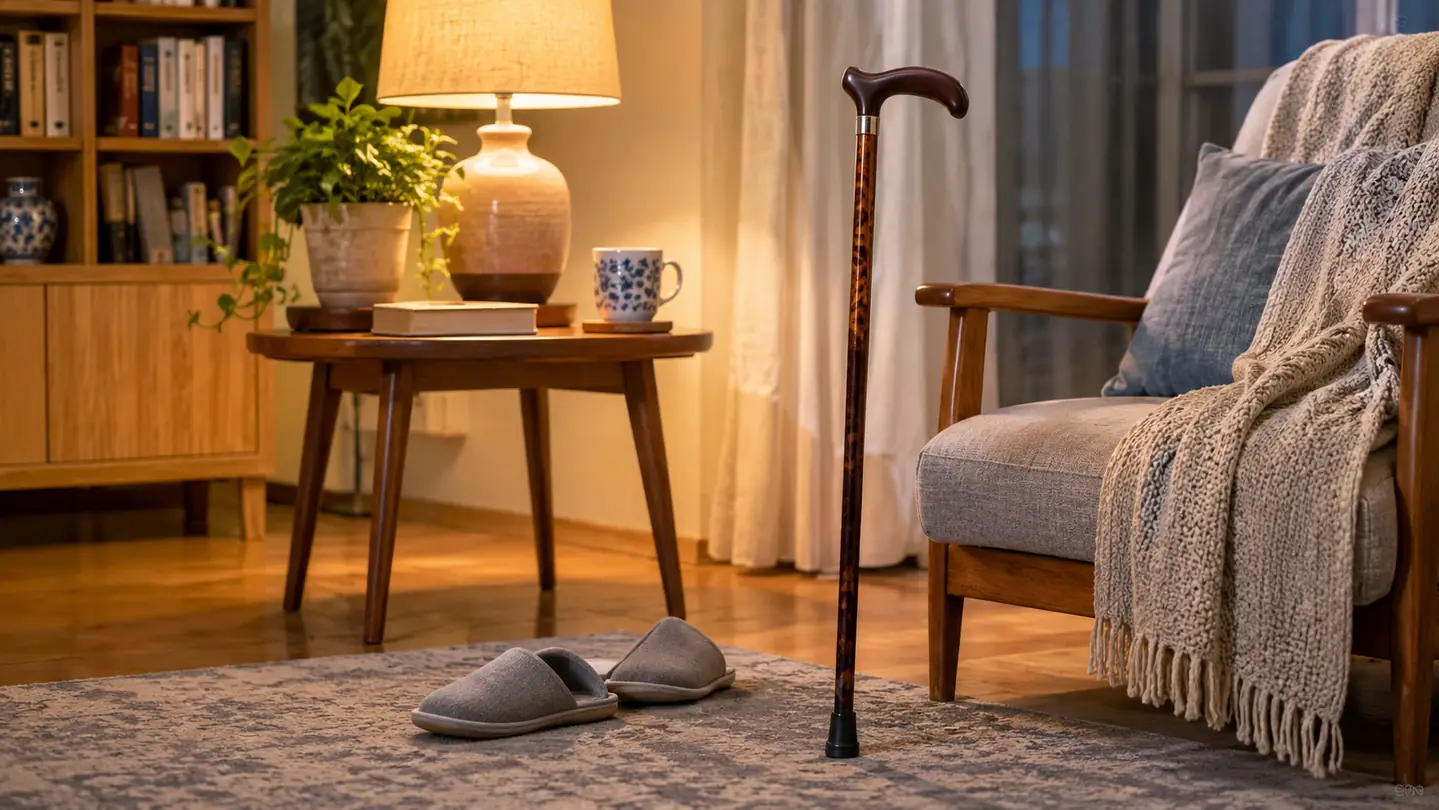
I expected the four point base to be the selling point, and it is, but not for the reason I assumed. The stability is real, and I will get to that. The thing that changed our evenings is that the cane stands up. Before, the walker was a piece of furniture parked in the middle of the hall. Now the cane stands beside her chair like an umbrella, and when she wants to get up, she reaches for it without looking down.
Balance is mostly about not having to improvise. A person who has to find the cane, bend for the cane, or steady herself on the arm of a chair while she picks the cane up is a person doing three things at once. A cane that stands on its own removes two of those. That is the short version of the ten reasons a quad cane feels steadier, and it is the difference Samira noticed in the first week. She stopped using the walker indoors by day five.
At night it stands beside her chair in the downstairs room she sleeps in, and the bed assist bar stays where it was installed. One is for getting out of bed. The other is for walking once she is up. Keeping those two jobs separate is the reason neither one gets in the way of the other, and the cane standing on its own is what makes it work at two in the morning when nobody is awake to hand it to her.
Where It Falls Short
The base is the trade. Four points are steadier and they are also wider than a single tip, and 4.3 inches is enough to matter in a tight bathroom or a narrow hall. If your hallways are narrower than ours, put a tape measure across the doorway before you buy, because a cane that catches on the frame every trip is a cane that ends up left in the corner of the room.
The second thing is technique. A four point cane is used with the hand opposite the weak side, and it should be planted with all four tips down before you step. That is a training question, not a product question, and it is exactly what a physical therapist is for. If nobody has watched you walk with it, the extra base will not fix a habit. Samira had two sessions with hers after the surgery and it shows.
The third is small. The included components list says only Cane, so there is no strap and no clip in the box. If you need to hang it on the side of a walker or carry it on a bus, plan for that yourself. And the folded size the listing gives is 31 inches, so this is a back seat item, not a handbag item.
What I Liked
- Stands on its own on the 4.3 inch base, so nobody has to bend to pick it up
- Adjusts from 31 to 36 inches in one inch steps with a push button
- 1.1 pounds of aluminum, easy to move from room to room
- Foam handle is comfortable for thin hands and does not look clinical
- Load capacity of 300 pounds per the listing
Where It Falls Short
- The wide base catches on narrow door frames
- No strap or clip in the box
- The rubber tips are the wear point and need checking
- Four points do not replace learning to plant it before you step
- Folded length of 31 inches makes it a car item, not a purse item
Day five she stopped using the walker indoors. What sold her was not the four tips. It was that the cane was still standing when she came back from the kitchen.
Who This Is For
This is for the person who needs steadier support indoors than a single tip gives, who is between 4 foot 9 and 6 foot 1, and who is tired of picking a cane up off the floor. It suits a hallway, a kitchen, and a bedside. It suits someone who wants an aid that looks like a cane and not like equipment.
It is also for the adult child doing the buying. If you are ordering this for a parent who is proud and does not want a walker parked in the living room, this is the compromise that tends to hold. It held here, and it held through a winter, which is when I expected it to fail.
Who Should Skip It
If the person using it needs to bear a lot of weight through the arm, or needs to sit and rest partway, a rollator is the right answer, and we bought one for exactly that reason. If your hallways and bathroom are narrow, a single tip or a narrower base will cause less daily friction. And if a therapist has already recommended a walker for balance, buy the walker. Do not let the difference in cost between two pieces of gear decide something a clinician has already answered.
If nobody has set the height, do that first. A cane at the wrong height is worse than no cane, because it teaches a lean that the body then gets used to. Twenty minutes with a physical therapist, or a nurse at your doctor's office, settles it.
Eighteen months in, it is still the cane by her chair
The self-standing quad cane from KINGGEAR, adjustable from 31 to 36 inches, 1.1 pounds, 300 pound capacity per the listing. Have your own doctor or physical therapist set the height when it arrives.
Amazon Check today's price on Amazon →