

The short answer is that these two canes solve different problems, and most people get sold the wrong one. If the thing that worries you is balance, meaning you feel unsteady when you stand still, turn around, or reach for a light switch, the KINGGEAR quad cane is the safer of the two. If your balance is genuinely fine and the problem is a tired hip, a sore knee or stamina, a plain single-tip cane is lighter, quicker and less work to move.
I spent 31 years as a nurse in an outpatient clinic, fitting canes and walkers alongside physical therapists, and for the past 18 months I have watched my mother use one cane every single day. Samira is 87. She had a hip replaced two years ago, she walks to the end of the street with a rollator, and she gets around the house with the KINGGEAR. What follows is what I would tell a friend who called me about it, with no catalog in front of me.
| KINGGEAR quad cane | Single-tip cane | |
|---|---|---|
| Standing at a standstill | Four rubber feet on a 4.3 inch base. It stays where you put it while you use both hands. | One tip. It goes down on its side the moment you let go. |
| Getting up from a chair | You push down on the handle and the base holds instead of skating away. | The tip can slide out from under your hand on a smooth floor. |
| Walking pace on open floor | The base has to come down flat before you lean on it, which costs a beat every step. | The tip swings with your arm and you keep your rhythm. |
| A full flight of stairs | The wide base rocks on a stair nosing and catches the riser, so you lift it instead of trusting it. | The tip plants on the tread ahead of you, which is how stairs are usually taught. |
| Weight through a sore hip or knee | Load spreads across four points, on an aluminum shaft rated to 300 pounds. | All the load goes through one tip, which is fine until the floor is not. |
| Carrying and storing | Folds to 31 inches and stands in a corner or a car footwell. | Leans against a wall until it slides down behind the coat rack. |
| Nothing to think about | You have to notice which way the feet point before you lean on it. | Point it and go. |
| Height adjustment | Adjusts from 31 to 36 inches in one inch steps, for users from 4 foot 9 to 6 foot 1. | Also adjustable, with different ranges by brand and model. |
Why One Cane Lives in This House and the Other Did Not
Before we bought anything, Samira tried a single-tip cane at the medical supply store and walked the length of the aisle twice with it. She liked it. It was light, it moved at her pace, and it did not announce itself as a piece of medical equipment, which matters more to her than to anyone else I know. Then she stopped to read the label on a box, let go of the handle for two seconds, and the cane went down on the floor with a clatter. She looked at it, then at me, and said something I will not repeat in print.
The second cane she tried had a four-footed base, and it stood there on its own while she finished reading the box. That was the whole test. That is the cane that came home, and it has been the only cane in the house since. Outdoors she uses the rollator, because the sidewalk is uneven and she needs the seat halfway to the corner. Indoors the hallway is too tight for wheels, so the cane does the work.
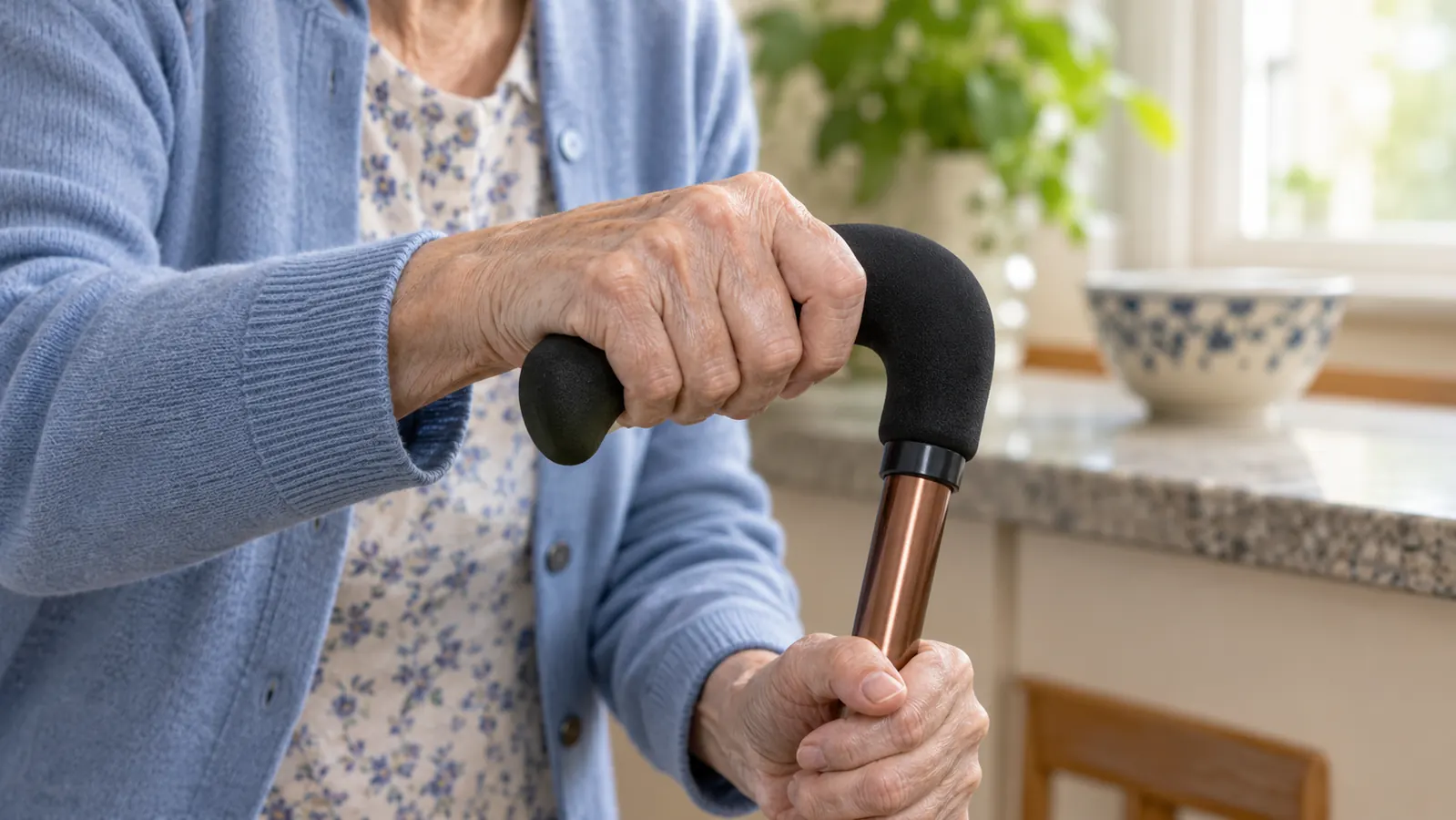
Where KINGGEAR Wins
The base is 4.3 inches wide with four rubber feet, and that is the entire argument. A cane that stands up on its own is a cane you can let go of. At our front door Samira sets it down, uses both hands on the lock and the deadbolt, and picks it up again. Beside her armchair at night it stays where she leaves it, so the trip to the bathroom at three in the morning does not begin with her bending over in the dark to fish a cane off the floor. In the clinic I watched people abandon a cane for exactly that reason. Not because it failed to hold them while they walked, but because it fell over every time they stopped.
Four points on the floor also spread the load. The shaft is aluminum and the listing rates it to 300 pounds, which is more than most people will ever ask of it, but the useful part is the spread. When Samira stands at the counter to fill the kettle, or stops halfway across the kitchen to answer me, she leans on the cane rather than balancing beside it. On a single tip that lean is a small gamble every time, because the tip can slide on a smooth floor. On four feet it does not.
The third thing is getting out of a low chair. She pushes down on the handle to stand and the base takes that push without skating, which turns a three-rock forward-and-back into one motion. I did not appreciate how much difference that makes until I borrowed the cane for a week when my own right knee flared up. I am 63 and I noticed.
It also folds. The shaft comes down to 31 inches, short enough to lie in the footwell behind the passenger seat of the Forester rather than ride in the cargo area next to the rollator. When we drive to church the cane comes in the car and the rollator stays home.
Where a Single-Tip Cane Wins
A single-tip cane is faster, and I am not going to pretend otherwise. The tip swings forward with your arm and you keep your rhythm. A four-footed base has to come down flat before you lean on it, so every step costs a fraction of a beat. Across a room that is nothing. Down a long corridor, or around a block, it adds up to a walk that feels like work. In the clinic the patients who covered real distance were almost all on a single tip, and they were right to be.
Stairs are the clearer win. A full flight is taught as rail in one hand, cane in the other, tip on the tread ahead, good leg up, then the cane again. A wide base rocks on a stair nosing and catches the riser, so you end up lifting and placing it instead of trusting it. If you go up and down a full flight every day, a single tip is the better tool, and no amount of stability at a standstill makes up for it. Samira does her one flight a day with the banister and me behind her, and we do not use a cane on those stairs at all.
The last point is that there is nothing to orient. You point a single tip and go. A quad base has to be set down roughly flat and facing the right way. After a few weeks that becomes habit, but in the first week it is one more thing to think about while you are already thinking about not falling. A single tip is also a simpler object, so when the rubber wears down there is one tip to replace instead of four.
The cane that waits for you while you find your keys
Four rubber feet on a 4.3 inch base, an aluminum shaft rated to 300 pounds, and a range of 31 to 36 inches for users from 4 foot 9 to 6 foot 1. It folds to 31 inches and it stands on its own. Ask your physical therapist what height you should be at, set it in the one inch steps, and leave it there.
Amazon Check Today's Price on Amazon →Eighteen months in, the only cane in this house still stands beside her chair at night. When you are 87 and up twice in the dark, that is not a small thing.

Fit Decides More Than the Base Does
The base gets all the attention, but height decides whether a cane helps or hurts. The rule I used for 31 years is the crease of the wrist. Stand up straight with your arms hanging, and the top of the handle should sit at the crease where your hand meets your forearm. Higher than that and you will hike your shoulder up to reach it. Lower and you round forward, which is the exact posture a cane is supposed to spare you.
The KINGGEAR adjusts from 31 to 36 inches in one inch steps with a push button, and the listing puts that at users from 4 foot 9 to 6 foot 1. Samira is a small woman and hers sits near the bottom of that range. My knee is the problem, not my balance, and at 5 foot 6 the same cane works for me two clicks up. One cane, two people, five seconds to change it.
Do that part with your own physical therapist or doctor rather than by eye. Which side to hold the cane on, how much weight to put through it, and whether a four-footed base suits your balance are clinical questions, and they depend on things I cannot see from here. What I can tell you is that an inch of error is noticeable by the end of a hallway, and it is the first thing I would check before blaming the cane.
What the Four Feet Do on a Rug, a Threshold and Three Front Steps
The living room has one old area rug over hardwood, and that edge is the only place in the house where the four feet need any attention. A wide base will catch on a curled rug corner if you drag it rather than lift it. The fix is a habit, not a product: lift and place, do not slide. On flat hardwood, and over the threshold between the kitchen and the hall, it is unremarkable, which is the highest praise I can give a piece of equipment.
The three front steps are the reason we own two different aids in the first place. Going down, she takes the rail with her right hand and the cane in her left, one step at a time. On a single step the wide base is an advantage, because she can stop and stand while she finds the next tread with her foot. On a whole flight it is not, which is why the inside stairs belong to the banister. If your own front steps are wood and get slick in winter, treat that as its own problem and ask about it separately.
Who Should Buy Which
Buy the KINGGEAR if balance is the issue, or if one side is weaker than the other since a hip or knee replacement. Buy it if you are mostly indoors on flat floors, if you have a chair you struggle to get out of, or if you need both hands free at a door, a counter or a sink. Buy it if you have stopped using the cane you already own because it keeps falling over. Samira has used this one daily for 18 months, and my honest complaints are that it is heavier to swing than a single tip and that a full flight of stairs is not its job.
Buy a single-tip cane if your balance is genuinely good and the cane is for stamina, a sore hip or a long walk. Buy it if you take a full flight of stairs several times a day, if you walk outdoors on pavement, or if you want something light that tucks under a chair at a restaurant. Buy it if you have tried a quad base and found the four-point placement fussy. Neither cane is the wrong choice in general. One of them is the wrong choice for a particular hallway, and you are the only person who knows which hallway that is.
If balance is the worry, start with the base that stays put
Self standing, folds to 31 inches, adjusts from 31 to 36 inches, rated to 300 pounds, and reasonably priced against what a fall costs a family. Set the height with your physical therapist, keep the rubber feet clean and dry, and give yourself a week to build the habit of setting it down flat.
Amazon Check Today's Price on Amazon →