
Here is the short answer. If the person you are shopping for cannot lift a foot over the side of the tub, a transfer bench is the only one of these two that solves the problem. If she can step into the tub on her own but cannot stand up for a whole shower, a shower chair does the same job with less floor space and less fuss. Everything past this paragraph is the part that actually decides it, and the deciding factor is fit, not features.
I am not working from a spec sheet. My mother, Samira, is 87. She moved into my house in Worcester two years ago after a hip replacement, and our only full bathroom is a tub and shower combo with a wall she could not step over. The first week she was here, I bought the Drive Medical tub transfer bench. It has straddled that tub ever since. I have also put a friend's shower chair in the same bathroom to see what it would and would not do, and I have watched which one my mother reaches for at seven in the morning when she is stiff and half awake. She trusts the bench. The chair she merely tolerated.
| Drive Medical Tub Transfer Bench | Carex Shower Chair | |
|---|---|---|
| Getting into the tub | You sit on the seat outside the tub and slide across. No leg has to clear the wall. | You step over the tub wall first, then sit down inside the tub. |
| Height adjustment | Adjustable legs set the seat from about 17.5 to 22.5 inches off the floor. | Many basic models are fixed height. You buy the regular or the tall. |
| Weight capacity | 350 pounds. | Usually 250 to 300 pounds on the basic models. Check the label on the one in front of you. |
| Frame and warranty | Aluminum frame, plastic seat, about 10 pounds, limited lifetime warranty. | Plastic or aluminum, usually a one-year warranty. |
| Space in the bathroom | Front legs stand on the floor outside the tub, so it takes floor space and stays put. | Sits entirely inside the tub or stall. Lifts out with one hand. |
| Shower stall with no tub | Needs a tub wall to straddle. Wrong tool for a walk-in shower. | Works in a stall with a low curb. |
| Taking a bath | Once it is set up, the tub is a shower. Nobody takes a bath without moving it. | Lifts out, and the tub is a tub again. |
| Getting it set up | The legs have to be set and the height dialed in before the first shower. | Out of the box and into the stall in about a minute. |
| Best for | Someone who cannot clear the tub wall at all. | Someone who can step in but cannot stand for a shower. |
Where the Drive Medical Tub Transfer Bench Wins
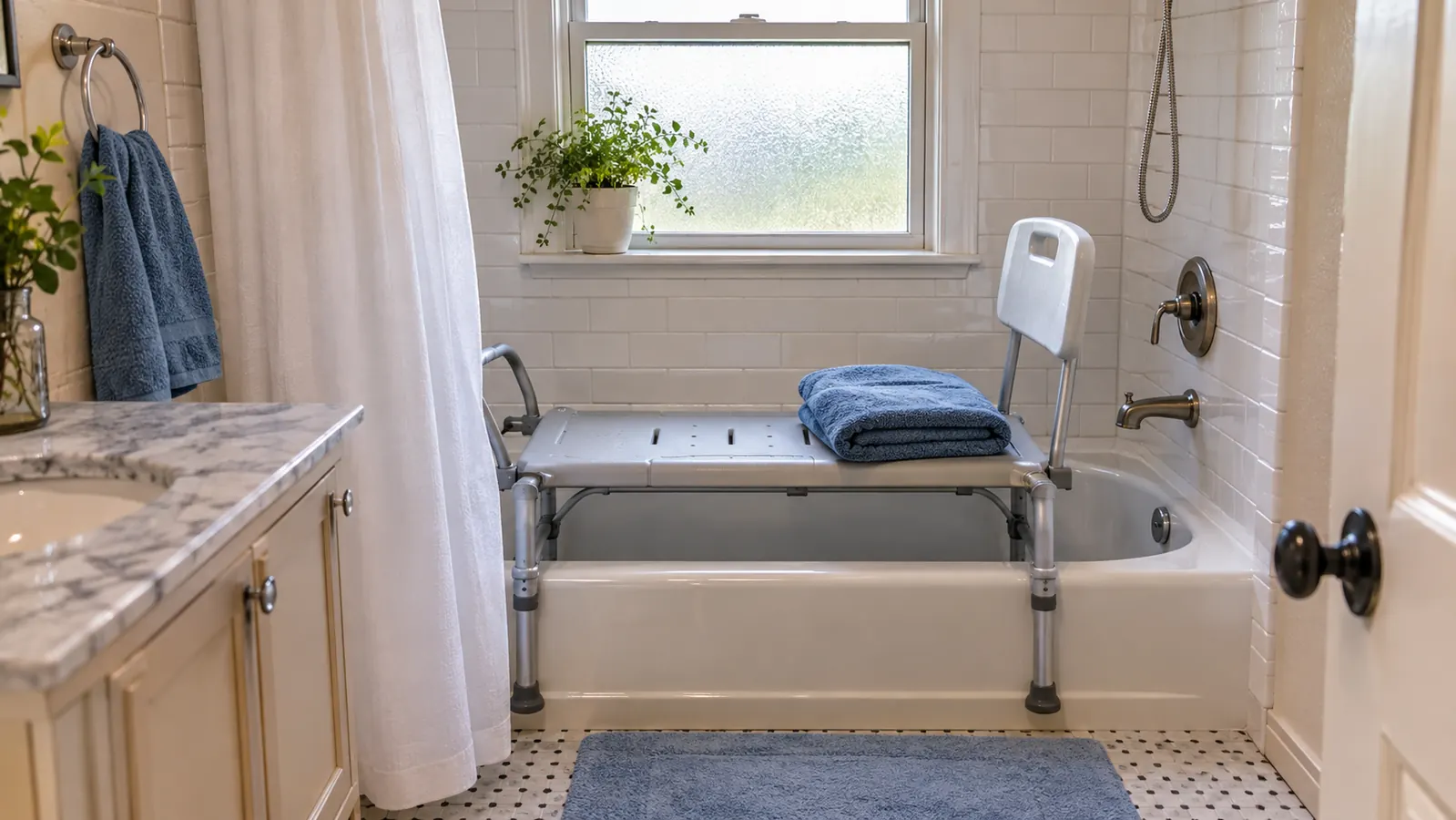
The bench wins one thing, and that one thing is the reason it exists: nobody has to step over the tub wall. Samira sits down on the half of the seat that hangs outside the tub, lifts one leg and then the other, and slides across. The seat is 15.5 inches deep, and that is the number that matters here. A deep seat gives her somewhere to put her weight while she is halfway across. A shallow perch turns the same movement into a balancing act on a wet surface.
The second win is height. The legs are adjustable, and they set the seat anywhere from about 17.5 inches to 22.5 inches off the floor. That range covers a short woman who needs her feet flat on the mat and a tall man who does not want his knees up around his ears, and it is the difference between a bench that fits the person and a bench the person has to fit herself to. The frame is aluminum, the seat is plastic, the whole thing weighs about 10 pounds, it holds up to 350 pounds, and it carries a limited lifetime warranty. Those are not glamorous numbers. They are the numbers you want when the floor is wet.
What I tried first was nothing clever. For three days I put a folded towel on the tub floor and had her sit on the edge of the tub with her feet inside the tub, and I stood on the bathroom floor holding her forearm. That arrangement works for somebody who weighs what a bag of groceries weighs. Samira does not. Getting down onto that tub floor meant a squat she could not reverse, and getting back up meant pulling on my shoulder, which is not a thing I want to be doing at 63 with arthritis in my right knee. The mat slid on the tub floor. The towel slid on the mat. On the fourth morning she told me she would rather wait until Sunday, when my brother Karim visits, than do that again, and that was the end of my homemade solution.
The seat is 15.5 inches deep. That is what decides whether the slide across feels controlled or feels like a gamble.
Where the Shower Chair Wins
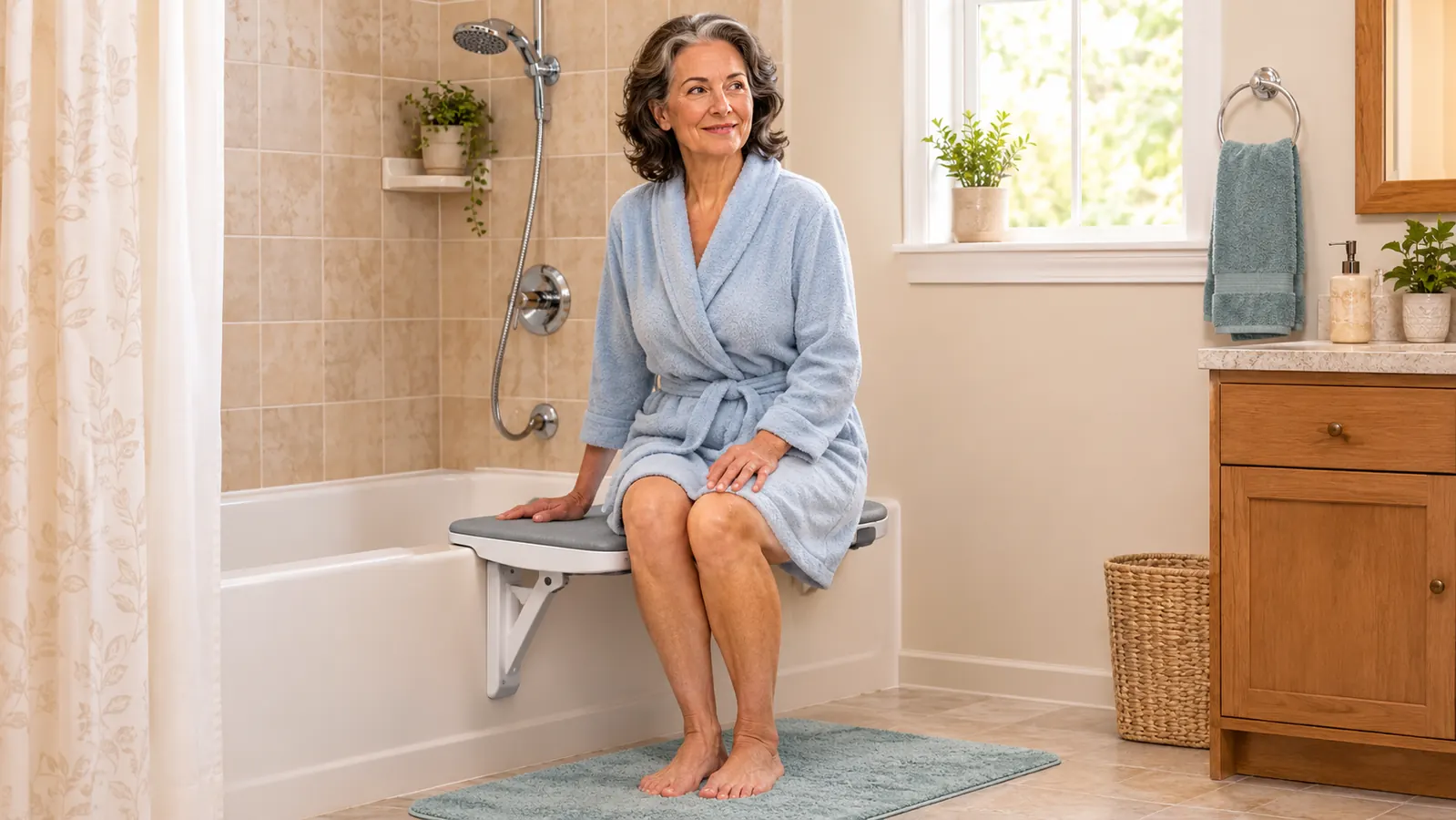
A basic shower chair wins the room. Take the Carex kind you see in every pharmacy, a molded seat on four legs with rubber tips. It sits entirely inside the tub or the shower stall, and it lifts out with one hand when you want the tub back. The bench cannot do that, because its front legs stand on the bathroom floor. Ours has lived across that tub for two years, which means nobody in this house has taken a bath since 2023, and scrubbing the tub now means working around a frame.
The chair also wins in a shower stall, and this is where people go wrong shopping online at eleven at night. A transfer bench needs a tub wall to straddle. If the bathroom in question has a walk-in shower with a low curb and no tub at all, a bench is the wrong purchase no matter how good it is, and a chair is exactly right. The chair is the easier object besides: nothing to set up once it is out of the box, no sliding technique to learn, and no explaining the transfer to a visiting aide who has never seen one before.
The chair I borrowed came from a neighbor whose husband used it for six weeks after a knee replacement, and it was the plain molded kind with no arms on it. I set it inside our tub one Saturday to see the difference for myself, with Samira watching from the doorway and telling me it looked like a beach toy. Getting in meant lifting a foot over the wall and planting it inside, then lowering down onto a seat that sat closer to the tub floor than the bench seat did. She did it. I watched her right hand go out to the tile on the way down. She did it once and she did not do it again, and I put the chair in the back of the Forester that afternoon. That is the whole comparison in one Saturday: the chair is fine for a person with steady balance and a good hand on the tile, and it is the wrong object for a person whose balance is the exact thing in question.
The Three Measurements That Decide It
Measure the tub wall first, from the bathroom floor to the top of the tub's side. Most tub walls land somewhere between 14 and 17 inches. A person who can clear that with one foot, with something solid to hold on the wall, does not need a bench. A person who cannot is not going to be persuaded by a chair, however much lighter the chair is. This is the whole question in one number, and it takes ninety seconds to answer.
Measure the floor in front of the tub second. The bench hangs over the outside of the tub, so the floor in front of it has to stay clear. In our bathroom that meant moving the laundry hamper and giving up the spot where the bath mat goes, and it means I step around the front legs every morning on my way to the sink. If the bathroom is tight enough that a bench blocks the door or crowds the toilet, a chair inside the tub is the better answer. You will know within a minute of standing in the room.
Third, measure her seated height. Sit her on a firm kitchen chair and measure from the floor to the crease behind her knee. That is roughly the seat height you are aiming for, and it is the sort of thing a physical therapist can check in five minutes if you are unsure. The bench covers about 17.5 to 22.5 inches, which takes in nearly everybody. Many of the basic shower chairs are fixed height, so you buy the regular or the tall and hope the tub floor and her knees agree with each other.
The day we measured, I used the metal tape from the hall closet and I wrote the numbers on the back of an envelope, because I knew I would forget them before I got to a computer. Tub wall: just under 16 inches. Floor in front of the tub to the toilet: 26 inches, which is enough for the front legs and not much else. Samira's knee crease, seated on a kitchen chair with both feet flat: 18 inches. Those three numbers are the reason the bench went in the cart and the chair stayed on the shelf. If that first number had come back at 11 inches, with her able to step in without holding anything, I would have bought the chair and kept my floor space.
If she cannot clear the tub wall, this is the one that works
The Drive Medical bench spans the tub so she sits outside and slides across, with legs that set the seat height to her and a 350 pound capacity. Two years in our only bathroom and it has not moved.
Amazon Check Today's Price on Amazon →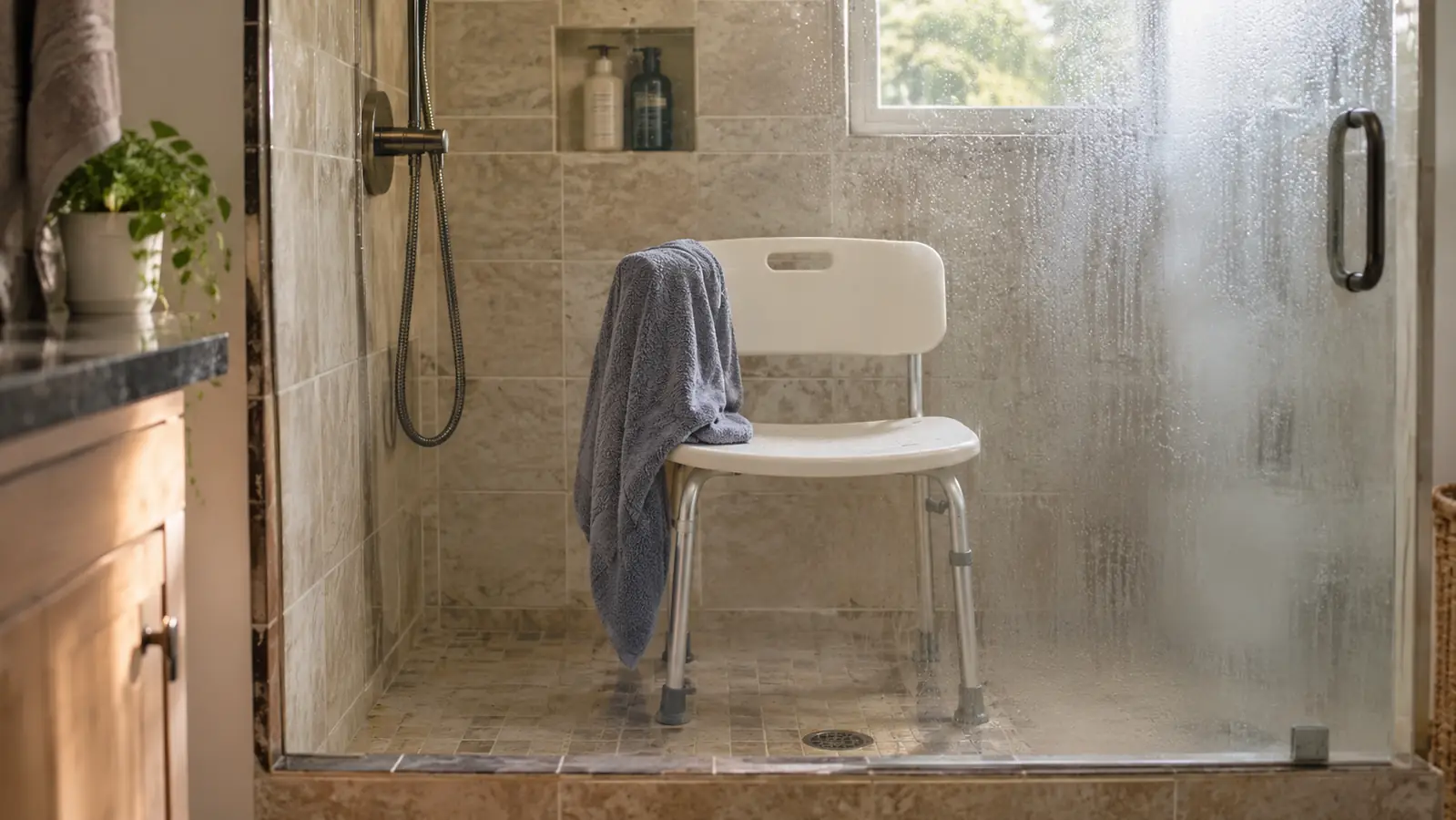
Who Should Buy Which
Buy the bench if she cannot step over the tub wall, if she needs to sit down before she does anything else, if she is heavier than the basic chair is rated for, or if a caregiver is helping her in and out. Buy it too if a surgery is already scheduled and you are shopping ahead, because it covers the weeks when she cannot lift a leg at all, and a chair cannot be adapted into a bench later. Buy the chair if she can step into the tub on her own and only needs to sit while she washes, if the bathroom is a stall with a low curb, if the tub has to stay usable for everyone else in the house, or if the gear has to travel to a hotel or a daughter's house.
There is one more case, and it is the common one: the bathroom stays exactly as it is and the person gets slower. If you are choosing today for someone who can just barely clear the wall, choose the bench. That is not a prediction about her health. It is a decision about which object stops working first. A chair is fine until the morning she cannot get her foot over the side, and on that morning it becomes furniture. People ask whether they can use both. You can, in a house with two bathrooms. In one bathroom they fight over the same square of floor.
One practical note about shopping. The bench arrives in a flat box and takes about twenty minutes to put together, and you want a level in your hand and the height set before the first shower, not during it. Set it with the person sitting on it if you can, and check the seat height twice, once empty and once with her on it, because a leg that is one notch off is something she will feel in her hip long before she can explain it to you. I set ours on a Sunday with my brother Karim holding the tape and Samira sitting on the seat saying higher, and then no, lower, and the whole thing took half an hour. Half an hour of fiddling is worth it to skip two years of a seat that sits a little too low.
What I Would Tell You If We Were Standing in My Bathroom
Three things. The bench is a seat, not a grab bar, so if she is unsteady standing up from it, the answer is a bar on the wall and a visit from a physical therapist, not a heavier bench. Put a handheld shower head on the wall before the bench arrives, because sitting down to shower and then reaching for a fixed head is how people end up twisted sideways under a cold spray. And keep the bath mat flat, replacing it when the backing starts to go, because the slide across the seat is only as safe as the floor she steps onto afterward.
The other thing I would tell you is about the look of it. Samira hated the bench on sight. It is a piece of equipment sitting in the middle of her bathroom and she said so, at length, for a week. Then she took a shower without needing me to hold her elbow, and she stopped mentioning it. If the objection in your house is that it looks like a hospital, that is a real objection and I am not going to pretend otherwise. Weigh it against the shower she takes alone.
Whatever you choose, ask her doctor or physical therapist about fit and use before you set it up. They know her balance and her hip better than a page on the internet does, this one included.
Two years in the same tub, and it is still the right call
Adjustable legs, a 350 pound capacity, an aluminum frame, and a seat deep enough to slide across without guessing. If the tub wall is the problem, this is the fix.
Amazon Check Today's Price on Amazon →