

Two years ago my mother came home from the hospital with a new hip and a short list of things she could no longer do alone. The bathroom was at the top of that list. The upstairs toilet in our 1950s colonial sits low, the floor is tile, and the nearest thing to hold onto is a towel bar I would not trust with a wet towel. I spent thirty-one years as an outpatient clinic nurse telling families to get a grab bar installed. Then I stood in my own bathroom and realized the wall behind the toilet is not where my mother's hands go. Her hands go forward and to the sides, where she pushes herself up. That is how we ended up with the Medline toilet safety rail, and why it is still around that toilet two years later.
Here is what it actually is, without the marketing language. A freestanding aluminum frame that sits around the toilet with an arm rest on each side. The frame is height adjustable from 27.5 to 31.5 inches, the space between the arms adjusts from 18 to 24 inches, and the whole thing weighs 4.4 pounds. The product name lists a 250 pound capacity while the spec sheet lists a 300 pound maximum weight recommendation, so if the person using it is anywhere near either number, ask your own doctor or physical therapist before you buy. This is a bathroom aid, not a medical device, and no article should be your only source of advice on how to use one.
The rail that ended the towel bar era in our bathroom
A freestanding aluminum frame, height adjustable from 27.5 to 31.5 inches, arms 18 to 24 inches apart, 4.4 pounds. It sits around the toilet we already had.
Amazon See the Medline rail on Amazon →It gives you something to push up from, not just something to hold
There is a difference between steadying yourself and standing up, and most bathroom safety advice blurs it. Standing up from a low seat is a push. You plant your hands and drive down through your arms. A bar on the wall behind you helps with balance but gives you nothing to push against at the angle your body needs. The arms on this frame sit at sitting hand height, so the effort goes where the grip is. My mother noticed that on the first day, and she is not a person who admits things quickly.
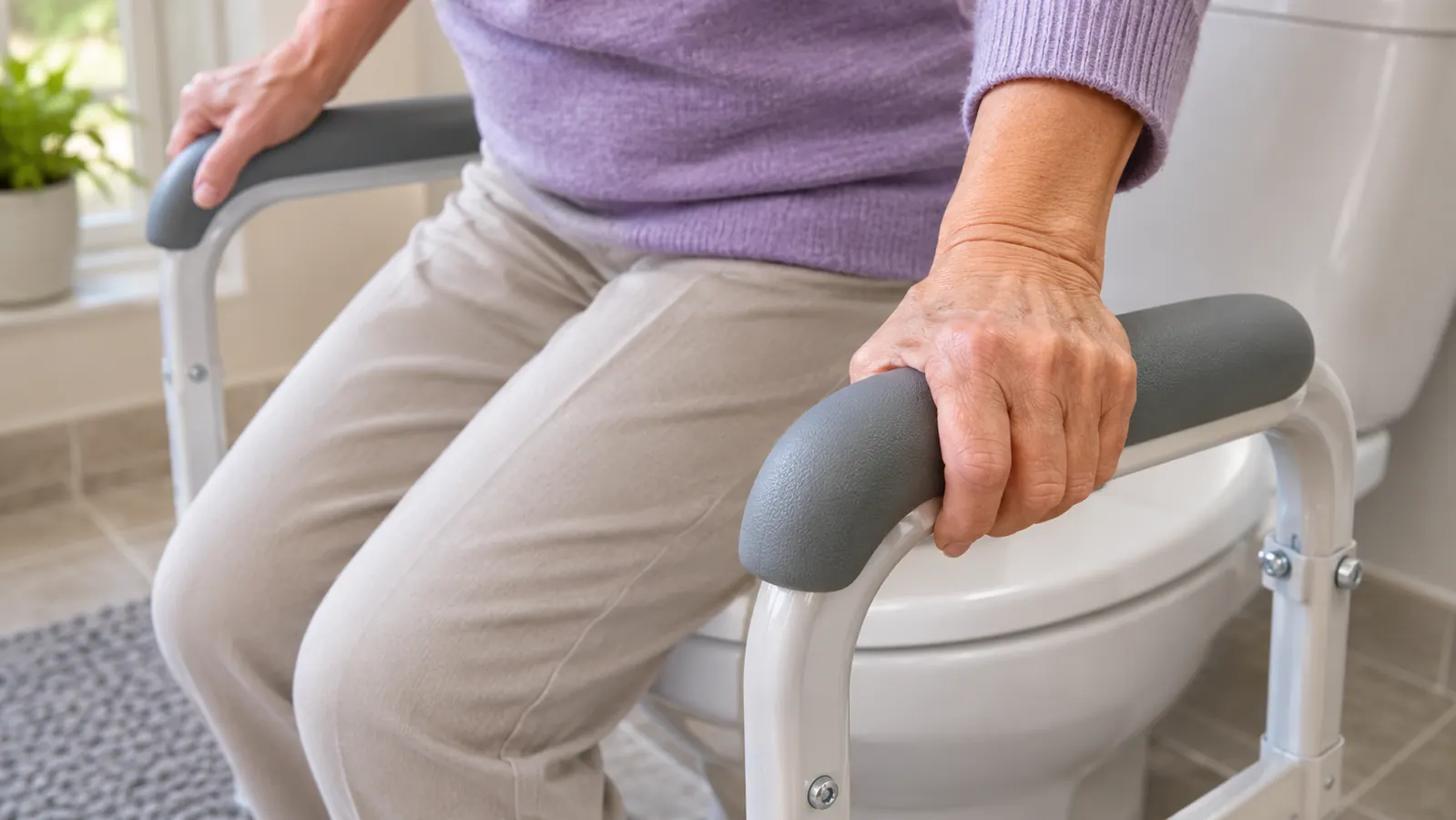
The arms sit in front of her, where her hands already go
Watch anyone rise from a low chair and you see the same sequence. The hands come forward first, to the thighs or the edge of the seat, and then the push happens. A rail that puts its two grips out in front, one on each side, works with that motion instead of fighting it. The space between the arms adjusts from 18 to 24 inches, which matters more than it sounds. Too narrow and she is squeezing past. Too wide and she is reaching. We set ours at the narrower end for a small frame.
The height adjusts so her feet stay flat on the tile
A rail that is too high makes you reach. A rail that is too low makes you fold forward, which is the exact motion that feels unsteady after hip surgery. This frame adjusts from 27.5 to 31.5 inches, so you can find the height where her feet are flat on the floor and her knees are not above her hips. We did not guess at it. We set it once while the home health physical therapist was in the house, and it has not moved since. That half hour was worth more than all the reading I did.
You keep the toilet you already have
The alternative most families look at first is a raised seat, and a raised seat changes the toilet for everyone who walks in. The Medline frame goes around the bowl instead. Nothing is removed, nothing is stacked, and a guest who does not need help can still use the bathroom without a negotiation. That was the deciding factor for my mother. She did not want a bathroom that announced itself to every visitor who came up the stairs.
It folds, and it weighs 4.4 pounds
This is the practical part nobody mentions. The Medline frame is foldable and it weighs 4.4 pounds, so I can fold it against the wall when I scrub the floor, and I can lift it with one hand. If a relative visits who also needs support, it goes in the back of the Forester without a production. My brother Karim does not have to plan his Sunday around it. Equipment that is hard to move is equipment that gets left in place and starts to feel permanent, and permanent is the thing my mother objects to.
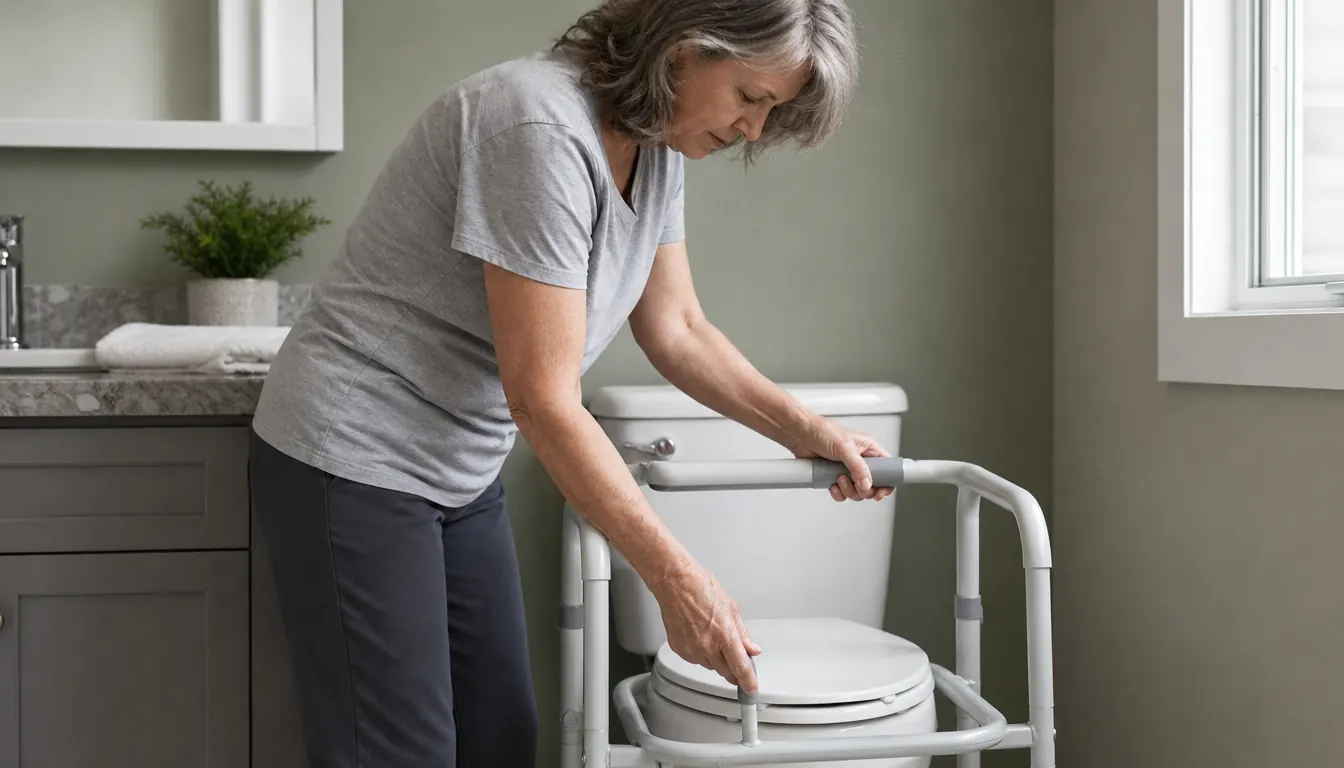
The 3 a.m. trip stops being the scariest one
Almost every fall story I heard in thirty-one years of clinic work had a time attached to it, and the time was usually somewhere between midnight and five. Half asleep, in socks, on tile, in the dark, with nobody to grab. That is the trip a rail is really for. You reach out before you are fully awake and your hands find the arms instead of empty air. It does not replace a nightlight and it does not replace a clear path to the door. It is the difference between finding something and finding nothing.
It makes helping her less awkward
For the first month I hovered. Hand at her elbow, ready to catch, which she hated and I could not stop doing. The rail gave me somewhere else to put my attention. She uses the arms, I stand at the doorway, and neither of us is performing a rescue. If you are the adult child in this arrangement, you already know why that is worth more than the frame costs. It changed the tone of our mornings, not just the mechanics of them.
It holds up to twice-daily use and wipes clean
Ours has been around that toilet for two years, used several times a day by a woman who is not gentle with anything. The aluminum frame has a scratch-resistant powder coating, and it wipes down with the same cloth I use on the sink. No rust spots, no wobble, no loosening at the joints. I check it the way I check everything, half expecting to tighten something, and there has been nothing to tighten. That is the whole durability report, honestly.
It fits most bathrooms, but only if you measure first
The frame measures about 29 inches deep by 19.8 inches wide, with the arms adjustable between 18 and 24 inches apart. In a small bathroom, that footprint is the thing that decides the purchase. Measure the space in front of the bowl and to each side before you order, and check that the door still swings past it. I have watched more families return bathroom equipment over fit than over anything else, and it is always the same conversation, held after the box is already open.
She gets the door closed
This is the reason I would buy it again, and it has nothing to do with aluminum. For the first few weeks after the surgery, my mother left the door open and called out when she was finished. Then she stopped calling out. Then she started closing the door. The rail made that possible, because it let her get up without a person standing in the room. If you are shopping for a parent, that is the thing you are actually buying, and it will never appear on a spec sheet.
What I'd Skip
I would skip the suction cup grab bars that let go of tile at the worst possible moment, and I would skip stacking a raised seat on top of another raised seat to chase more height. I would skip buying any rail before measuring the room and the door swing. And I would skip any plan that treats a bathroom aid as a substitute for a visit with your own physical therapist. Fit is individual. A nurse writing on the internet, including this one, cannot see your bathroom or your mother's hip, and should not pretend otherwise.
Standing up from a low seat is a push, not a pull. Put the grip where the push happens and the whole thing stops being a struggle.
Two years, several times a day, nothing to tighten
The Medline toilet safety rail is still around our upstairs toilet. Height adjustable, arms 18 to 24 inches apart, 4.4 pounds, folds flat when I clean the floor. Measure your space, ask your therapist, then decide.
Amazon Check today's price on Amazon →