

The Medline toilet safety rail and a raised toilet seat both answer the same worried question: how do I get on and off the toilet without reaching for a wall that is not there? My mother, Samira, is 87. She moved in with me two years ago after a hip replacement, and the upstairs bathroom became the first room we had to solve. We bought the Medline rail the same week as her tub transfer bench. A raised seat was the other option we looked at, and I have set one up in a guest bath for a short-term visitor. They are not interchangeable. One gives you something to hold. The other gives you less distance to travel.
Here is the short answer. If balance is the problem, choose the safety rail with arms. If height is the only problem and you already have a solid grab bar or counter within reach, a raised toilet seat can be enough. If you have both problems, the rail is the safer first purchase, because it gives you two arm rests and lets you keep the toilet you already have. The Medline frame is the one that lives around our upstairs toilet today. It is not perfect, and there are reasons a raised seat wins in some houses. But for a person who feels unsteady at the moment of sitting or standing, the rail does the job a raised seat cannot.
| Medline Toilet Safety Rail | Raised Toilet Seat | |
|---|---|---|
| Main job | Gives you two arm rests to hold while you sit down and stand up | Adds height so you do not have to lower yourself as far |
| Arm support | Two fixed arm rests, with 18 to 24 inches between them | Usually none unless you choose a model with arms |
| Height adjustment | Adjusts from 27.5 to 31.5 inches | Fixed height per model, so you buy the rise you need |
| Floor space | Frame surrounds the toilet and takes up floor space | Sits on the bowl and leaves the floor clear |
| Portability | Folds, but it is a 4.4 pound frame to move and reset | Lifts off in one piece for travel or storage |
| Cleaning | Frame wipes down, but the legs and arms add surfaces around the bowl | Lifts off for cleaning around the bowl |
| Balance support | Lets you push up from both sides without twisting toward the sink | Still relies on a wall, sink, or grab bar for balance |
| Toilet paper access | Arms can crowd a side holder in a narrow bathroom | Leaves the side of the toilet clear |
| Installation | Sets around the toilet, so measure width and depth first | Lifts on or locks to the bowl depending on the model |
| Weight limit | Title lists 250 lb; spec table lists 300 pound maximum recommendation | Varies by model, so check the label |
| Best for | Someone who feels unsteady while sitting or standing | Someone who only needs less bending and has support nearby |
The Setup in Our House
Before the rail, Samira used the sink edge to lower herself onto the toilet. That worked until the morning her hand slipped on a wet counter. Nothing dramatic happened, but it scared her enough to stop pretending the bathroom was fine. We set the Medline rail around the upstairs toilet and adjusted the height until her hands landed at a comfortable spot. The frame is aluminum, it weighs 4.4 pounds, and it folds, so I can move it when I scrub the floor. The listed height range is 27.5 to 31.5 inches, and the space between the arms is 18 to 24 inches. Those numbers matter more than any description.
The first week, she used it every time, even at night. She did not want anything that looked like a hospital, and the frame is visible, but it is a plain rail around the toilet, not a commode. It does not change how the toilet flushes or how the seat sits. It just gives her two bars to hold. I still check the feet to make sure they are flat and dry. A rail on a loose bath mat is not a safety aid. It is a prop.
Where the Medline Toilet Safety Rail Wins
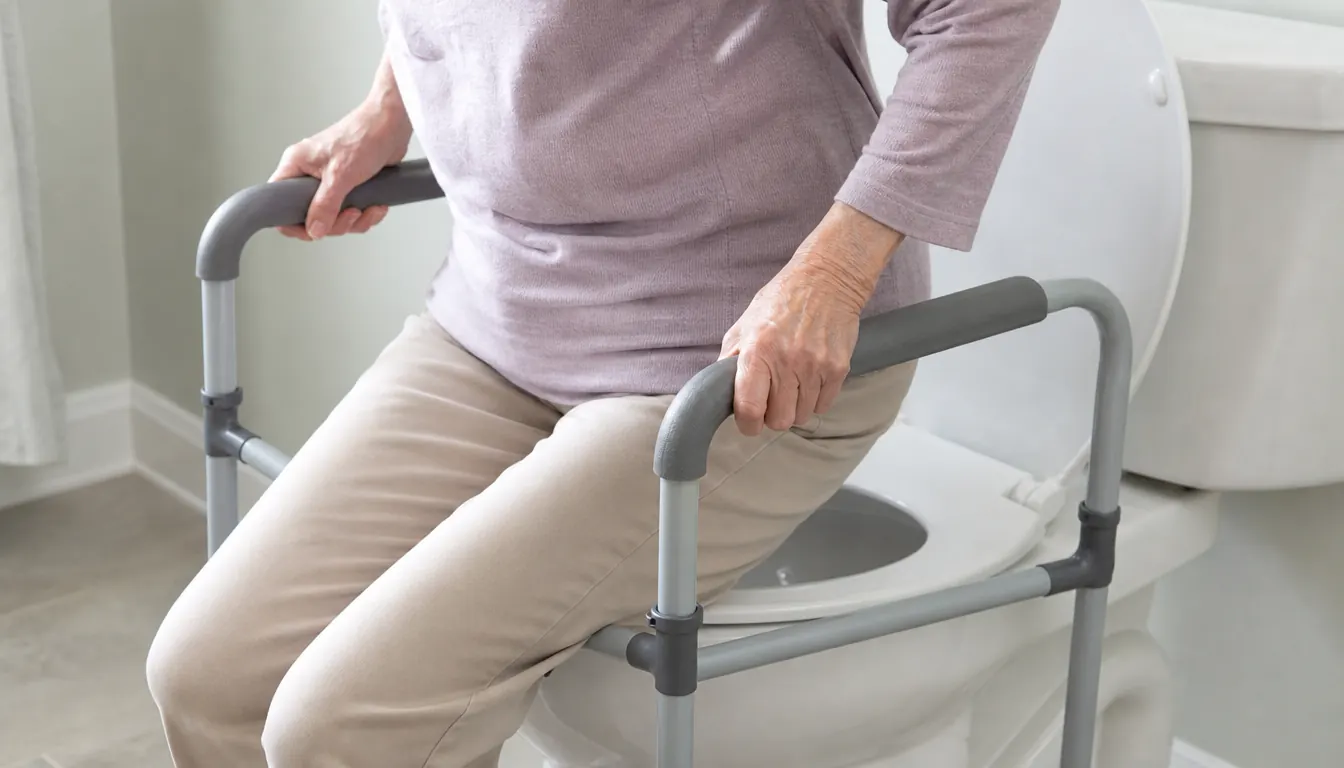
The biggest difference is the arm rests. A raised seat may add height, but most models give you nothing to hold. You still have to push off the seat or reach for the vanity. The Medline rail gives you a fixed bar on each side, with 18 to 24 inches between the arms. For Samira, that means she can lean forward, put a hand on each arm, and stand without twisting toward the sink. That twist is the part that scared me. It is also the part a raised seat does not fix.
The second win is height adjustment. The frame adjusts from 27.5 to 31.5 inches, so the arms can sit where your hands naturally fall. A raised seat is fixed. You buy the rise you buy, and if it is wrong, you live with it or return it. The Medline frame also fits around most toilets, but you have to measure. The listing gives an overall width of 19 to 22 inches and a depth of 29 inches. In a narrow bathroom, those numbers are the difference between a useful rail and a bruised hip. The frame is light enough to move at 4.4 pounds, and it folds, but I would not call it portable. It is portable the way a kitchen chair is portable. You can move it, but you do not want to carry it on a trip.
A raised seat shortens the trip. The Medline rail gives her hands a place to land at the end of it.
Where a Raised Toilet Seat Wins
A raised toilet seat wins on floor space. It sits on the bowl, so there is nothing around the base to step over or clean around. In a small half bath, that matters. If you use a walker or a wheelchair in the bathroom, the rail's legs can be in the way. A raised seat leaves the floor clear. It also lifts off in one piece for cleaning and travel. If you visit family or stay in a hotel, you can bring it. The Medline rail folds, but it is still a 4.4 pound frame. You are not going to pack it in a suitcase.
It is also less conspicuous. Samira hates anything that looks like a hospital, and a raised seat is easier to overlook than a frame around the toilet. But that convenience comes with a trade. A raised seat does not give you arms. If you need to push up, you will still reach for the wall, the sink, or a grab bar. And a raised seat can make the toilet taller than is comfortable, especially if the bowl is already high. That is why I would not choose one just because it is smaller. Choose it because the only problem is height and you have support nearby.
If balance is the issue, give yourself both arms
The Medline toilet safety rail is the frame we kept around the upstairs toilet after the first week. It adjusts in height, gives you two arm rests, and folds when you need the floor clear. Check the width and depth against your bathroom before you order, and ask your physical therapist if you are not sure about the height.
Amazon Check Today's Price on Amazon →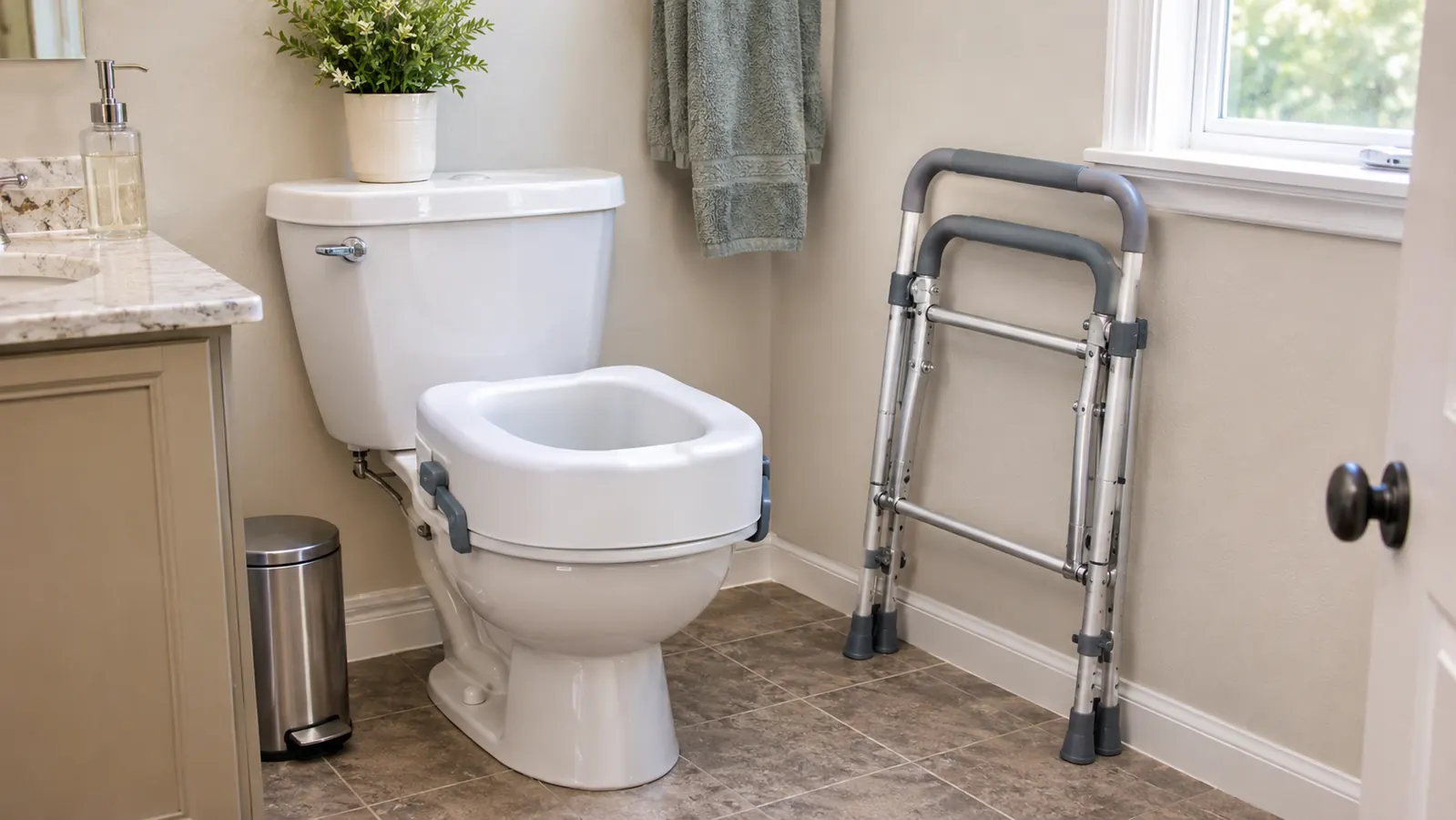
What Neither One Fixes
Neither product replaces a grab bar, and neither one makes a wet floor safe. A rail gives you something to hold, but it does not stop you from slipping on a bath mat or a slick floor. A raised seat gives you less distance to travel, but it does not give you balance. If the bathroom floor is wet, if the lighting is poor, or if the toilet is in a tight corner, those problems still need fixing. We added a night light and a non-slip mat. We also moved the laundry hamper out of the path. The rail helped, but the room had to be less cluttered too.
Neither product is a substitute for a physical therapist's advice. I spent 31 years in an outpatient clinic, and I still asked Samira's therapist to check the height. A rail that is two inches off can make standing harder. A raised seat that is too high can make sitting down feel like a drop. If you are recovering from surgery or you have a condition that affects balance, get the fit checked. That is not being overly cautious. It is how you keep the bathroom from becoming the place where something goes wrong.
Who Should Buy Which
Buy the Medline rail if you feel unsteady at the moment you sit down or stand up. Buy it if you have had a hip replacement, if your knees make standing up hard, or if you find yourself looking for the sink before you are fully on your feet. Buy it if there is no grab bar beside the toilet and you do not want to install one. The rail gives you two hands of support without changing the toilet. It is also the better choice if a caregiver sometimes helps, because there is a clear place to hold on both sides.
Buy a raised toilet seat if the only problem is height. If you can stand up from a chair without using your arms, and you already have a solid grab bar or counter within reach, a raised seat may be enough. It is also the better choice for a small bathroom, a half bath, or a rental where you do not want to set up a frame. It travels well. It is easier to clean around. And it is less visible, which matters to a lot of people who do not want their bathroom to look like a clinic.
Some families use both. A raised seat reduces the distance, and the rail gives you arms. I would not stack them without checking the fit. The raised seat can change the height of the bowl, and the rail arms need to clear the seat. Ask an occupational therapist or physical therapist to look at the setup if you are combining them. The goal is not to buy the most equipment. The goal is to make the trip to the bathroom boring again.
What I'd Check Before You Buy
Measure the space around the toilet. You need the width at the floor, the depth from the wall to the front of the bowl, and the height of the seat. The Medline listing gives a 29 inch depth, a 19 to 22 inch width, and a height range of 27.5 to 31.5 inches. Check the toilet paper holder too. On our toilet, the holder is close enough that the right arm rest is a little in the way. It is not a deal breaker, but I moved the roll to a freestanding holder. A safety rail you have to reach around is still better than nothing, but it is not the calm setup you want at 2 a.m.
Check the weight limit carefully. The product title lists a 250 lb capacity, while the spec table on the same listing says 300 pounds maximum recommendation. That is a real mismatch, and I would ask the seller which number applies. If the user is close to either number, choose a rail with a higher published limit. Also check that the feet sit flat on the floor. Ours sits on the bathroom floor, not on a bath mat. The aluminum frame has a scratch resistant coating, so it wipes down, but the legs still need to be dry and flat. A rail that rocks is worse than no rail, because it teaches you to trust something that will not hold.
Finally, set the height before you rely on it. The arms should be low enough that you can push down without shrugging, and high enough that you do not have to bend forward to reach them. If you are not sure, ask your physical therapist to check the height with you. That is not a waste of an appointment. It is the difference between a rail that helps and a rail that just sits there.
The rail we still use two years later
If you need a steady place to put your hands, start with the Medline toilet safety rail. Measure your bathroom, set the height, and keep the floor dry. It is not a grab bar and it is not a wheelchair, but it is the difference between a careful sit and a fall.
Amazon Check Today's Price on Amazon →