
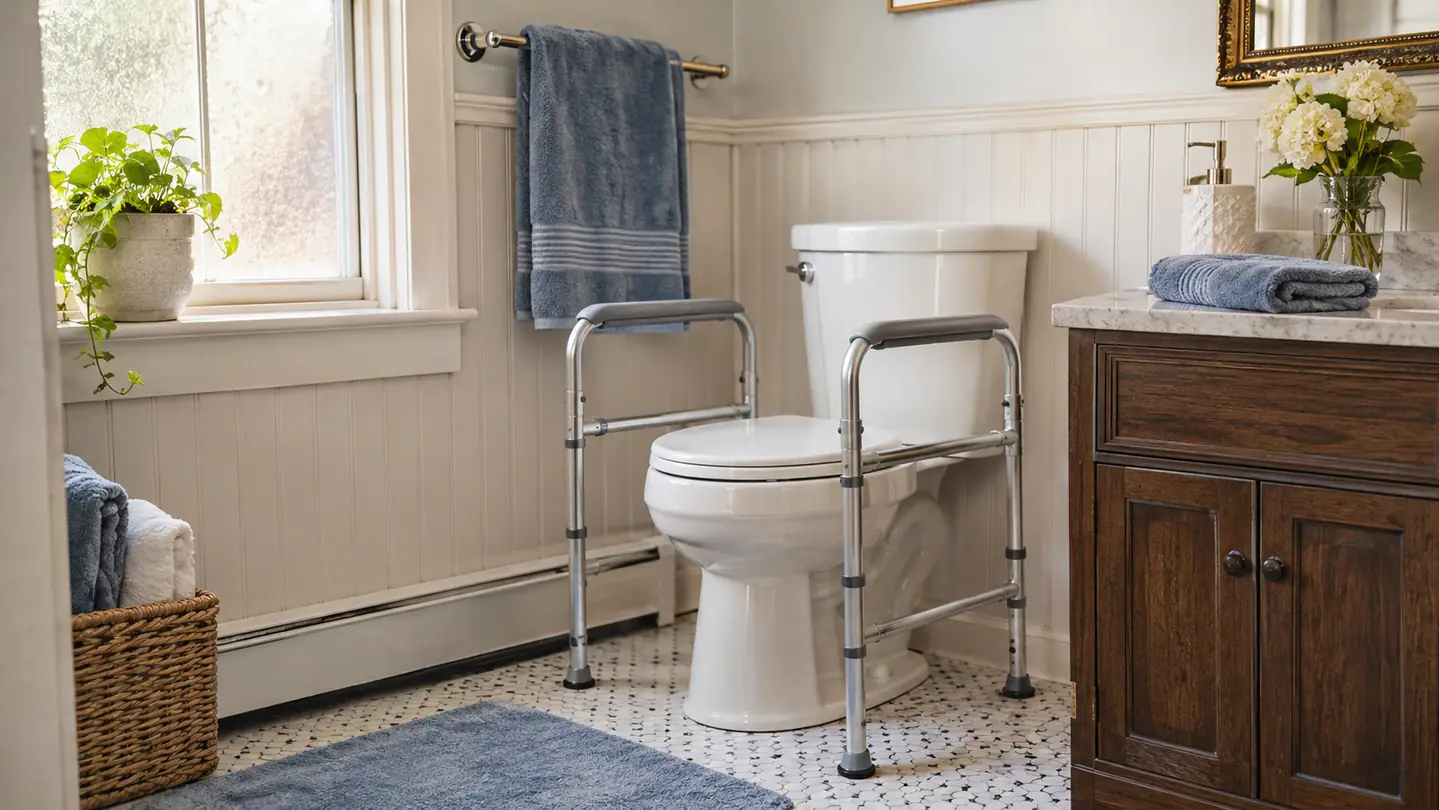
Two years ago my mother Samira came home from the hospital with a new hip and a list of things she was not allowed to do. The bathroom was not on that list, which surprised me, because it is the room where I saw more older adults get hurt than any other in thirty-one years of clinic nursing. She is 87 now. The toilet in our upstairs bath sits at the standard height, which is to say low, and there was nothing within reach to hold on to except the sink, and a sink is not built to be pulled on.
I ordered the Medline toilet safety rail the same week I ordered the transfer bench. It has stood around that toilet ever since. Two years and change, twice a day most days, plus the nights. Samira weighs about 135 pounds. She is sharp, she is stubborn about doing things herself, and she has firm opinions about anything that makes her bathroom look like a hospital room. The frame has survived all of it, and so has she. Here is what I can tell you about it, plainly, from a nurse who was also the daughter doing the installing.
The Quick Verdict
The frame my mother actually holds. Arms adjust from 27.5 to 31.5 inches so her hands land where they expect to, it goes around the bowl without drilling, and nothing has broken in two years of daily use. It costs you floor space and it will rock if you set the legs carelessly.
Amazon Check Today's Price →The rail her hands find before her eyes adjust
Aluminum frame, 4.4 pounds, powder coated and easy to wipe down. Arms adjust from 27.5 to 31.5 inches, with 18 to 24 inches of space between them. It sits around the toilet on its own legs, so nothing goes into the wall or the tile.
Amazon Check Today's Price on Amazon →How I've Used It
The frame goes around the toilet, not over it. Two arms, one on each side, each with a flat grip at the top that runs the length of the seat. The four legs are adjustable and the whole thing stands on the floor on its own feet. Nothing is screwed into the wall, nothing clamps to the bowl, nothing goes into tile. That last part mattered to me more than I expected, because this is a 1950s colonial and I did not want to be patching holes in a bathroom wall at 63 years old.
In practice, a normal morning looks like this. Samira walks in with her quad cane, parks the cane against the vanity, turns, and puts both hands on the arms before she lowers herself. She does it in one slow motion now, the way you would sit into a good armchair. Before the frame, she did it in three stages and used the sink for the middle one, and I held my breath every time. At the end she reverses it. Hands on the arms, lean forward, push up. She does not need me in the doorway anymore, which was the entire point of buying the thing.
The part I did not expect was nighttime. She gets up once most nights. The light in that bathroom is dim and her glasses are on the nightstand, not on her face. With the arms in place her hands find them before her eyes have adjusted. She has told me twice that she does not think about the toilet anymore. For a woman who thinks about everything, that is a real compliment.
On her bad arthritis days, or after a poor night, she still calls for me. I stand in the doorway and do nothing, which is the correct amount of help. A rail like this one is not there to replace a person. It is there so that a person does not have to be there for the ordinary trips.

What the Frame Actually Is
The frame is aluminum with a scratch-resistant powder coating, and it weighs 4.4 pounds. Arm height adjusts from 27.5 inches to 31.5 inches. The frame itself is listed at 27.5 to 31.5 inches long, 19 to 22 inches wide and 27.5 to 31.5 inches high depending on where you set it, with 18 to 24 inches of clear space between the arms. Those are the numbers that decide whether this works in your bathroom, so I am giving them to you straight instead of dressing them up.
On capacity, the listing contradicts itself a little and I would rather tell you than smooth it over. The product title says 250 pounds. The attribute field says the maximum weight recommendation is 300 pounds. I do not know which number Medline intends as the working limit, and I would not push either one. Samira is around 135 pounds, so it has never come up in this house. If the person you are buying for is anywhere near 250 pounds, call Medline before you rely on the frame, and ask them which figure is the rated one.
The arms are the part that earns its keep. They are flat, wide enough for a whole hand, and they run the length of the seat on both sides. They do not taper away at the front, which means her hand is still on something solid when she leans forward to stand. The listing describes arm rests for stability and a secure grip, and that language holds up in use. This is not one grab bar bolted at an angle to a wall. It is two rails you can hold at once, which is exactly what a replaced hip wants you to do.
The legs are the other half of the story. Four points on the floor, each with a foot, and no attachment to the toilet at all. That design is why it installs in minutes and why it is also entirely dependent on how carefully you set it up. I will come back to that.
How It Has Held Up Over Two Years
Nothing has broken, loosened or gone soft. The powder coating is intact across the arms, which is where hands go twenty times a day, and along the legs, which is where wet bathroom air goes. There is one small scuff on the front right leg from the vacuum cleaner, and I can find it if I look. After two years in a room with a shower in it, that is the entire damage report.
The frame has stayed where I put it. It does not wander across the tile as she sits and stands, which was my main worry, since a frame that creeps is a frame that eventually tips. I check the leg heights every few months with my hand, not with a level, and they have not drifted. If they ever do, the adjustment is a simple twist at each leg.
Cleaning takes a cloth. I wipe the arms on shower days, every other day, out of habit more than necessity, because a powder-coated surface does not hold much. There are no small crevices where a bathroom gets ugly. If you have ever cleaned around a bolted grab bar, you know what I am sparing you.
The Fit Details That Decide Whether It Works
Arm height matters more than most people expect. Set too low and the person has to fold further forward than a new hip wants to go. Set too high and they cannot get their weight over their feet to push up, so they end up pulling on the arms instead, which is the wrong direction entirely. Samira's arms sit at about 29 inches off the floor. Take the measurement from the person seated on the toilet, not from the person standing in the doorway.
Width is the other measurement, and it is the one that rules this frame out of a lot of homes. You need roughly 19 to 22 inches of clear floor around the bowl, plus room for a person to stand at the front. Ours is a small upstairs bath, and the frame takes the space between the toilet and the wall on one side and the toilet and the tub on the other. There is room for a person and a frame in there. There is not much room for anything else. If your bathroom is tighter than that, this is not the tool for you, and no amount of adjusting will change it.
The listing also gives a seat depth of 16.75 inches, which is roughly the footprint it expects the bowl to fill. Ours is close enough that the frame straddles it cleanly. If your toilet is unusually long or unusually short, measure the base before you order, because a frame that has to straddle a wider or longer base will not sit flat, and a frame that does not sit flat will rock.
One honest comparison. Downstairs we have a half bath that is too narrow for any frame, so I had a wall grab bar installed instead. Two different tools for two different rooms. The frame gives you two arms and no drilling. A grab bar gives you one arm, a hole in the tile, and a professional in your house for an afternoon. In a room with the space, I would take the frame.

Where It Falls Short
The front legs live where feet want to go. Samira has caught the front left leg with her slipper more than once while turning. Not a fall, not even close, just a stutter in place that she laughs off and I do not. You should know the frame stands in the walking path and that a person with a wide turn is going to bump it. In a very small bathroom, that alone can be disqualifying.
If the four feet are not level, the frame rocks, and it tells you immediately. That is not a defect, it is a 4.4-pound aluminum frame behaving exactly as physics says it must. Set it up on a floor you know is level, put your weight on each arm in turn and watch for movement, and recheck it after anyone else has cleaned the bathroom, since a mop tends to nudge things.
This is a frame to push up from, not a bar to hang sideways on. If the person you are buying for pulls rather than pushes, or shifts their whole weight sideways to stand, they need a properly rated wall bar and a professional to install it. I would rather say that plainly now than have you find out on a wet floor.
And it looks like medical equipment, because it is medical equipment. Samira's only real objection in the first month was that it announced itself the moment you walked in. She has stopped mentioning it, but she has not stopped seeing it. If appearance is going to be a daily argument in your house, spend that argument before you order, not after.
What I Liked
- Arms adjust from 27.5 to 31.5 inches, so one frame fits a tall and a short user
- Two arms mean a two-handed push up, which is what a replaced hip wants
- Aluminum frame weighs 4.4 pounds, powder coated and easy to wipe down
- Sits around the bowl on its own legs, no drilling into wall or tile
- Two years of daily use with nothing broken, loosened or rusted
Where It Falls Short
- Front legs sit in the walking path and catch a slipper
- Rocks noticeably if the legs are not set level
- Takes real floor space, narrow bathrooms cannot fit it
- Capacity is 250 pounds in the title and 300 in the attributes, so ask if that matters
- It looks like hospital equipment, and some people mind that a great deal
Two years in, her hands find the arms before her eyes have adjusted to the light. That is the whole review.
Who This Is For
This frame is for someone who can stand and walk but cannot get down onto a low seat and back up again without something to hold. That covers a lot of people. Someone six weeks out of hip or knee surgery. Someone managing arthritis in the knees or hands. Someone who is simply getting older in a house built in 1955 with standard-height toilets and no grab bars in sight. If the person can take their own weight on both legs and only needs leverage, this is the right tool at the right scale.
It is also for the adult child doing the buying, who needs something that goes in this afternoon without a contractor, comes back out when a parent visits, and does not leave four holes in the tile behind. I installed ours myself in the time it takes to make coffee. That has value that does not show up in any specification.
Who Should Skip It
If the person cannot bear weight on both legs, needs help transferring, or has fallen in the bathroom already, do not start here. That situation calls for a commode or a raised seat and a proper assessment from an occupational therapist or physical therapist, and probably a conversation with the doctor as well. A frame that gives leverage is not a substitute for supervised transfer, and buying one can create a false sense of safety that is worse than nothing.
Skip it too if the bathroom is narrower than the 19 to 22 inches the frame needs, if the person pulls toward themselves rather than pushing up, or if their weight is anywhere near the 250-pound figure in the title. And if the person in question has already told you they will not have hospital equipment in their bathroom, take them seriously the first time. Ask your own doctor or physical therapist about fit and use before you order anything for someone else's body. I have watched people buy the right product at the wrong time and give up on all of it.
Two arms, four legs and no holes in the tile
Height adjusts 27.5 to 31.5 inches at the arms. Width runs 19 to 22 inches with 18 to 24 inches between the grips. Measure your bathroom floor and your own seated arm height first, then check the rail against both numbers.
Amazon See Current Price and Dimensions on Amazon →