

Fourteen months ago my mother could not get out of bed in the morning without a hand to hold. Not because her legs had given out. She had a hip replaced two years earlier and the surgery went well, and she walks to the end of the street and back most days with her walker. The problem was narrower and harder to talk about. She did not trust the first thirty seconds of the day, so she sat on the edge of the mattress with her feet flat on the floor and waited, sometimes a full minute, working up to standing while I pretended to be busy in the hallway. That is the honest reason a Medline bed assist bar ended up on the side of her bed. The version I gave my brother on the phone was shorter and made me sound more decisive than I was.
I am not a doctor and I am not going to write like one. I spent thirty-one years as a nurse in an outpatient clinic in Worcester, Massachusetts, most of it alongside physical therapists, and the lesson that stayed with me is how often the wrong piece of equipment talks a person out of their own independence. A rail that shifts half an inch under a hand. A handle two inches off from where it should be. A grab bar that looks reassuring and gives nothing back. So this is not a celebration of a product. It is a plain account of what this bar does, what it does not do, and who I would and would not hand it to.
The Quick Verdict
A steady, height-adjustable handhold that turns the hardest thirty seconds of the morning into a two-second push. It only works if the mattress stays put, and it is not a bed rail, whatever you assume from the name.
Amazon Check Today's Price →The thirty seconds that decide how the rest of the day goes
She has used this bar every morning for fourteen months. It is the first thing her hand finds and the last thing it lets go of before she stands.
Amazon Check Availability on Amazon →How I've Used It, Morning After Morning
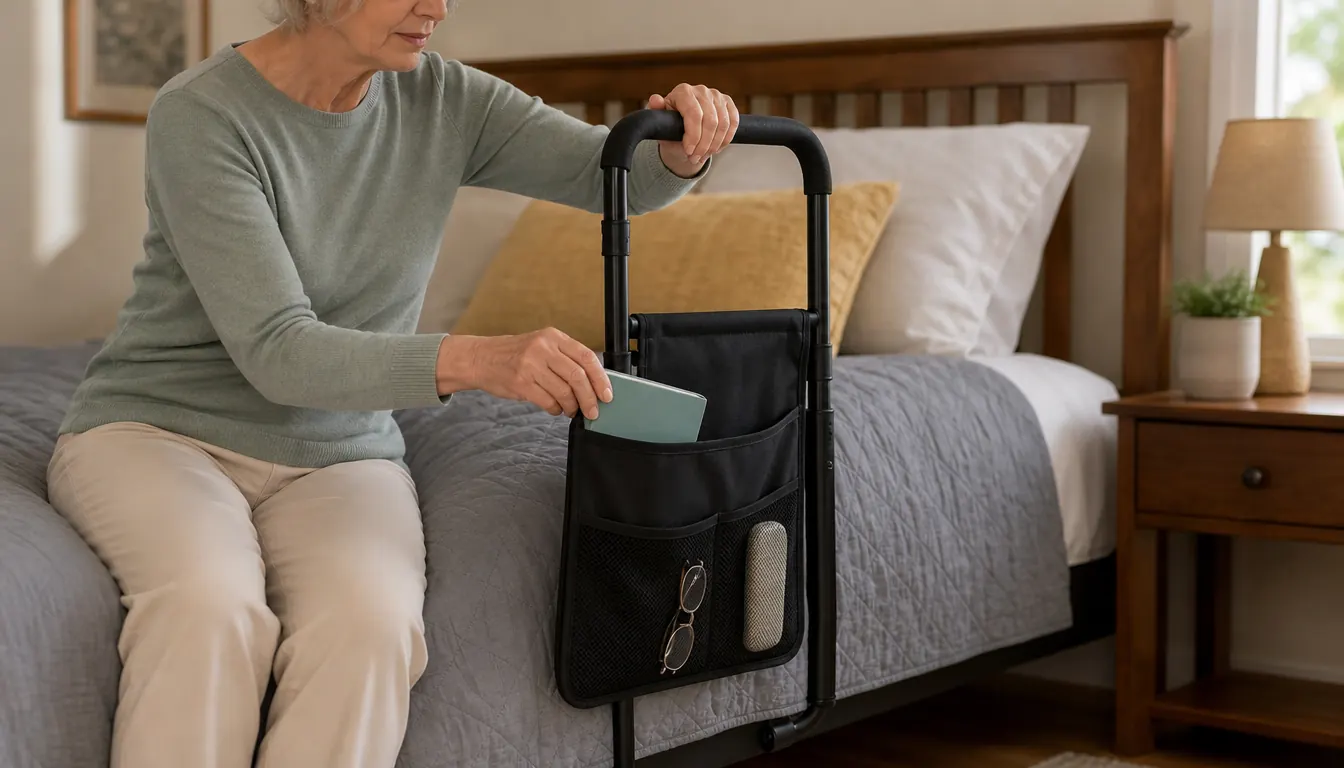
The bar has one job in our house and it does it around seven every morning. She rolls to the edge of the mattress, sits up, plants her left hand on the frame, swings her feet down and stands. On the days I am in the room her right hand finds my forearm. On the days I am not, it finds the handle of her walker, which lives folded by the wall. The bar is the first move of the day, not the last one, and that ordering is exactly what I wanted from it.
The second job is small and she would deny it counts for anything. Slippers. She sits on the edge of the bed, leans over, and works them onto her feet while her other hand holds the bar. Before we had it she did that standing up with one palm on the nightstand, and the nightstand is a piece of furniture, not a fixed object. It slides. It has always slid. Nobody in this house thinks about the nightstand until they watch an eighty-seven-year-old lean on it.
The third job I did not expect at all. She uses the bar to turn over in the night. She takes hold, pulls herself onto her side, and lets go. It takes two seconds. It has cut down on how often she calls out at three in the morning, and that has nothing to do with safety and everything to do with not wanting to ask.
How I Ended Up Buying One
The bed is a queen in the downstairs guest room. When my mother moved in two years ago after the hip, we made that room hers, because the stairs in this house are original to 1950 and steep enough that I did not want her on them in the dark. It is a firm mattress on a plain box spring, no adjustable base. That detail matters more than anything else in this review, so keep it in mind.
The bad morning was a Tuesday in early spring. She sat up, swung her legs over, pushed off the mattress with both palms, and her hands slid. She did not fall. She sat back down hard, and then she laughed, which is what she does instead of saying that something frightened her. I was in the kitchen and heard the mattress shift. By the end of that week the bar was on order, and on Sunday my brother Karim held the mattress up while I worked the frame into place and said several things I will not repeat here.
It has been on that bed ever since. Nothing has loosened. Nothing has bent. I wipe it with a damp cloth every month or so, which is the entire maintenance schedule and all the care it asks for.
Before this I looked at two other answers. A wall-mounted grab bar beside the bed, which would have meant drilling into plaster in a room where the studs are wherever the 1950s left them, and a rail with legs that stands on the floor, which I set aside because it is a trip hazard in a small room and my mother would have hated it on sight. Both are reasonable in other houses. Neither fit mine.
What the Bar Actually Is
The plain description. The Medline bar is a U-shaped frame that weighs a little over six pounds. You slide it between the mattress and the box spring on the side of the bed she sleeps on, and the mattress does the holding. There is nothing to bolt into the floor and nothing to screw into a wall, which mattered to me in a house where I have already made enough holes.
The manufacturer lists it for non-articulating twin, full and queen beds. The height adjusts. The overall dimensions are 27.5 by 14 by 43.75 inches, and it wipes clean with a damp cloth. I did not test it against a lab standard. I tested it against one queen bed in one room in Worcester, and it fits with room to spare.
It looks like equipment. That is the honest description and I am not going to dress it up. My mother hates anything that announces itself as medical, and this one sits quietly at the edge of the mattress and reads as part of the bed once the covers are straight. She has not once complained about how it looks, which from her is a review all by itself.
The Height Adjustment Is the Whole Thing
If you take one thing away, take this. What you change is how high the handhold sits relative to the mattress. Too low and she is reaching down, which turns a push into a pull from a poor position. Too high and her hand passes under it on the way up. A hand that misses a rail once does not reach for it a second time.
It took us three tries over two weeks to settle on the right height. The first setting was too high. She gripped it, stood, and said it felt like reaching for a shelf. The second was low enough that she had to bend her elbow at an odd angle. The third is where it has stayed for fourteen months. My advice is to adjust it with the person who uses it standing right there, not alone with a tape measure, and then ask your physical therapist whether the height you landed on matches how she actually stands. Mine watched her stand three times and then nodded, which is about as much enthusiasm as I get out of a Tuesday appointment.
A rail two inches too high is worse than no rail at all, because she reaches, misses, and learns not to trust her own bed.
What Nobody Tells You: The Mattress Is Doing Half the Job
Almost every complaint I have read about this bar traces back to the same thing. It is only as steady as the mattress sitting on top of it. A light mattress on a smooth box spring can slide. A mattress that already slides will slide more once somebody is leaning on a frame beside it. Ours is heavy and the box spring has a fabric top, so it has not moved once in fourteen months. I checked it monthly for the first six anyway, and I still check it when I change the sheets.
If your mattress slides, deal with that first. A thin rubber mat between the mattress and the box spring is the usual fix and it is worth trying before you buy anything at all. I would rather tell you that now than have you buy a bar, feel it shift, and decide the bar is the problem when the bed was.
The Storage Bag Is Better Than I Expected
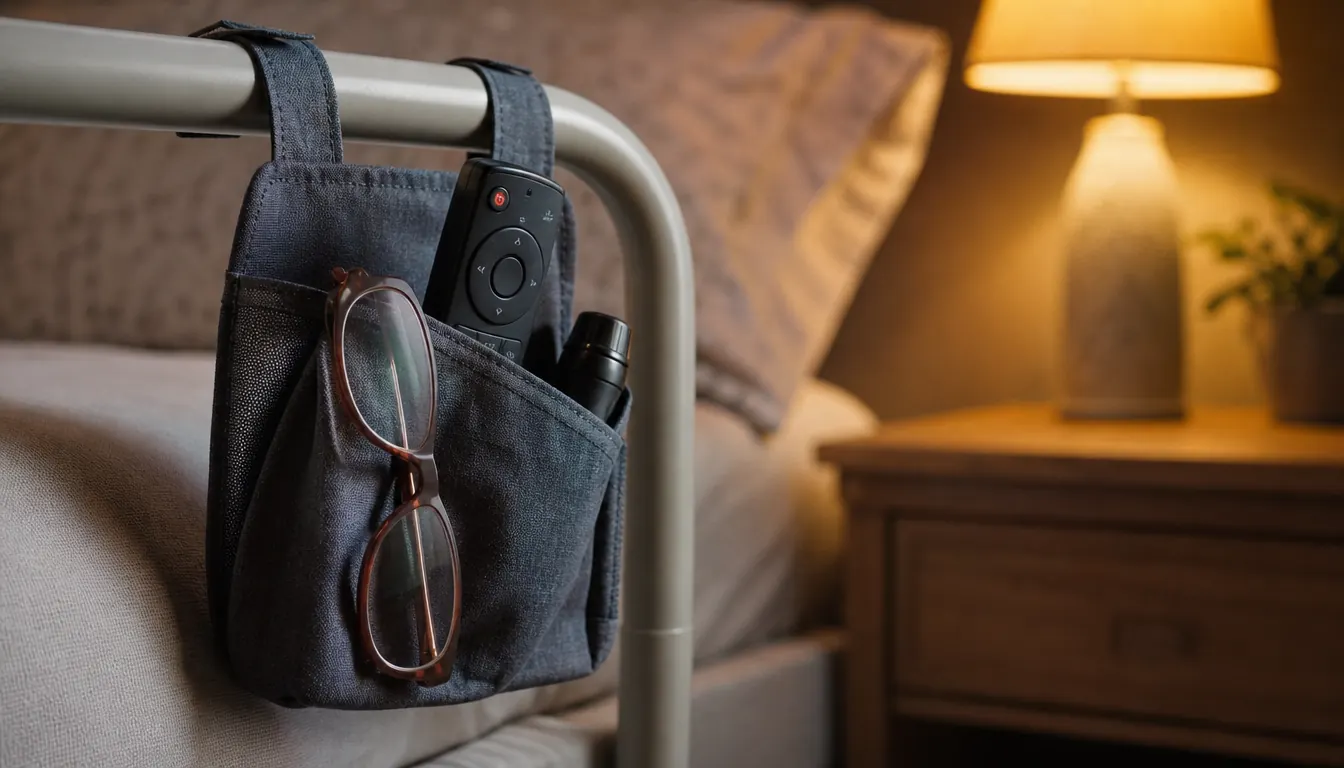
A nylon storage bag hangs from the frame and holds more than the pictures suggest. In our house it holds her reading glasses, the television remote, and a small flashlight. The flashlight was my idea and it has earned its place twice, once during a power cut in December and once when she dropped a pill on the floor at eleven at night and did not want to wake the house.
What I did not expect is that the bag does as much for her dignity as the bar does. Nobody has to be called to fetch her glasses. She is not lying there at seven in the morning waiting for a knock on the door. Written down it is a small thing. Lived, it is not.
Where It Falls Short
It is one bar on one side. If she wakes at two in the morning and wants to get up on the other side of the bed, there is nothing there to hold. In our house that is not a problem because the far side is against the wall, but look at your own room before you order.
It is a handhold, not a restraint. If somebody is rolling toward the edge in their sleep, or if confusion is part of the picture, this is the wrong product and I would be on the phone to an occupational therapist about a proper bed rail instead. The bar is for a person who is steady once they are upright and needs help getting there.
Pulling strength matters too. She pushes down on it. She does not haul herself up sideways by it, and I would not want her to. If the person using it needs to drag their whole body weight across it, ask a professional what to use, because a single bar held by a mattress is not built for that and no listing should imply it is.
The bag is nylon and shallow. It holds glasses, a remote and a small flashlight. It will not hold a water bottle upright and it will not take a paperback without the corners poking out.
And the first fitting is a two-person job. Not because it is complicated, but because lifting a queen mattress with one hand while working a frame with the other is how a daughter in her sixties wrecks her back. Ask somebody to help, and if there is nobody, ask a neighbor.
What I Liked
- Height adjusts to match the bed, which matters more than any other feature
- The mattress holds it in place, so nothing is screwed into a wall or floor
- Steady under a firm mattress on a box spring, with no give after fourteen months
- The nylon bag keeps glasses, a remote and a flashlight within reach
- Light enough to shift when the sheets are changed
- Listed for non-articulating twin, full and queen beds
Where It Falls Short
- One side only, so the far side of the bed has no handhold
- Only as steady as the mattress above it
- Not a bed rail and not meant for someone who rolls or is confused
- The storage bag is shallow
- First fitting takes two people
- No use on an adjustable base
What Fifteen Thousand Reviews Get Right
At the time of writing, the Medline bed assist bar carries a 4.6 average across more than fifteen thousand ratings. What struck me is how closely the complaints match my own notes. Mattress slide. A height that takes fiddling. And the plain look of the thing, which is the look of equipment in a bedroom that used to be a guest room.
The praise is just as consistent and it is never about appearance. It is people saying they can get out of bed without calling for help. That is the entire product. Every other detail is decoration.
What I Would Change
Two things. I would sell it as a pair, or at least make the second bar easy to find, because a bed has two sides and the person using it does not always wake up facing the side you planned for. And I would put a visible mark on the frame so that once you find your height you can find it again after the sheets come off, because ours took a week of guessing to settle and I would not want to repeat it.
Neither of those is a reason to skip it. They are the notes of somebody who has lived with the thing for over a year and would like it to be a little better.
Who This Is For
This is for a person who can stand once they are upright but cannot comfortably get from lying to sitting to standing without something to push against. It suits a firm mattress on a box spring, on a bed that does not adjust, in a room where one side is the side that matters. It suits somebody like my mother, who wants the bar to blend into the furniture and would rather do without than have her bedroom look like a hospital bay. And it suits the adult child who is tired of listening for the mattress from the next room.
Who Should Skip It
Skip it on an adjustable base, because the manufacturer says not to use it there. Skip it if the mattress slides and you have not fixed that first. Skip it if the person using it is unsteady once standing, or if they might lean their full weight sideways on it, because that is a bed rail job and this is not a bed rail. Skip it if you need a handhold on both sides, or if nobody can help with the first fitting. And skip it if what you actually need is a way to keep somebody from getting out of bed at all, because that is a different conversation and it belongs with an occupational therapist, not a product page.
If the hard part is the getting up, this is the one I would buy again
Fourteen months on the same bed, one height setting, nothing loose. Ask your physical therapist about the height, then let her stand beside it three times before you trust it.
Amazon See the Medline Bed Assist Bar on Amazon →