
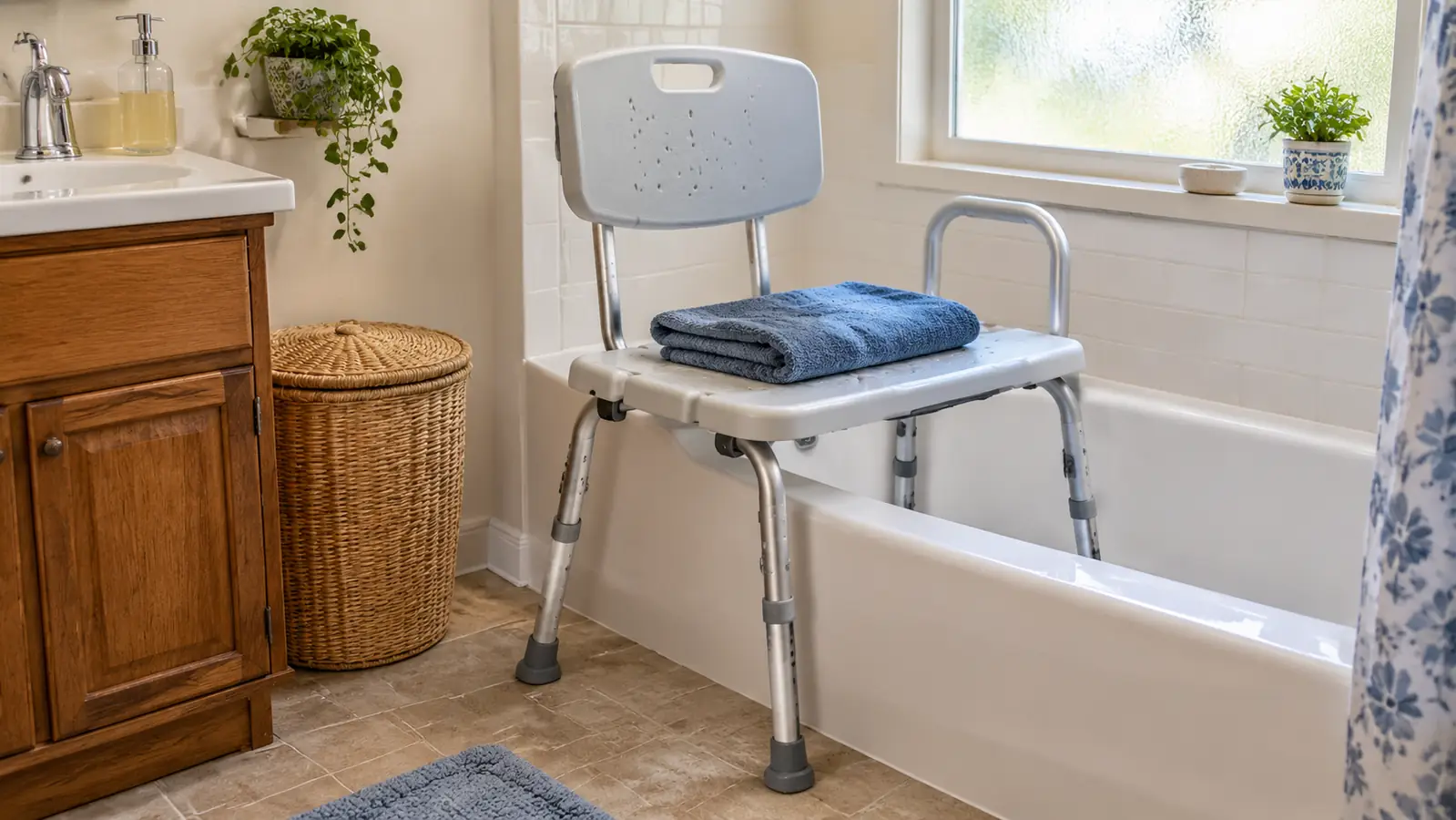
My mother, Samira, is 87. Two years ago she had a hip replaced, and when she came home to my house in Worcester she could not get into the bathtub. The tub is not unusual. It is an ordinary tub in an ordinary 1950s colonial, and the wall is about as high as tub walls are. She simply could not lift a leg over it, and the one afternoon she tried, she ended up sitting on the bathroom floor with her back against the door, more frightened than hurt. That was the week we bought a Drive Medical tub transfer bench.
The bench did not make her taller, stronger or steadier. What it did was remove the one move she could not do, which is stepping over the wall while balanced on one leg. Instead she sits down on dry land, outside the tub, and slides across. That is the whole idea. Everything below is the detail that makes the idea work on a Tuesday morning when she is tired and the bathroom is steamy and I am standing in the doorway trying not to hover.
I spent 31 years as a nurse in an outpatient clinic, working beside doctors and physical therapists, so I am fussy about exactly two things here: seat height, and where a person's hands go. One plain statement before the steps. Ask your own doctor or physical therapist whether this setup suits your body. I can tell you what happens in this house. I cannot tell you what is safe for your hips or your balance.
Half the seat stays outside the tub, so nobody steps over the wall
The Drive Medical tub transfer bench is a plastic seat on an aluminum frame, about 10 pounds, rated to 350 pounds, with legs that adjust so the seat sits between 17.5 and 22.5 inches off the floor. You sit down on the half that is over the bathroom floor, lift your feet over the wall one at a time, and shift across.
Amazon See today's price on Amazon →Five Steps, In the Order I Would Do Them
Setup first, because a bench at the wrong height is worse than no bench. Then the transfer in, the shower itself, and getting out. I have put getting out last on purpose. It is the part people rush, and rushing is the only part of this that has ever worried me.
Step 1: Set the Height Before Anyone Sits On It
Seat height is the most important setting on the bench and the one people skip, because it arrives looking ready and it is tempting to just drop it in the tub. Do not skip it. The legs adjust, and the seat can sit anywhere between 17.5 and 22.5 inches off the floor. Samira is not tall, and in our bathroom the seat sits near the bottom of that range. A six-foot man in the same tub would want it near the top.
Here is the measurement that matters. Have the person sit on the outside half of the bench with both feet on the bathroom floor. If the feet rest flat and the knees are roughly level with the hips, the height is right. If the feet dangle, it is too high. If the knees sit noticeably above the hips, it is too low, and standing up from it later will be harder than it needs to be. Set all four legs to the same height, then sit again and check. A bench with one leg a setting off will rock, and a rocking bench is a fall waiting to happen.
Check it again after a week. The number that looked right on the day you set it up is not always the number that feels right after seven showers. And if two people of very different heights share the bench, set it for whoever uses it most, and treat the occasional user as an occasional problem rather than readjusting all four legs twice a day.
Step 2: Put the Back Legs Inside the Tub
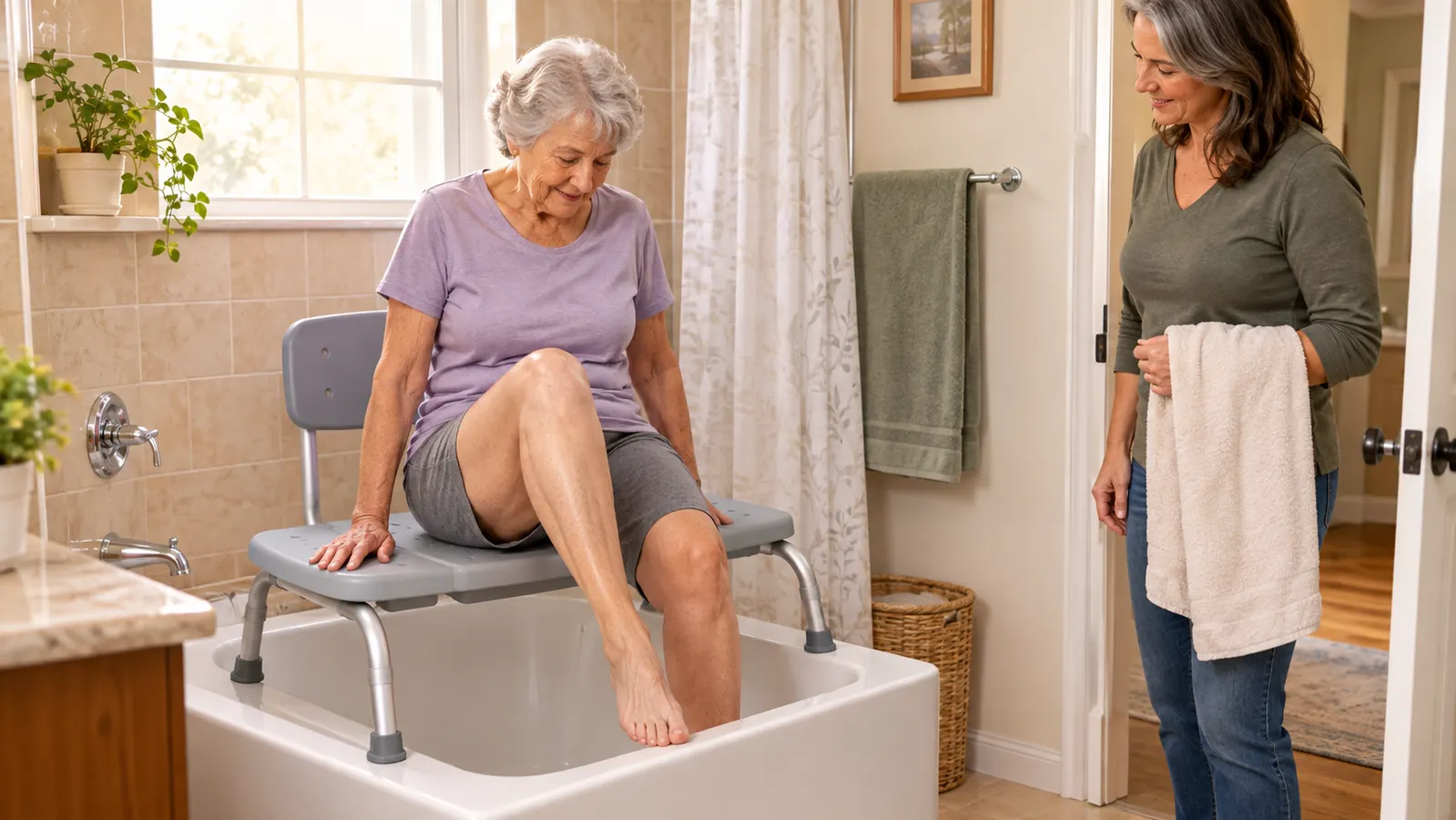
The Drive Medical bench sits across the tub wall, not along it. The two back legs go down inside the tub, the two front legs stay on the bathroom floor, and the seat spans the wall so that half of it is over dry floor and half is over the tub. Set up that way, the frame carries the person, which is what the aluminum frame is for. Set up any other way, with the whole bench inside the tub or the whole bench outside it, and the person is back to stepping over the wall.
Clear the tub floor before you place it. Bottles, a loofah, a thick bath mat, all of it goes. The back legs need a flat clean surface. On the floor side, mop up any water first, because a wet tile floor under a leg is the same as a leg on a skateboard. Then push the bench firmly toward the wall until the frame stops, and press down on the outside edge with the heel of your hand to check that nothing shifts.
In our house the bench never comes out, and that is a real trade-off worth saying out loud: the upstairs tub is now a shower and nothing else. Nobody here has taken a bath in two years. For us that is not a loss. If someone in your household still wants to soak, decide that before you buy rather than after, because a transfer bench and a bath are not the same bathroom.
Step 3: Sit Down Outside and Slide Across
This is the move the whole bench exists for, and it is worth practicing once with two people and no water running. Put a towel on the seat if the plastic feels cold or slick, dry your hands, and stand with the backs of your legs touching the outside edge. Reach back with one hand, find the seat, and sit down the way you would sit on a bench in a park. Slowly, weight going down and slightly back. Not straight down, and not forward.
Now the feet. Lift one foot over the tub wall and set it down inside, then the other. Do not swing both at once, and do not lift a foot while your hands are full or while you are leaning sideways to see what you are doing. Once both feet are inside, put one hand on the seat beside your hip and the other on the seat in front of you, lift your hips a few inches, and shift across until you are sitting over the tub rather than over the floor. Small moves. Two or three small shifts beat one big heave.
The thing not to do is twist. Twisting is how people hurt a new hip, and it is what happens when someone reaches for the shampoo bottle behind them while their feet are still on the wrong side of the wall. Feet first, then hips, then hands, then everything else. If you are the one helping, stand where the person can see you and where you can see their feet. Keep your hands off their body unless they ask, and let them set the pace. A caregiver who grabs will startle someone who is concentrating, and a startled person on a wet surface is a fall.
Feet first, then hips, then hands, then everything else. Twisting is how people hurt a new hip.

Step 4: Shower Seated Without Reaching
Once you are over the tub, the shower itself should be boring. A handheld shower head on a rail is the best companion a transfer bench has, because it lets a person rinse without lifting an arm overhead or turning to chase the water. We fitted one the same week as the bench, and it did more for Samira's independence than anything else in that bathroom.
Everything the person needs should be within reach before the water goes on. Soap in a pump bottle rather than a slippery bar, a long-handled sponge for the legs and feet, a towel on the rail, and nothing left on the tub floor where a foot has to go. Sit the whole time. Standing up to rinse is the most common thing I see, and it is precisely the move the bench was bought to prevent.
Shower days here are every other day, and I am in the room. Not washing. Standing at the door with a towel, handing things over, staying out of the way. Samira would tell you she does not need me there. She is also the woman who once sat on the floor and cried, so we have agreed to disagree. If you are the caregiver, settle what you will and will not do beforehand, so the conversation does not happen while someone is wet and cold.
Step 5: Get Out the Same Way, Only Slower
Getting out is the reverse with one addition: dry first. Sit over the tub, dry the legs and feet properly, and only then lift the feet back over the wall one at a time. Wet feet on a bathroom floor are the whole problem, and drying them while you are still over the tub is how you avoid it. Put a towel where the feet will land, then move it out of the way before anyone stands on it.
Shift the hips back across the seat to the outside half, hands on the seat where you can see them, then stand the way you would stand from a chair. Feet flat, nose over toes, push through the legs rather than pulling on anything with the arms. If the room is steamy and the person has been sitting a while, count to ten before standing. Heat and a long sit are a poor combination for balance, and a minute of patience costs nothing.
The last step is the one nobody writes down. Dry the seat, dry the floor, hang the towel back on the rail. The next person to use that bathroom is usually the same person, and they will be just as tired next time. Samira does this herself. It takes about a minute, and it is, in her words, the part that makes it her bathroom instead of a clinic.
What Else Helps
A transfer bench solves one problem. The bathroom has others. A towel rail close enough to reach from the seat, a nightlight for the two-in-the-morning trip, and a nonslip mat on the floor beside the tub all matter more than people expect, and none of them are difficult. Keep the bathroom warm, too. Cold makes people tense, and tense people move badly.
Two other aids earn their place in this house. The toilet safety rail around the upstairs toilet matters because the bathroom trip is one continuous journey: sit, stand, shuffle, sit again, stand again. A bench at one end of that journey and nothing at the other is half a solution. And the other bathroom aid I would not give up is that handheld shower head, which deserves a third mention and gets one.
What I would not do is treat any of this as a substitute for asking a professional about your own body. Fifteen minutes with a physical therapist in your own bathroom, watching you do the transfer once, is worth more than any article, this one included. If the person using the bench has had a hip replaced, ask specifically about the precautions your surgeon gave you, because the rules about how far to bend and how far to turn are not the same for every surgery. Ask about the bench height while you are at it. A physical therapist will tell you in ten seconds whether it looks right.
Two legs in the tub, two on the floor, and nobody balanced on one foot
The Drive Medical tub transfer bench is rated to 350 pounds, weighs about 10 pounds, and adjusts between 17.5 and 22.5 inches, with a seat 15.5 inches deep. It carries a limited lifetime warranty. Settle the height against the person who will actually use it before anything else.
Amazon Check today's price on Amazon →