

The riskiest thirty seconds of my mother's day are not the stairs and not the shower. They are the moment she sits up in bed and has to find her feet. Her hip replacement was two years ago and she is steady once she is upright, but that first push off the mattress is where her balance has the least to work with. A soft mattress edge holds nothing. It gives.
We tried the obvious fixes first. A nightstand pulled close, which meant twisting sideways before she was steady. A firm pillow wedged under the mattress edge, which slid out by the second night. A kitchen chair beside the bed, which is a genuine fall risk the moment someone forgets and moves it back. What worked was a Medline bed assist bar: a light frame that slides under the mattress and puts a firm handle at the height her hand already wanted. Ours has been on Samira's bed for about fourteen months. This is the order I would do it in if I were setting one up tomorrow, including the parts I got wrong the first time.
A handle that does not move when she leans on it
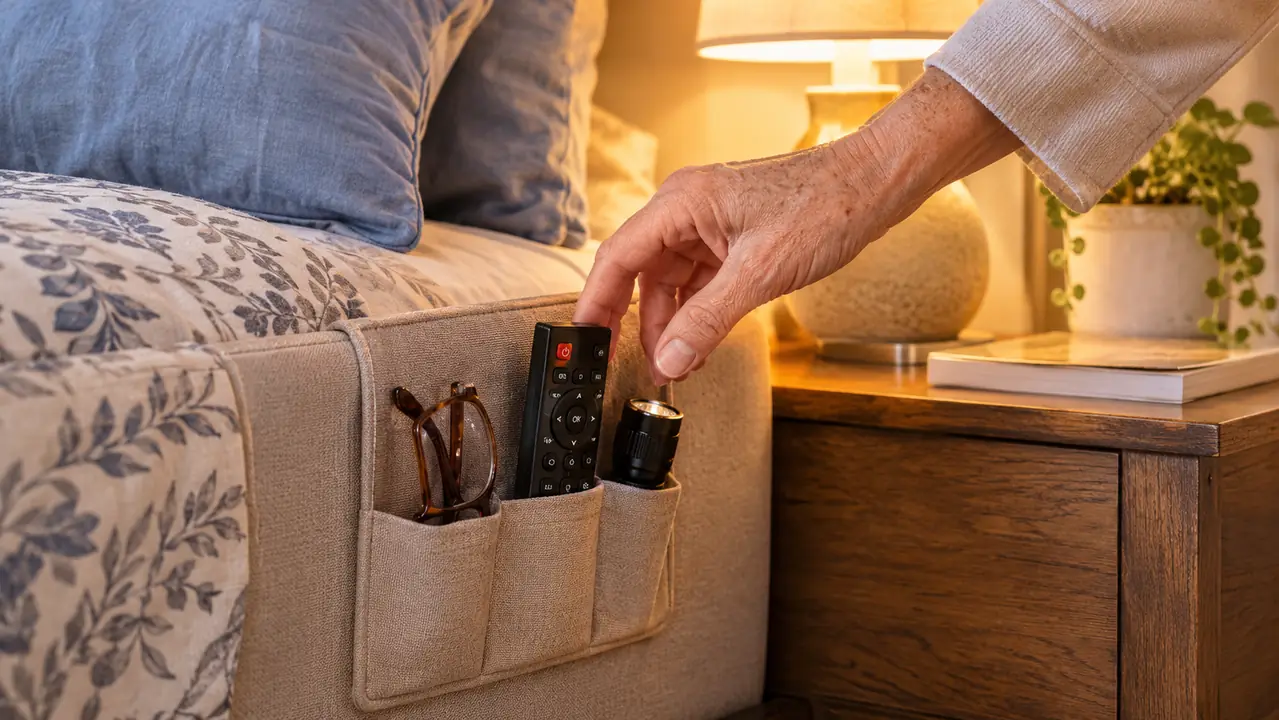
The Medline bed assist bar is height adjustable, slides under the mattress on non-articulating beds, and has a nylon storage pocket for glasses, a remote or a flashlight. It wipes clean with a damp cloth and weighs 6.4 pounds, so you can carry it upstairs and reposition it yourself.
Amazon Check Today's Price on Amazon →One plain thing before the steps. I spent thirty-one years beside doctors and physical therapists in an outpatient clinic, which means I know how to set up equipment and I know what I do not know. I am not your nurse. Ask your own doctor or physical therapist whether a bed rail suits your situation, especially if balance, confusion or nighttime wandering is part of the picture.
Step 1: Measure the bed before you shop
Start with a tape measure against the side of the bed and two numbers: floor to the top of the mattress, and the thickness of the mattress itself. Write both on the back of a receipt and take it with you. The Medline bar is listed at 27.5 by 14 by 43.75 inches overall and weighs 6.4 pounds. Those numbers tell you two useful things. It has to clear your mattress height at the upper end, and at 6.4 pounds you can carry it up a flight of stairs and shift it a few inches without waiting for help.
The second thing to check is the bed itself. This style of bar is made for non-articulating beds, the plain ones where the mattress sits flat and stays flat. If your bed has a remote and the head section rises, the frame moves with the mattress and the bar moves with it, so this is the wrong tool and you should ask an equipment supplier what fits an adjustable bed. Samira's bed is a plain double in the downstairs room, which is one of the reasons this worked so well for us.
The third thing is the floor under the bed. The weight of the frame rests on the base that sits under the mattress, and it holds best when the bed is not going to slide. Our old colonial has hardwood upstairs and down, and a plain bed on hardwood is fine. A bed on casters that rolls when you push it needs those casters locked before anyone leans on anything.

Step 2: Set the height before the bar goes under the mattress
Adjust the height while the bar is still on the floor or leaning against a wall, not after it is buried under a mattress. The adjustment is the entire point of the product, and it is far easier to do in daylight with room to turn the thing over.
Here is the height I aimed for. Samira sits on the edge of the bed with her feet flat on the floor, and the top of the handle comes to roughly where her hand hangs when her arm is relaxed at her side. Not above her shoulder, which makes her reach up and haul. Not down at mattress level, which makes her fold forward to find it. When she stands, the handle sits near hip height, so she can rest the heel of her hand on it and push straight down. Too high and people grip and pull. Too low and they lean over the bar with their feet behind them. Both are worse than no bar at all.
Get a second person to hold the frame steady while you check the height, then lower it and try again. We adjusted ours twice before it felt right, and the second adjustment was about an inch and a half. An inch and a half is the difference between a bar she trusts and a bar she argues with.
Once the height is set, seat the bar and test it yourself before she does. Lean your own weight on the handle from the side she will use, push down, then push down harder. If it shifts at all, the base is not far enough under the mattress. Follow the printed instructions that come with it for the install itself, then recheck the movement with your own hands.
Step 3: Put the handle where her hand actually lands
Position matters as much as height. The bar should sit where her hand lands when she is lying on her side at the edge of the bed, ready to push up, which for Samira is roughly level with her hip and a little toward the head of the bed. Slide it as far under the mattress as the frame allows. The further in the base goes, the more mattress weight presses down on it and the less the whole thing wants to tip when she leans.
Keep the nightstand out of the way. Ours sits about a foot from the side of the bed, far enough that she is not turning toward it, close enough that her glasses are within reach without a stretch. If the nightstand has to move six inches to make room, move it. A rail wedged against furniture is a rail that gets used at an angle, and it will not hold the way it should.
Fourteen months, no falls, and the only thing that changed in that bedroom was a six pound frame under the mattress and a pocket for her glasses.
Step 4: Practice the three-part movement
The movement is the part nobody explains, and it is where a bar either helps or hurts depending on how it is used. Ours goes like this. Roll onto her side near the edge with the knees bent. Push down on the handle with the top hand while the lower forearm takes some weight on the mattress. Swing both legs over the side together, sit up, and stop. Then sit for a count of three with both feet flat before standing, using the bar for balance rather than for lifting.
The rule I keep repeating to her is to push down, not pull in. A bar under a mattress is held there by the weight of the mattress. Pushing straight down drives the base into the floor and it does not move. Pulling the handle toward the chest, or leaning back and hauling on it, lifts the base off the floor, and that is how these things tip. If she catches herself pulling, the height is usually the problem and needs to come down an inch.
We practiced together for a week, in the afternoon, when she was not tired and not in a hurry. Morning is the worst time to learn a new movement, because that is when the stiffness is worst and the patience is shortest. By the second week she was doing it without thinking, and now the only thing I hear at seven in the morning is the television going on.
The first week is the risky one, and it is rarely the bar's fault. It is because a person who has been getting out of bed the same way for eighty years does not remember to reach for a new handle at six in the morning. What helped us was putting the handle where her hand naturally went anyway, then mentioning it every night before bed for a week, right up until it stopped being a reminder.
Step 5: Test it weekly and give the morning a landing place
Once a week, push down hard on the handle with both hands before she gets up. It should feel like part of the bed. If it rocks, something has shifted and the frame needs to go back where it belongs. Check that the base is still well under the mattress and that the mattress itself has not crept. Mattress pads and slippery sheets are the usual culprits. Ours needed repositioning twice in the first month and has not moved since.
The storage pocket is more useful than it sounds. Samira keeps her glasses, the remote and a small flashlight in it, which means she is not leaning over the edge at two in the morning patting the floor for a light. The pocket is nylon and the whole bar wipes down with a damp cloth, which is the only maintenance either of us has done in fourteen months.
One thing to watch in that first month: the bar becoming a place to hang things. A towel, a cardigan, a tote bag. Every one of those turns a firm handle into something that shifts when she grabs it in the dark. We have one house rule, which is that nothing lives on the bar except the pocket and what belongs in it.
What Else Helps
Three other things made the morning safer, and none of them needed a trip to a store. A lamp on the nightstand with a switch she can reach without sitting up, because the worst combination in any bedroom is dark plus hurry. Her slippers placed where her feet will actually land, so she is not bending forward at the exact moment she is least steady. And the KINGGEAR quad cane standing beside the chair by the window, so the walk from the bed to the bathroom starts with the cane already in her hand.
Lighting deserves a second sentence. Samira's room has the nightstand lamp and a small plug-in nightlight by the door, and the nightlight is the one that matters most. It means the room is never fully dark and she never has to feel along a wall for a switch with one hand while the other hand is busy holding a bar.
The other piece is a conversation with her physical therapist. I can tell you what worked in our house. I cannot tell you what is right for your mother's hip, her strength or her balance, and neither can a product page. Ask a professional to watch her get out of bed once. It takes five minutes and it is the most useful five minutes in this entire process.
And one thing I would not do. Do not set a bed bar up as a way to keep someone in bed. A rail used to stop a person from getting up is a restraint, and that is a clinical decision rather than a shopping decision. If confusion or nighttime wandering is part of the picture, talk to her doctor before you buy anything that attaches to the bed.
None of this is complicated. Measure the bed. Set the height low enough that she can push straight down. Put the handle where her hand already goes. Practice the movement when nobody is rushed. Check it once a week. The bar has one job, which is to give her something that does not move during the thirty seconds when she needs it most. Fourteen months in, that is exactly what it does.
Set it up once, then stop thinking about it
Height adjustable, 6.4 pounds, a nylon pocket for glasses and a flashlight, and a damp cloth is the whole maintenance routine. The Medline bed assist bar has been on my mother's bed for fourteen months and has not needed a single repair.
Amazon Check Today's Price on Amazon →