

The first week the quad cane came into this house, my mother carried it more than she used it. She would pick it up at the bottom of the stairs, hold it against her side like an umbrella, walk to her chair, and set it down. She was eighty-five then and had decided the cane was for other people. What changed her mind was not a lecture from me. It was the afternoon she stood up too fast, put her hand on the arm of the sofa, and found it was not quite where she thought it was.
She has used it every day since. Not because she got weaker. Because she got a cane that could stand beside her chair on its own, and because she learned, over a few weeks, where to put it. That is the whole job, really. A quad cane does not steady you by existing. It steadies you when it is the right height, in the right hand, planted in the right spot, on the right surface. The KINGGEAR quad cane in our front hall has been through all of this with her, and the lessons were mostly about the small habits, not the device.
I spent thirty-one years as a nurse in an outpatient clinic, mostly beside doctors and physical therapists. What I know about canes I know from watching therapists fit them, and from watching people bring them back in saying the cane did not help. Almost every time, the cane was set three inches too high. Before you take any of this as your own plan, please have your own doctor or physical therapist look at your fit and your gait, because a cane set up wrong can make you less steady, not more.
The cane that stands up on its own so you are not reaching for it in the dark
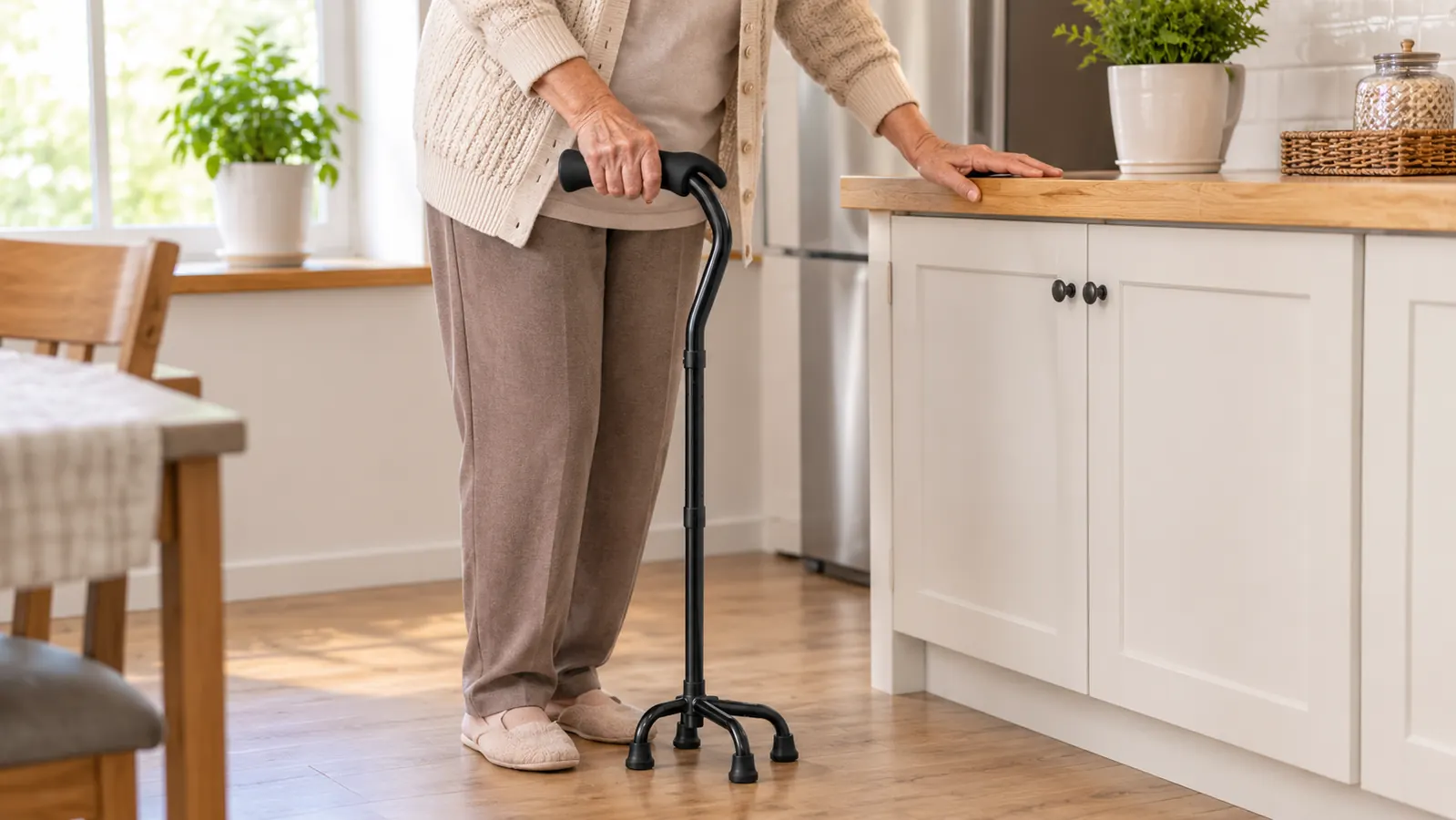
A four-tipped base, aviation aluminum, adjustable from 31 to 36 inches in one-inch steps, and light enough to lift with two fingers. It is the aid my mother keeps beside her chair, and it has held up for eighteen months of daily use.
Amazon Check Today's Price on Amazon →Step 1: Get the height right before anything else
A cane should reach roughly the crease of your wrist when you stand up straight with your arms hanging at your sides and your everyday shoes on. Not your slippers. The shoes you actually walk in. If the handle sits above that crease, you will hunch your shoulder every time you lean on it, and after twenty minutes your upper back will ache and you will start to skip the cane. If the handle sits below it, you will bend forward, and bending forward is exactly the posture a cane is supposed to prevent.
The KINGGEAR adjusts between 31 and 36 inches in one-inch increments with a push button, which sounds fussy until you realize what it is actually for. One-inch steps mean you can go up one notch when you switch from slippers to outdoor shoes, and back down when you switch back. My mother is five foot two. She is on the second-lowest setting, and the difference between that and the next one up is the difference between walking the length of the hallway and stopping halfway.
Have someone help you the first time. Stand with your back against a wall, shoes on, arms down. The helper holds the cane upright beside your right foot and slides the button until the handle meets the crease of your wrist. Then tighten the collar, press the button down hard to make sure it clicks into the hole, and put weight on it. If it slides, it is not locked. Test it before you take a step, every time you change the height.
Step 2: Use it in the hand opposite your weak side
This is the single most common mistake I see. People assume the cane goes in the hand on the sore side, because that is the side that needs help. It is the opposite. The cane goes in the hand on the strong side. If your right hip or right knee is the trouble, the cane goes in your left hand. If your left side is the trouble, it goes in your right.
The reason is mechanical. When you step forward with your weak leg, the cane on the opposite side comes down at the same moment, and together the cane and the strong leg make a wide, stable triangle around your body's center of gravity. That triangle is the whole point. Put the cane in the weak-side hand and you get no triangle. You get a lean.
If both sides are about the same, pick whichever hand feels natural and stay with it. Do not switch back and forth during the day. Consistency matters more than which hand. My mother uses her right hand and always has. I use the same cane with my left when my knee is bad, and I have to think about it every single time, which tells you how automatic the wrong habit can become.
Step 3: Move the cane and the weak leg together
The sequence is simple and it feels wrong for the first week. Cane forward. Weak leg forward, landing at about the same moment as the cane. Strong leg forward, past the cane. Repeat. That is it. The cane and the weak leg are partners. They move as one unit and they land as one unit.
What most people do instead is cane, strong leg, weak leg, which puts the cane out in front like a probe and leaves the weak leg unsupported. Or they plant the cane and then take a big step, which turns the cane into something to lean on rather than something to steady with. A cane is not a crutch. You are not putting your weight on it. You are using it to widen your base and give your brain a reference point, so it stops worrying about falling and lets you walk.
A four-point base changes the feel of this in a way that surprised my mother. A single-tip cane has to be lifted and placed with each step, or it drags. The four tips on the KINGGEAR let the cane stand up between steps, so you are never chasing a moving target. She describes it as the cane waiting for her. That sounds small. When you are eighty-seven and tired, a cane that waits for you is the difference between crossing the kitchen and not bothering.

Step 4: Sit down and stand up without reaching
Most cane injuries in a house do not happen while walking. They happen at the moment of sitting or standing, when the cane is somewhere else and a hand goes looking for it. The fix is to decide, once, where the cane lives at each chair you use. Beside the arm, handle up, four tips flat on the floor. Then it is always in the same place, and your hand learns the reach without your eyes.
To sit down: back up until the backs of your legs touch the chair, keep one hand on the cane, reach back with the other hand for the arm or the seat, and lower yourself slowly. Do not drop. To stand up: slide forward to the edge of the seat, feet flat and slightly under you, one hand on the cane planted a few inches ahead of your foot, the other on the chair arm or your knee, and push up while leaning slightly forward. The cane takes the wobble, the chair takes the weight.
This is where a self-standing cane earns its place. The KINGGEAR stays upright on its four-point base, so when my mother is settled in her chair and reaches for it later, it is where she left it, at the height she left it, handle at the top. A single-tip cane would be on the floor. She would be leaning over to get it. That lean, in a living room with an old area rug, is exactly the motion I do not want her making alone at seven in the morning.
Step 5: Handle the three front steps and the stairs
Our house has three concrete steps up to the front door and a full staircase to the upstairs bathroom, and my mother uses both, slowly, once a day. The rule for the front steps is the cane goes down first and comes up last. Going down, plant the cane on the step below, then step down with the weak leg to meet it, then the strong leg. Going up, the cane stays on the step where you are, you step up with the strong leg, then the weak leg, then bring the cane up.
The stairs are different, and this is not a place for a cane if there is a banister. A banister is bolted to the house. A cane is not. On stairs, use the handrail with one hand and let the other hand steady you against the wall, and take one step at a time with both feet landing on the same step before the next. My mother climbs with the banister and me behind her, and the cane waits at the top of the stairs. If your stairs have no rail, get one. That is a hardware problem, not a cane problem.
On the sidewalk, the four-point base reads uneven pavement better than a single tip, and the cane is light enough to lift with two fingers when she needs to swing it up over a curb. The KINGGEAR weighs about a pound. That matters more than it sounds. A heavy cane gets left in the car.
A cane is not a crutch. You are not putting your weight on it. You are using it to widen your base so your brain stops worrying about falling and lets you walk.
What Else Helps
Clear a path. Not the whole house, just the two routes you actually walk, from the chair to the kitchen and from the chair to the bathroom. Move the coffee table four inches. Tape down the corner of the area rug or take the rug out. My mother's cane caught the edge of ours twice before we lifted it and put a grippy pad underneath. Nobody falls on a clear path.
Get a second pair of eyes on your walk, once. A physical therapist watching you cross a room for ten minutes will see the heel strike, the lean, and the shortened step that you cannot feel yourself doing, and will tell you whether a quad cane is even the right aid for you. Some people do better with a rollator. My mother uses one outdoors on the sidewalk for exactly that reason, and the quad cane indoors where the hallway is too tight for wheels. A cane that is right for the kitchen is not automatically right for the sidewalk.
And check the tips. The rubber feet on any cane wear smooth, and a smooth foot on a hardwood floor is a skating rink. Look at them every few months. If the tread is gone or the rubber is hard and shiny, replace them. Do not wait for a slip to tell you.
Who this is for
This is for someone who needs a little steadiness on one side, indoors, on short familiar walks, and who wants an aid that stands up on its own beside a chair. It is for the person who has been carrying a cane instead of using it, because a cane they do not have to bend over to pick up is a cane they will actually pick up. And it is for the grown children doing the shopping, who are trying to buy something their parent will accept, which is a different problem than buying something that works.
It also suits someone like me, at sixty-three, with a cranky knee that is bad two days out of ten. The KINGGEAR lives in the front hall and I borrow it on those days, and it fits me at a different height setting than it fits my mother, which is the point of the one-inch adjustment.
One cane, two heights, and a base that holds it upright while you get your balance
Adjustable from 31 to 36 inches in one-inch steps, aluminum frame, four-point rubber base, and about a pound of weight. Eighteen months in this house and it still stands beside the chair every morning.
Amazon Check Today's Price on Amazon →