

The first thing nobody tells you about a quad cane is that it is not an upgraded cane. It is a different tool with a different job. If you buy one expecting a single-tip cane with extra feet bolted on, you will spend the first week catching the base on every doorway and the second week leaving it in the closet. I set one up for my mother expecting exactly that, and inside three days she told me it was either going back or I was going to have to teach her how to walk with it.
The cane in our house is the KINGGEAR self-standing quad cane, and it has been here about 18 months. My mother, Samira, is 87. She had a hip replaced two years ago and moved in with me in Worcester, Massachusetts, a few weeks after that. The KINGGEAR is her indoor cane. Outdoors she uses a rollator with a seat, and the two do not compete for the same job, which took me a while to understand. This is the honest version of what I wish someone had put in front of me before we opened the box.
The Quick Verdict
A steady, well-built indoor cane for someone who needs a wide base under the hand on flat floors. A poor fit for stairs, narrow hallways and uneven ground, and the self-standing claim depends entirely on getting the height right.
Amazon Check Today's Price →If What You Need Is a Wide Base That Stays Put on Hardwood
Adjusts from 31 to 36 inches in one-inch steps, folds to 31 inches, and holds up to 300 lbs. Measure your wrist crease first, then match it to the range.
Amazon Check Today's Price on Amazon →How I've Used It
Samira uses this cane every day, between her bedroom in the downstairs guest room, the half bath, the kitchen and her armchair. I use it on bad knee days when my right knee is swollen, which happens more in February than in July. I have mild arthritis in that knee and I was not the person this cane was bought for, but I have put a few hundred trips on it myself, so I know what it feels like when you actually lean on it.
What I can describe is the last 18 months in this house. Three front steps. Hardwood floors throughout, with one old area rug in the living room that is curled at a corner and has been the subject of more than one family conversation. A narrow hallway between the kitchen and the front room that is barely wider than my shoulders. Stairs to the one full bathroom upstairs, which she climbs once a day, slowly, with the banister and me behind her.
Those are the conditions the cane has to survive. Not a showroom floor. A cane that performs beautifully on a flat display and catches on a rug edge at home is a cane that ends up in the closet, and the write-ups that only describe the showroom floor are the reason people get surprised by the thing they unwrap.
The first week was bad. She caught the base on the door frame of the half bath three times in two days and told me she hated it. What changed was the height. I had set it too high, because too high feels safer when you are the one doing the setting, and too high made her reach forward and hitch. We dropped it an inch, checked it against her wrist crease with her shoes on, and the catching mostly stopped. The cane did not get better. I got the setup right.

What the Numbers on the Listing Actually Mean
The listed range is 31 to 36 inches, and the same listing says it fits someone from 4 foot 9 to 6 foot 1. Those two numbers are related, but they are not the same thing, and mixing them up is the most common mistake I see in cane shopping. The 31 to 36 inches is the length of the cane itself, from the tip of the base to the top of the handle. The height range is a rough translation of that into human bodies, and rough is the right word for it.
The adjustment is a push button and it moves in one-inch steps. One inch is a bigger jump than it sounds like when you are talking about a cane. If 32 inches is slightly too low and 33 is slightly too high, you are going to live with slightly too low or slightly too high, because there is nothing in between. Most canes work this way, so this is not a knock on this one, but it is the reason a cane that gets set up in a hurry is often a cane that has been an inch off for years.
The weight is listed at 1.1 lbs and the aluminum feels like it. I can lift it with two fingers, and more to the point Samira can lift it with two fingers, which matters when she is moving it from the chair to the bathroom door. The listed load capacity is 300 lbs. Nobody in this house needs that, but I have leaned on it with most of my weight while getting out of a low chair more than once, and the frame has not flexed or complained. The four tips are rubber, the handle is foam, and it folds to 31 inches.
The foam handle is a small thing that turned out to matter. Samira's hands are not strong, and the foam is soft enough that she can hold it with a loose grip instead of a fist. It has not split, gone shiny or slid in her hand, and 18 months of daily use is a fair test. If your hands sweat, foam beats a hard plastic grip and loses to a molded one, and I would not argue with anyone who prefers the latter. On this cane it has been fine.
The fold is worth one sentence. At 31 inches folded it fits across the cargo area of my Forester and behind the passenger seat, and it stands in the front hall closet without falling over. It does not fold small enough for a handbag and it is not meant to. If you want something that disappears into a tote, this is not that thing.
The Self-Standing Claim, Tested on Real Floors
The cane stands on its own. That is the feature the whole product is built around and it is why we bought this model instead of a plain quad cane. Whether it actually stands comes down to two things: all four tips flat on the surface, and a height setting that lets the base sit level. Get either one wrong and it leans.
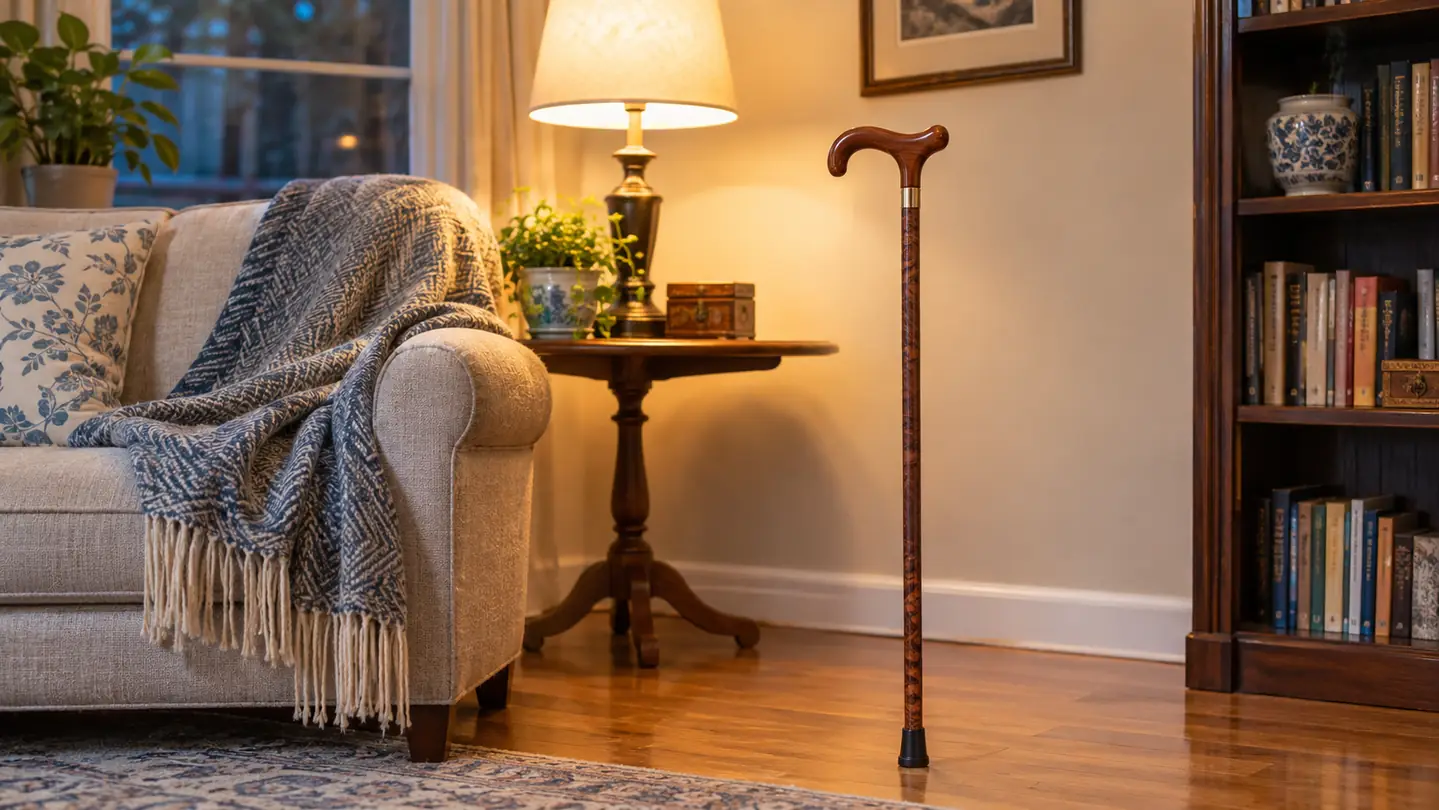
On the hardwood in the front room, it stands. It stands beside her armchair all night and in the morning it is still standing, which matters more than it sounds like it should. My mother gets up twice a night. A cane that has fallen over is a cane she has to bend down and pick up in the dark, and at 87 that is a worse risk than the one the cane was bought to solve. That single behavior, standing there overnight, is the reason this model stayed in the house after the first week.
On the area rug it is less reliable. The rug has pile and it is not flat, so one tip settles lower than the others and the cane leans. On the tile in the half bath it stands well. On the front steps, no. On grass, no. On a cracked sidewalk, no. The base is 4.3 inches wide, which is a real footprint, and a real footprint is exactly what you do not want on uneven ground, because a wide base finds every lump before your hand does.
The four rubber tips pick up grit. Once a week I turn the cane over and dig the little stones out of the tips with a butter knife. Skip that and the cane slides on hardwood, and a cane that slides is more dangerous than no cane at all. That is not on the listing and it should be. It is also the kind of small maintenance job that a person living alone will never think to do, so if you are the grown child in this picture, put it on your own list.
One more note on surfaces. Wet tile is the one to watch. The half bath floor gets slick after a shower, and the rubber tips are good on it but they are not magic. We keep a towel down until the room dries. If your bathroom floor is smooth and there is no mat, get the mat before you get the cane.
KINGGEAR lists a lifetime guarantee on the cane. I have not had to test it. Nothing on this cane has failed in 18 months of daily use, and I am not going to pretend I know how the company handles a claim. The push button has stayed firm, the foam handle has held up, and the rubber tips are worn but intact. If something does give out, I will find out how good that guarantee is the same way you would.
What I Liked
- Stands on its own on flat flooring, so it is upright beside the chair or bed in the morning
- Adjusts 31 to 36 inches in one-inch steps with a push button that has not loosened in 18 months
- Light aluminum frame at a listed 1.1 lbs, easy to lift and hand from one person to another
- Rated to 300 lbs, which covers most adults with room to spare
- Foam handle has not split or gone shiny with daily use
- Folds to 31 inches for the car or a closet
Where It Falls Short
- The 4.3 inch base catches on thresholds, baseboards and the curled corner of a rug
- Useless on stairs and poor on grass, gravel or a heaved sidewalk
- The four rubber tips collect grit and have to be cleaned out or the cane slides
- One-inch adjustment steps leave some people between sizes
- Wide base is awkward in a narrow hallway, so it gets dragged rather than lifted
A cane that has fallen over is a cane she has to bend down and pick up in the dark, and at 87 that is a worse risk than the one the cane was bought to solve.
Where a Quad Cane Is the Wrong Tool
On stairs, this cane is useless, and I want to be blunt about that. You cannot put a four-tip base on a stair tread and you should not try. Samira climbs the stairs once a day with her right hand on the banister and me a step behind her. The cane stays at the bottom. If the stairs in your home are part of the daily route and the banister is your only support, the answer is a second handrail, not a wider cane.
Outdoors, the wide base is a liability. It finds every crack in the sidewalk, every lip on a curb, every piece of gravel on the driveway. That is the trade. The footprint that lets it stand up in the front room is the same footprint that makes it catch. This is why she uses the rollator for her morning walk to the end of the street and back. The rollator rolls over the sidewalk instead of catching on it, and it has a seat for the halfway rest.
Inside, there is one spot where it is genuinely awkward. The hallway between my kitchen and the front room is narrow, and the base clips the baseboard if she does not lift it cleanly. She has learned to pick it up a little higher than she would a single-tip cane. A visitor will not. The first thing a visitor does with this cane is drag it, and the second thing is apologize.
Getting into the passenger seat of my Forester takes a small choreography. She sets the cane against the door, sits down first, and then I hand it in to her. If she tries to hold it while she swings her legs in, the base catches the sill. It is a five-second thing, and it is the kind of five-second thing a person living alone has to solve in advance, because there is nobody at the door to hand it in.
What Nobody Tells You About Fitting It
Fit is not a detail. Fit is the whole thing. The standard way to set a cane is to stand up straight in the shoes you actually wear, let your arms hang, and have someone mark where the crease of your wrist falls. The top of the handle goes at that mark. Not at your hip, not at the top of your leg. At the wrist crease.
Two things ruin that measurement. The first is doing it in slippers and then wearing shoes out, which changes your height by half an inch and quietly ruins the fit. The second is setting it once by eye and never checking again. We check Samira's every few months. The numbers on this cane are stamped clearly enough to read and the height does not drift on its own. People do.
Two more points belong here. If you have one weak side, the cane goes in the hand opposite the weak side, not the same side. And if you are being fitted after surgery or after a stroke, get the fitting from a physical therapist, not from me and not from a listing page. I spent 31 years in an outpatient clinic beside doctors and physical therapists, and the most reliable thing I learned is that cane height is worth ten minutes of a professional's time. Ask your own doctor or physical therapist about your fit and about how much weight you should be putting through the cane. I cannot answer that for you and neither can a review.
Who This Is For
This cane is for someone who needs steadier support on flat indoor floors and who wants the cane upright and ready when they reach for it. That is my mother exactly. She is unsteady for the first ten steps after she stands up, she is fine once she is moving, and the wide base under her hand is the difference between a confident walk to the kitchen and a shuffle along the wall.
It is also a reasonable second cane for someone who already has a single-tip cane for outings and wants something more planted for the bathroom, the kitchen and the trip to the car. The rule I have come to believe is simple. If the cane needs to stay upright on its own, get the quad base. If you can lean a cane against the wall and pick it up an hour later, a single-tip cane is lighter, faster and much less likely to catch on things.
Who Should Skip It
Skip it if stairs are part of your daily route. Skip it if most of your walking is outdoors, on grass, gravel or a sidewalk with heaves in it. Skip it if the hallways in your home are narrow enough that you turn sideways to pass. Skip it if a physical therapist has fitted you with something else, because their measurement beats anything you read here, including mine.
And skip it if the real problem is getting out of a chair or out of bed. A cane is a walking aid. It is not a lever for standing up, and leaning hard on a cane to rise is how canes tip and people fall. If that is your situation, the conversation you want to have is about a bed rail or a chair with arms, not about the number of tips on the bottom of a cane.
The One We Kept, 18 Months Later, Still Standing Beside Her Chair
Folds to 31 inches, adjusts 31 to 36 inches in one-inch steps, holds up to 300 lbs. Check the height range against your own wrist crease before you order, and ask your physical therapist if you are unsure.
Amazon Check Today's Price on Amazon →