

Here is the short version, because I suspect you are skimming for it. The Drive Medical tub transfer bench is a plastic seat on an aluminum frame, and it solved a problem in this house that nothing else solved. My mother, Samira, is eighty-seven. She had a hip replaced two years ago and moved in with me that same month, into a 1950s colonial with one full bathroom upstairs and a tub she could no longer step over. The bench went into that tub during her first week here. She has used it every other day since, and she has not stepped over the tub wall once.
What nobody tells you is that the bench is the easy half of the decision. The bench itself is simple, it goes in, and it works. The hard half is your bathroom: the width of the room, the height of the tub wall, where the door swings, whether the shower head is on a hose, and whether the person using it has somewhere steady to put a hand. I have watched families buy the right aid and then leave it standing in a hallway because the room would not cooperate. That is the review I want to write for you, not a spec sheet.
The Quick Verdict
A simple, sturdy bench that removes the step into the tub entirely. It will not fix your shower head, your grab bars or your floor space, and it was never meant to.
Amazon Check Today's Price →The bench that took the step out of her morning
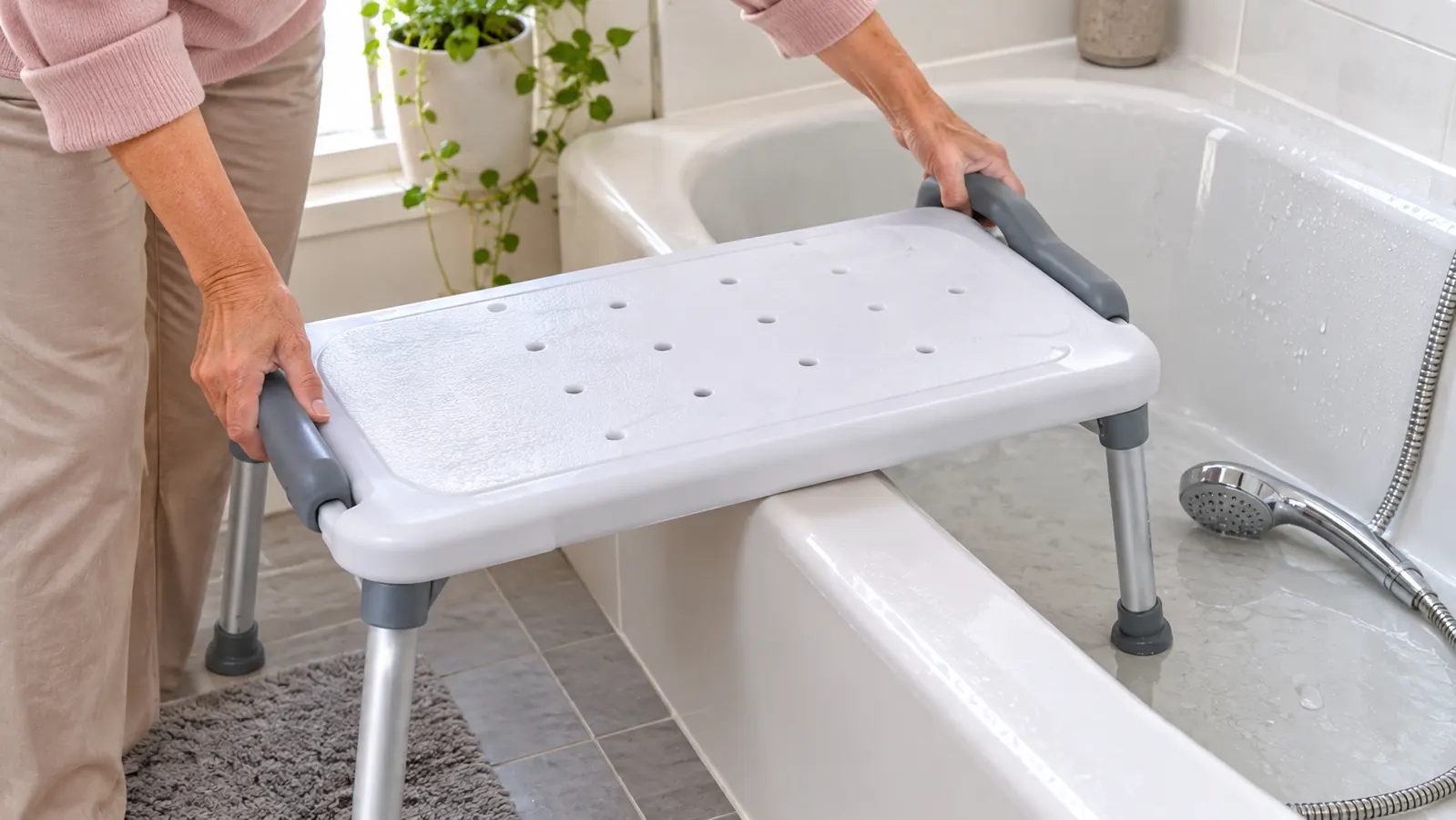
Part of the seat over the bathroom floor, part over the tub, and room to sit down before you slide across. Same bench, every other day, for two years.
Amazon Check Today's Price on Amazon →What Nobody Tells You Before You Buy One
The first thing nobody tells you is that a transfer bench is not a shower chair with a longer seat. A shower chair sits inside the tub or the shower stall, and you step in first, then sit. A transfer bench lets you sit down on dry floor and move across. If the person you are caring for can still step into a tub with one hand on something solid, a shower chair is simpler and takes up less room. If they cannot, a bench is the entire point.
The second thing is that the bench only works if the bathroom is arranged for it. Ours is a small upstairs bathroom with the tub along the far wall. When the bench is in place, the seat occupies the near half of the tub. That means Samira sits down outside the tub, lifts her legs over the wall one at a time, and slides across. There is no graceful way to do that in a bathrobe, and I want you to know it before you buy, because the first week is clumsy for everybody and it is not the bench's fault.
The third thing is that most households need one more piece of equipment than they planned on. The bench gets a person into the tub. It does not help them stand back up from a low plastic seat, and it does not give them anything to hold. We added a handheld shower head the same month, and I spent the first several weeks standing just outside the curtain with a towel over my arm, because Samira did not want to be helped and I did not want her to fall. Both of those are honest parts of the picture and neither one is in the product listing.
How We Actually Use It
Samira showers every other day. The routine has not changed in two years. She sits on the bench with her feet still on the bathroom floor, swings one leg over the tub wall, then the other, and slides across until she is centered on the seat. I hand her the shower head. She washes herself. When she is done, she slides back, puts her feet down on the floor, and stands. The whole thing takes about twenty minutes and she does it without me touching her, which matters more to her than any safety feature I could name.
The seat height is the detail that makes that routine work. The bench adjusts from about 17.5 inches off the floor to about 22.5 inches, and Samira's is set near the low end, because she is not tall and she wants her feet flat on the tile when she sits. The measurement that matters is not bench height by itself. It is bench height compared with the height of your tub wall. If the seat sits well above the wall, the slide across becomes a small drop and it feels unstable. If the seat sits level with the wall or slightly above it, it feels like sliding along a counter.
One thing I would tell anyone setting this up: get the height right before the first shower and then leave it alone. Ours took an evening of adjusting, sitting, adjusting again. All of the legs have to land level or the seat rocks, and a rocking seat is worse than no seat. I did it with my brother Karim on a Sunday, one of us holding the seat steady while the other worked the legs. If you are doing it alone, plan on it taking twice as long and be patient with it.
The Fit Question That Decides Everything
The bench measures 23 inches wide and the seat is 15.5 inches deep. Our bathroom is narrow enough that the bench eats most of the walking space between the tub and the vanity, so anyone coming in afterward walks sideways. That is a real cost and I will not pretend otherwise. Before you buy, put a tape measure across the floor where the bench will sit. You need the full 23 inches plus room for a person to stand at the end of it and turn around. A bench that fits the tub but leaves nobody room to stand is a bench that gets used once.
Then measure the tub wall. The bench straddles it, with part of the seat over the bathroom floor on the outside and part over the tub on the inside. That only works if the wall is low enough that a person can lift a leg across while seated. Samira manages it. A friend of ours has a deeper soaker tub and the same bench, and she has told me she wishes she had measured first, because her wall is high enough that getting her legs across takes real effort. Nothing about the bench is wrong in that house. The bench is simply being asked to do a job the tub makes hard.
The other fit question is the floor inside the tub. Bathroom floors slope slightly toward the drain, and a bench with legs can end up with one leg carrying less weight than the others. Ours sits steady because I checked it with weight on the seat, not empty. I sat on it myself, more than once, before I let my mother near it. If you are setting one up for a parent, do that. Sit on it. Shift your weight. If it moves, adjust a leg.
Weight, Frame and the Fine Print
The Drive Medical bench is rated to 350 pounds. The frame is aluminum and the seat is plastic, and the whole thing weighs about 10 pounds, which means one adult can carry it but not comfortably around a corner. It comes with a limited lifetime warranty, which is the sort of thing that matters less than it sounds, because the failure you worry about is not a warranty failure. It is a leg that works loose after three years of daily use. What protects you there is checking the legs every few months, not the paperwork.
At 10 pounds it is light enough to lift out of the tub for cleaning and heavy enough that I would not ask Samira to do it. I take it out about once a month, scrub the seat, and set it back. In two years nothing has cracked, nothing has rusted, and no leg has needed more than a quarter turn to tighten. That is the honest durability report: not impressive, not fragile, just steady. For a piece of plastic and aluminum that lives in a wet room, steady over two years is a good result.
Before the bench we tried the obvious things. A plastic stool inside the tub, which required stepping in. A towel on the floor and a chair by the door, which required standing to wash. A hand held on my forearm, which required me to be home every time. None of those is stupid, and all of them put the step back in the middle of the routine. The bench works because it removes a movement instead of adding support. That is a different idea from most bathroom safety gear, and it took me a while to appreciate it.
What I Liked
- Removes the step over the tub wall entirely, which is the whole reason to buy one
- Height adjusts from about 17.5 inches to about 22.5 inches, which covers most tub walls and most people
- Rated to 350 pounds and stayed steady under daily use for two years
- Light enough at 10 pounds for one adult to lift out of the tub for cleaning
- Simple enough that a caregiver can set it up in a single evening
Where It Falls Short
- 23 inches wide, so a narrow bathroom loses most of its walking space
- The plastic seat gets cold and hard, and a towel over it is not optional in winter
- Water pools on the flat seat and it needs wiping down after every shower
- The legs have to be level or the seat rocks, and getting there takes patience
- It does nothing about standing up, so most households need a wall bar or rail too
Where It Genuinely Frustrates Me
The seat is cold. That sounds like a small complaint and in July it is. In January, in a house in Worcester, a plastic seat in an unheated bathroom is a genuine disincentive, and there were mornings when Samira delayed her shower because of it. We solved it with a folded towel laid over the seat while she undresses, then moved aside. If you buy this bench, buy a second towel for the bathroom and keep it there. It is a silly fix for a real problem and almost nobody mentions it in the reviews.
The second frustration is water. A flat plastic seat holds a puddle, and the puddle is under the person, not beside them. After every shower I wipe the seat down with the towel and drape it over the tub. Skip that and the seat stays wet until the next person comes in. It is not a design flaw exactly. It is what a flat seat does. But it means the bench adds one small chore to every shower, and I would rather you heard that from me than discovered it on a cold morning.
The bench did not make her safer by being clever. It made her safer by taking a step out of her day, and she has not taken that step in two years.
The third frustration is the one I feel most. The bench does not help Samira stand. She sits down easily and stands by pushing off the tub wall with one hand and the edge of the seat with the other, and that works, but it is the part of the routine where I watch her closely. If your parent has weak arms or a bad shoulder, budget for a wall bar beside the bench on the same trip to the store. The bench gets them in. Something else has to help them out.
What It Does Not Do
It does not replace a shower chair you already have and like. If the person bathing can step into the tub with a hand on something solid, a chair inside the tub is simpler and takes up less of the room. The Drive Medical bench earns its space only when the step itself is the problem. That sounds obvious. It is surprising how many people buy the bench first because it looks more serious, then find they have brought more furniture into a small bathroom than they needed.
It does not fix a bathroom that is genuinely unsafe. If the floor is slick, if the only light is a single bulb over the mirror, if the toilet is two feet from the tub and there is nothing to hold between them, the bench is one piece of a larger job. I would rather say that plainly than sell you a seat and let you think the room is handled. Ask your own doctor or physical therapist what the person you are caring for actually needs, because that answer changes with shoulders, hips, balance and pride.
Who This Is For
This bench is for a household where someone cannot step over the tub wall anymore, and where the bathroom has 23 inches of floor to give and a tub wall low enough to swing a leg across. It is for the person who wants to keep bathing themselves and is willing to be clumsy about it for a week while they learn the slide. It is for the caregiver who would rather stand outside the curtain than lift a person out of a tub. Two years in, that is exactly what it has done here, and I would buy it again tomorrow.
Who Should Skip It
Skip it if your tub wall is high, if the bathroom is too narrow to stand at the end of the bench, or if the person bathing can still step in with one hand on a bar. Skip it if the real problem is standing up rather than getting in, because a bench will not touch that. And skip it if nobody in the house can lift 10 pounds and set the legs level, because a bench that is not set up right is worse than the tub. Ask your physical therapist what the limiting step actually is before you spend anything.
Two years, one bench, no step over the wall
The Drive Medical tub transfer bench has lived in our upstairs tub since Samira moved in. It is not clever and it is not pretty, and it is the reason she still showers herself.
Amazon Check Today's Price on Amazon →