

My mother, Samira, walked to the end of our street and back every morning for as long as I can remember. Two years ago she had a hip replacement, and for a while the hospital-issue two-wheel walker was all she had. It was safe. It was also slow, and it had nowhere to sit, and by the time she reached the corner she was finished for the day. We bought a Drive Medical rollator walker with seat about twenty months ago, a few months after her surgery. It is the reason she still makes that walk.
I spent thirty-one years as a nurse in an outpatient clinic, so I have fitted a lot of people to a lot of aids, and I have watched plenty of them end up in a closet by the second month. What follows is the plain list I would give a friend: ten things the seat and the four wheels actually change, and one thing I would skip. Ask your own doctor or physical therapist about fit before you buy anything, including this.
The seat is why she still walks to the corner
Four wheels, a back support that folds away and a seat at the halfway point. Check the height range against your own measurement before you order.
Amazon Check Today's Price on Amazon →She can sit down in the middle of the walk
Our street has no benches. Halfway to the corner, where the mailboxes are, Samira stops, turns the rollator around, sits and rests for two or three minutes. Then she gets up and finishes. Before this, the same distance took everything she had and she started skipping days. The seat is not a comfort feature to me. It is the reason the walk is a round trip instead of a trip she slowly stops taking.

Standing in line stops being the hard part
The pharmacy queue and the minutes before church are both standing tests. She used to lean on the counter and hope the line would move. Now she turns the rollator, sits down and waits her turn like anyone else who found a chair. At church she arrives early and sits on it in the aisle until the pews open up. It sounds small. It decides whether she agrees to go at all.
Four wheels keep up with a normal walking pace
A two-wheel walker has to be lifted and set down with every single step. Over a hundred feet that is a lot of lifting. The rollator rolls, so her arms do less and her legs do the work, which is exactly what her physical therapist wanted. The 7.5 inch wheels clear the seam where our walk meets the street and the mats at the pharmacy door without me tipping the front end up for her first.
It folds flat into the back of a Forester
It folds, and that is the whole reason it goes anywhere. Folded, the Drive Medical rollator fits in the cargo area of our Forester with room left for the groceries, and the item weight is 20 pounds, which I lift with one hand and Samira manages with two on a good day. Sunday visits with my brother Karim, the church lot, the pharmacy run, all of it works because the thing collapses flat and comes back up in seconds.
The height adjusts to the person, not the reverse
The handles move up and down on a height adjustment lever, and that is not a small detail. The listing puts the maximum height at 35 inches and gives a minimum height recommendation of 59 inches for the user. Samira is set so the handles land at the crease of her wrist when she stands straight, which is the rule of thumb we used in the clinic. Yours may be different. Have your physical therapist check it once.
A steel frame rated to 350 pounds on a 20 pound rollator. It holds her when she sits down and it still goes in the back of the car.
The back support folds up and lifts off
Most of the time the back support stays up and she leans against it. When we fold the rollator for the car, folding the back down buys the inch that lets it sit flat instead of at an angle against the seat. If someone else in the house wants to sit forward and turn while they are on it, the back lifts off entirely. Five seconds of adjustment, repeated every week, adds up.
It does not flex when she leans on it to stand up
The frame is alloy steel and the weight capacity is 350 pounds. Samira is nowhere near that number, and that is the point. When she puts both hands down and pushes herself up off the seat, the frame does not rock or shift under her. I have watched people stand from a light rollator that moved, and the flinch that follows is hard to undo. A frame with margin in it earns the extra pounds.
It looks like a walking aid, not a hospital prop
Samira hates anything that looks like a hospital. She refused the two-wheel walker in public and would not take it into church. The rollator reads as equipment for someone going somewhere, not a patient being moved from room to room. She takes it to the pharmacy and to church and does not complain about being seen with it. That sounds like vanity. It is the difference between an aid she uses and an aid in the closet.
It lives folded by the front door, ready in seconds
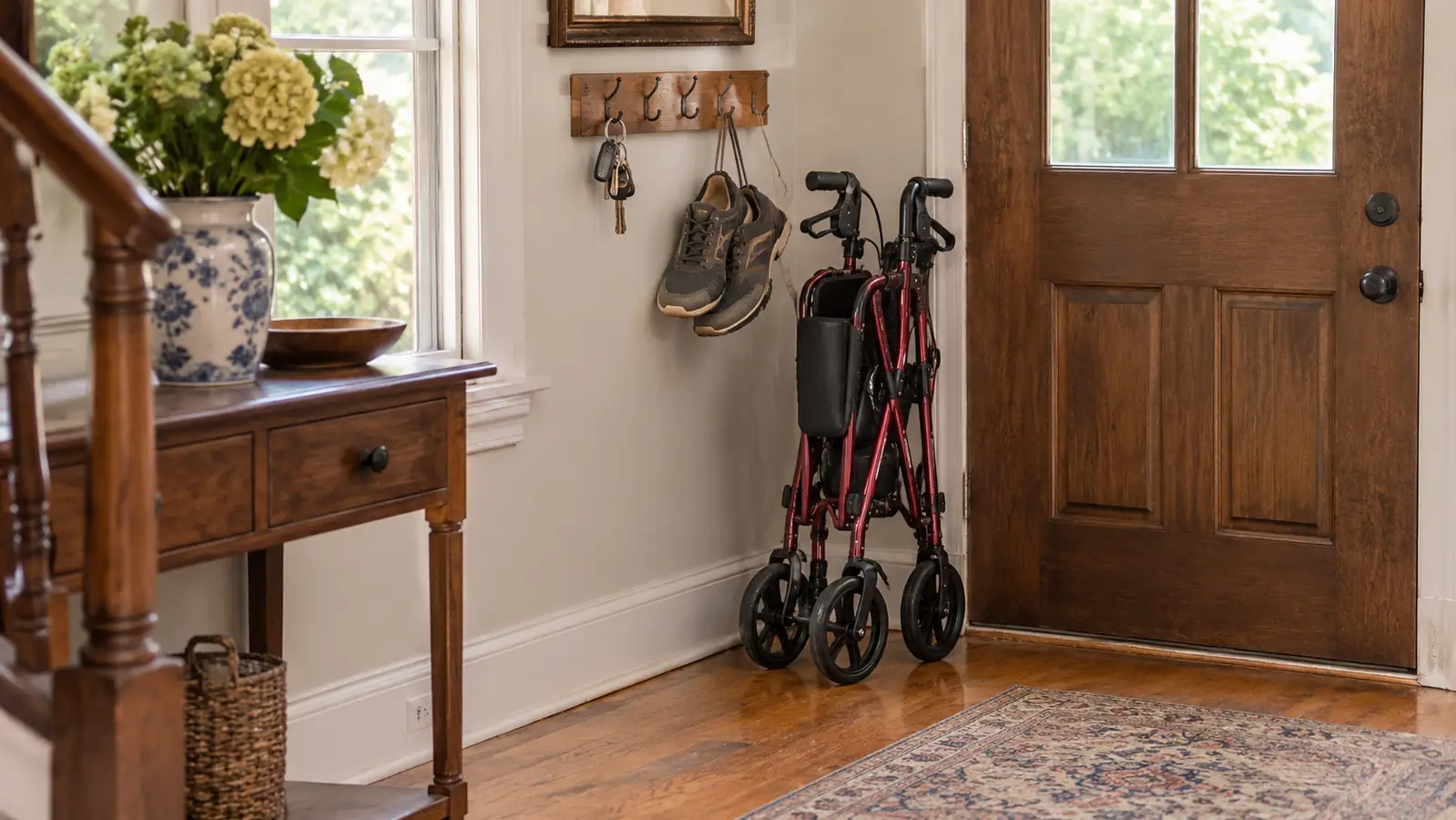
I will be honest about the indoors. Our downstairs hallway is too tight for four wheels, so inside the house she uses her quad cane and the rollator stays folded in the front hall. That suits me, because this is the outdoor aid and it needs to be grab and go. Folded beside the door, the Drive Medical rollator opens in a few seconds and she is out on the sidewalk before I have my shoes on.
The limited lifetime warranty means we shopped once
The Drive Medical listing carries a limited lifetime warranty, which in a house that has already replaced a washing machine this year is a real consideration. Twenty months of daily use and nothing has loosened, rattled or needed a part. Aid shopping is tiring, and doing it twice because the first one fell apart is worse than paying attention the first time. This one, so far, has not asked anything of us.
What I'd Skip
I would skip any rollator you cannot adjust. A fixed height frame is cheaper up front and it is the reason so many of them end up in a garage with a layer of dust on the seat. I would also skip the idea that this replaces a cane indoors. In a tight hallway it does not, and if you buy it expecting that, every tight turn will feel like a failure. And I would skip ordering before someone measures the handle height against the person who will actually use it.
One more honest note. If the person you are shopping for never stops on a walk and has steady balance, a plain rollator without a seat is lighter to lift in and out of a car, and lighter matters every single trip. The seat is for the person who needs the rest, and Samira needs it. Buy for the body in front of you, not the one in the catalog photo, and let them try it in the hallway before you go anywhere near a sidewalk.
Twenty months, one walk a day, no falls
If someone in your house has stopped going out because there is nowhere to sit down, start here. Measure the handle height first, then take the Drive Medical rollator out on a quiet street.
Amazon See the Drive Medical Rollator on Amazon →