

Here is the short answer, because most people asking this question are standing in a clinic hallway with a catalog in one hand and a discharge sheet in the other. A standard walker is the right tool when the job is getting from a bed to a bathroom and back, on a floor that does not change. A rollator is the right tool when the job is leaving the house. They are not two versions of the same product competing on quality. They solve different problems, and plenty of families end up owning one of each before they are finished.
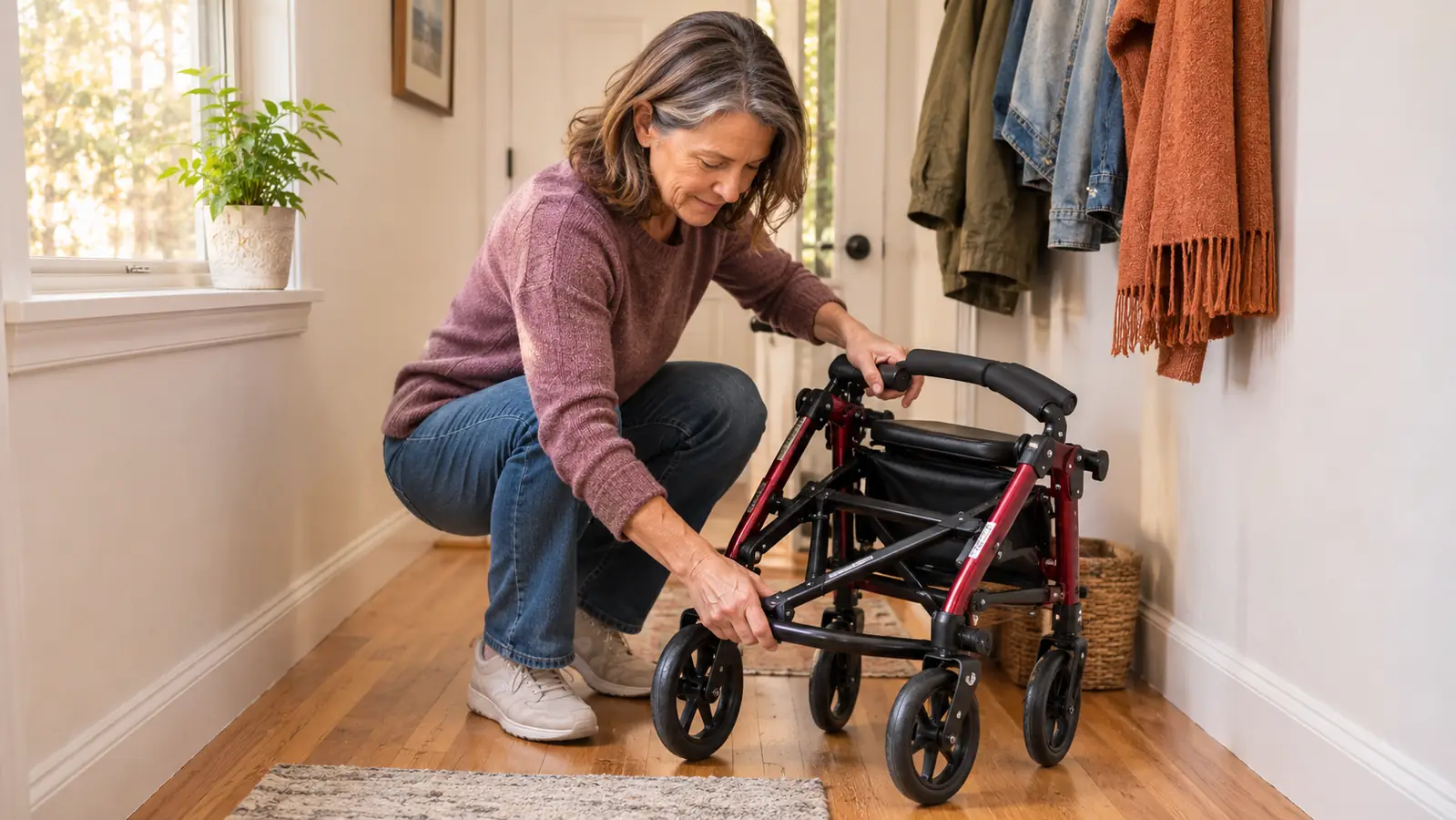
A standard walker is the aluminum frame that comes home from the hospital: two small wheels at the front, two rubber-tipped legs at the back, no seat, no brakes, and your hands doing the work of stopping it. The Drive Medical rollator walker with a seat is a different animal. Four wheels, hand brakes at both grips, a padded seat, a backrest that folds up and lifts off, and a frame that folds flat enough to lie in the back of a Subaru Forester. We bought the Drive Medical rollator about twenty months ago, a few months after my mother's hip replacement, when the hospital-issue walker started to feel slow on the sidewalk. I have watched her use both since. Neither one is better. One is better for a specific job.
I spent thirty-one years as an outpatient clinic nurse in Worcester, Massachusetts, most of it beside physical therapists who fitted walkers and canes all day long. So I am fussy about the details that get skipped on a product page: handle height, footprint, weight, and what a person does with her hands when the pavement tilts. What follows is what I have watched in my own front hall, not medical advice. Fit is individual, and your own doctor or physical therapist should have the last word on which aid is safe for you.
| Drive Medical Rollator with Seat | Standard Two-Wheel Walker | |
|---|---|---|
| Resting halfway | Padded seat and a backrest that folds up, so one long walk becomes two short ones | No seat. You rest against a wall, a fence or a parked car |
| Stopping on a slope or at a curb cut | Hand brakes at both grips | Rear rubber tips drag, and your own grip is the only brake |
| Sidewalk cracks and uneven pavement | 7.5 inch wheels roll over tree roots and lifted slabs | Small front wheels catch, and the rear tips have to be lifted over |
| A narrow hallway or a small bathroom | 21.5 inches wide and 25.5 inches deep, which is a lot of frame for a tight hall | Narrower footprint, pivots in place without a three point turn |
| Lifting it into a car | 20 pounds, and it folds flat, but you are still lifting 20 pounds | A fraction of the weight, and nothing to fold |
| The first week of use | Brakes, folding order and turning radius all have to be learned | Pick it up, set it down. Nothing to learn |
| Days when full weight on one leg is not allowed | It rolls unless the brakes are set, which is a lot to ask of tired hands | Stays planted exactly where you put it |
| Weight capacity | Rated to 350 pounds | Usually rated lower, and the number is printed under the frame |
| Warranty | Limited lifetime on the frame | Varies by maker, often a single year |
Where the Drive Medical Rollator Wins
The seat is the entire argument, and it is not a small one. My mother's morning walk goes to the end of the street and back, about a quarter mile on a sidewalk with two curb cuts and a slope at the corner. On the hospital walker she could get out there and not back. With the Drive Medical rollator she sits down at the corner for a minute or two, then walks home under her own steam. That is the difference between an aid she reaches for every day and an aid that quietly keeps her in the house. We learned it the hard way. The first autumn after her surgery she tried the hospital walker to the corner on a Saturday morning, made it as far as the stop sign, and stood holding a telephone pole for four or five minutes before she could turn around. She did not try it again for two weeks. The rollator arrived in November and the walk resumed the same week.
Four wheels also change what counts as walkable. The 7.5 inch wheels roll over the lifted slab near our neighbor's fence and over the roots by the corner, both of which stop the small front wheels of a standard walker dead. The hand brakes are the other half of that confidence. The first week she squeezed too hard and stopped in the middle of the crosswalk with a car waiting. Now she uses them the way you use a brake pedal approaching a stop sign, light steady pressure instead of a grab.
The frame is rated to 350 pounds and carries a limited lifetime warranty, and both numbers matter more than they sound. A person who is unsteady leans hard. She leans on the Drive Medical rollator in a way she never leaned on the hospital walker, because it does not skate away from her hands when she puts weight on the grips. Ours has been folded, unfolded, sat on and hauled in and out of a car for twenty months, and the folding mechanism is still tight. That mechanism gets a workout it was never designed for. She folds it herself most mornings, pulling the frame up by the crossbar rather than using the lever the way the instructions show, and there is still no rattle in it. The backrest, which lifts off for storage, clicks back into place on the first try every time. I expected to be replacing something by now and I have not.
Where a Standard Walker Wins
Our downstairs hallway is about as wide as a doorway plus a hand. I measured it with a tape one Sunday, out of curiosity. Thirty-two inches from wall to door casing, with a radiator on one side that takes another four. The Drive Medical rollator is 21.5 inches wide and 25.5 inches deep, which leaves six inches of room to maneuver, and the rear wheels track wider than the front ones do. Turning it around in that hallway takes a three point turn that my mother will not perform at two in the morning. A standard walker goes in and comes out without a thought. That is the plain reason the rollator lives folded in the front hall and her indoor aid is a quad cane. Had she needed a frame indoors rather than a cane, it would have been the standard walker and not the rollator.
Weight and simplicity are the other two places the simple frame wins. The rollator is 20 pounds. A standard walker is a few pounds of tubing you can lift with two fingers, and there is nothing to fold, nothing to lock and nothing to remember. My brother Karim lifts the rollator into the Forester on Sundays without complaint, but my mother could not do it herself, and that is worth saying plainly. On days when a surgeon has restricted weight on one leg, a frame that does not roll is also the safer choice. That is a conversation for the surgical team, not for a product page.
The Aid That Gets Her Past the Front Steps
If the walk currently ends at the porch because there is nowhere to sit once she gets out there, the Drive Medical rollator with the seat is the piece that changes it. Folds flat for the car, rated to 350 pounds, and the seat is where the second half of the walk begins.
Amazon Check Today's Price on Amazon →The Fit Numbers That Decide It
Drive Medical lists a minimum height recommendation of 59 inches for this rollator, and the handles adjust up to a maximum height of 35 inches. Those two numbers rule people in or out faster than any review can. If the person using it is shorter than that recommendation, the handles will not come down far enough and she ends up hunched over the grips, which is exactly the posture an aid is supposed to correct. The maximum is a ceiling, not a target. Someone tall enough to need the grips near the top will find this frame fine. Someone who needs them higher than 35 inches will end up pushing the rollator along at shoulder height and will hate it inside a week. We set ours once, in the hallway, with her standing in her shoes rather than slippers, checked it against the crease of her wrist, and it has not moved since.
The fit test I used in the clinic: stand up straight with your arms hanging at your sides. The grips should land at the crease of the wrist. Higher than that and the shoulders climb. Lower and the person leans forward and pushes weight through the wrists. Set the handles, have her stand between them, then check the elbow angle. Repeat it after she has walked for five minutes, because everyone stands differently once they are moving.
The folded frame is listed at roughly 31.5 by 24.5 by 10.75 inches and 20 pounds, which is the number that decides whether it lives in the hall closet or in the trunk. Ours fits behind the rear seat of the Forester with groceries on top of it. It also means the rollator is not the aid you carry up a flight of stairs. It stays downstairs. On bath days she climbs the stairs with the banister and me behind her, and the rollator waits at the bottom.
Twenty months, one folded frame in the front hall, and the walk to the end of the street is still part of her morning.

What a Normal Day Looks Like With Each
Morning is the rollator. It comes out of the front hall, gets unfolded at the bottom of our three front steps, and waits while she comes down holding the banister. Then the sidewalk, the two curb cuts, the corner where she sits for a minute, and home again. Church on Sunday and the pharmacy on Thursday follow the same pattern, with the seat used more at the pharmacy because the line is long and the floor is hard. Thursday is the clearest illustration of what the seat is for. The line at the counter runs six or seven deep some mornings and there is not a chair anywhere in that store. She used to send me to stand in it for her, which she hated doing. Now she walks the aisle herself, sits on the rollator seat while I wait at the counter, and stands up when it is her turn. Small thing. It changed the tone of the whole errand.
Inside the house is where the two aids stop competing, because for us neither of them won the indoors. The rollator does not come in. The hallway is too tight and the old area rug in the living room has a lip on it that catches wheels. She uses a cane in the house and the rollator stays by the door. A standard walker would have lived in that hallway comfortably. The cane took that job for us, and the rollator took the outdoors.
The awkward parts are worth naming. The rollator eats floor space in a small front hall. It has to be folded to come through the front door and unfolded again on the porch, which is two extra steps in the rain. And the seat is a resting place, not a chair. She sits on it for a minute or two, never longer, and standing back up from it asks more of her legs than a deep armchair would. That is the trade. You get a place to sit, and you accept that it is a perch rather than a sofa.
Who Should Buy Which
Buy the rollator if the person is leaving the house, if there is a sidewalk, a church, a pharmacy or a neighbor's porch in the picture, and if the current walk gets cut short because there is nowhere to rest. Buy it if she meets the listed minimum height, if she can learn two brakes, and if somebody in the household can lift 20 pounds into a car. The Drive Medical version is a sensible first rollator for that job, and the 350 pound rating covers people the lighter frames do not.
Buy the standard walker if the goal is short trips on one level, if the hallways are narrow, if the person cannot manage brakes or folding, or if a surgeon has restricted weight on one leg. It is also the honest answer when someone is recovering and will not be going out for a few weeks. It is simple to own, simple to learn and hard to get wrong. Many households end up with both, and that is not a failure of planning. It is a corridor aid plus an outdoors aid, and they were never the same tool.
If the Walk Ends at the Front Door, Start Here
The Drive Medical rollator walker with a seat folds into a car, carries a 350 pound rating and a limited lifetime warranty, and puts a place to rest at the halfway point. Set the handles to wrist height, check the fit with her physical therapist, and take the first walk to the corner.
Amazon Check Today's Price on Amazon →