
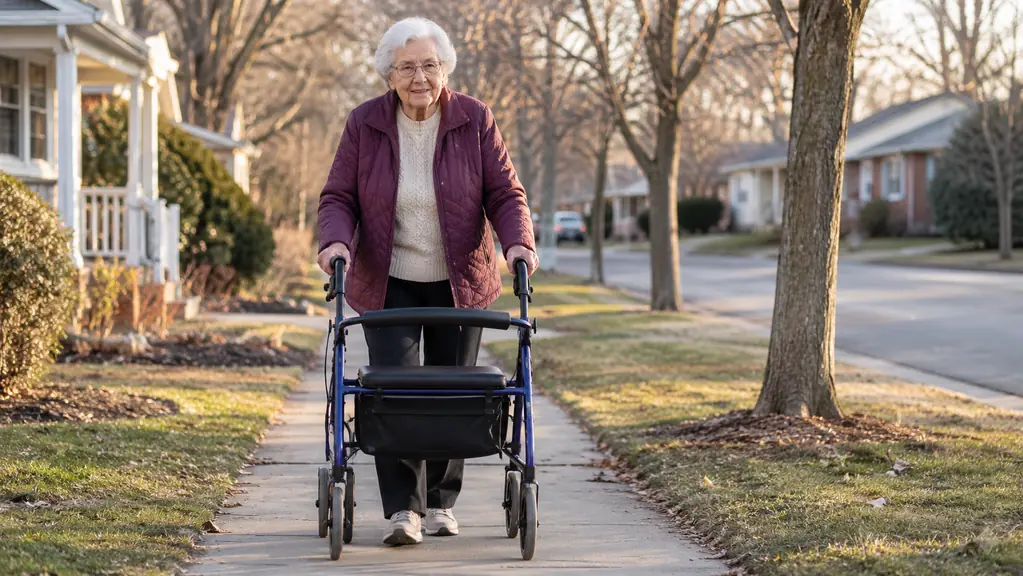
Samira was three weeks past her hip replacement the first time we took the hospital-issue walker out to the sidewalk. She made it about forty feet, stopped, and informed me that this was less a walking aid than a chair with legs. She was not wrong. A two-wheel walker is steady as a stone on a clinic floor and miserable on a cracked New England sidewalk, because you have to lift it, set it down and lift it again while your hip is still knitting.
About twenty months ago we traded it for the Drive Medical Rollator Walker with Seat, and her morning walk to the end of the street and back came back to her. She is 87. The route is flat, a little uneven, roughly a quarter mile round trip, with one corner where the pavement tilts toward the road. What follows is what I would tell a friend who asked how to take a parent outside on wheels without spending the whole walk braced for a fall. I spent thirty-one years as an outpatient clinic nurse. I am not her physical therapist and I am not yours. Fit and use are conversations to have with your own doctor or physical therapist.
Most of what keeps an older adult safe outdoors is not the walker. It is the height of the handles, the route you choose, when you turn around, and how the front steps get handled. Get those four things right and the walker stops being something anyone thinks about. Get them wrong and even a good one feels like a hazard. Here is the order I would do it in.
The aid that matches a sidewalk, not a hallway
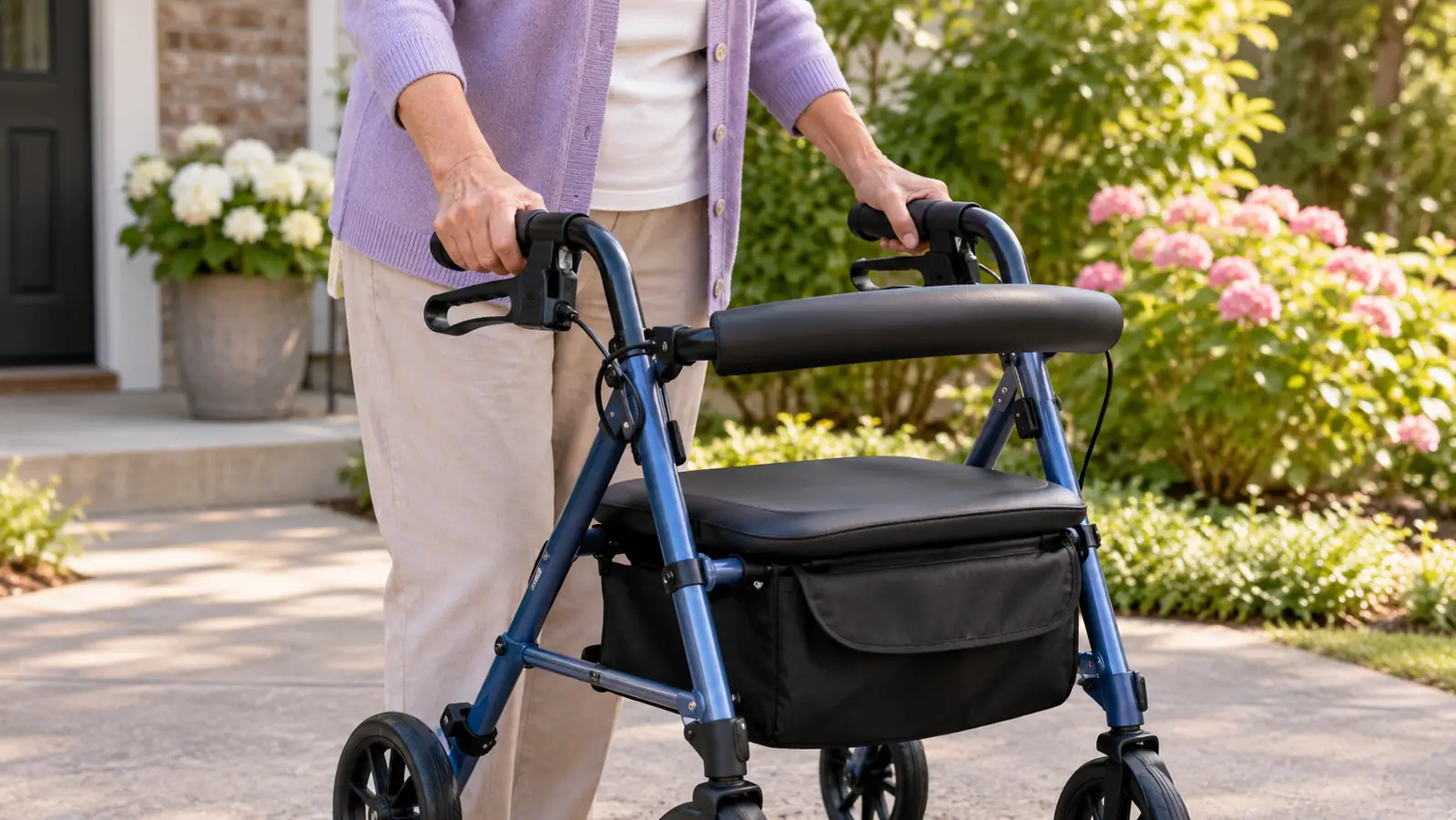
Four wheels, a fold-up removable back support and a seat for the halfway point. Steel frame rated to 350 pounds, handle height that tops out at 35 inches, 20 pounds when you lift it into the car. Samira has used hers nearly every morning for twenty months.
Amazon Check Today's Price on Amazon →Step 1: Set the handle height with her standing in her own shoes
The most common problem I see at the curb is a walker set for somebody else. Loaner equipment gets adjusted once, by a therapist who is not coming back, and then it sits in a garage for six years. Before Samira walked anywhere, I stood her on the hardwood in the shoes she actually wears outside, not slippers, and moved the grips with the height adjustment lever until her hands fell on them naturally.
The check is simple. She stands as tall as she can and rests her hands on the grips. Her elbows should be slightly bent, wrists straight, shoulders down. If she has to reach down or hunch, the handles are low. If her elbows are locked straight, they are high. The Drive Medical walker tops out at 35 inches of handle height, and the listing recommends a user at least 59 inches tall. Samira clears that minimum comfortably and her handles still had room to spare. If your parent is shorter than the minimum, or the grips will not sit where her hands want them, that is a fit problem and the next call is to her physical therapist.
Two more checks while she is standing there. The fold-up removable back support should rest at the small of her back, not push her forward, and it lifts off entirely if it bothers her. And she should be able to rise from the seat without hauling on the frame. Test that in the living room, where a wobble costs nothing, before it matters on a sidewalk.
Step 2: Walk the route yourself, on foot, before she does
The morning I walked Samira's route alone, I found four things I would never have noticed from the porch. A slab lifted an inch by a root in front of the neighbor's hedge. A curb cut that holds water for two days after rain. A stretch where the sidewalk leans toward the road. A storm drain with slots wide enough to swallow a cane tip. None of that is a crisis. All of it turns a stroll into a vigilance exercise if you find it while she is on it.
The wheels help more than people expect. Seven and a half inches of wheel rolls over a lifted slab edge that would stop a small wheel dead, and it rolls over the lip of a threshold too. What it will not roll over is loose gravel, wet leaves, sand washed to the edge of the road after a winter, or a crack running the wrong way across your path. Look at the surface, not the scenery.
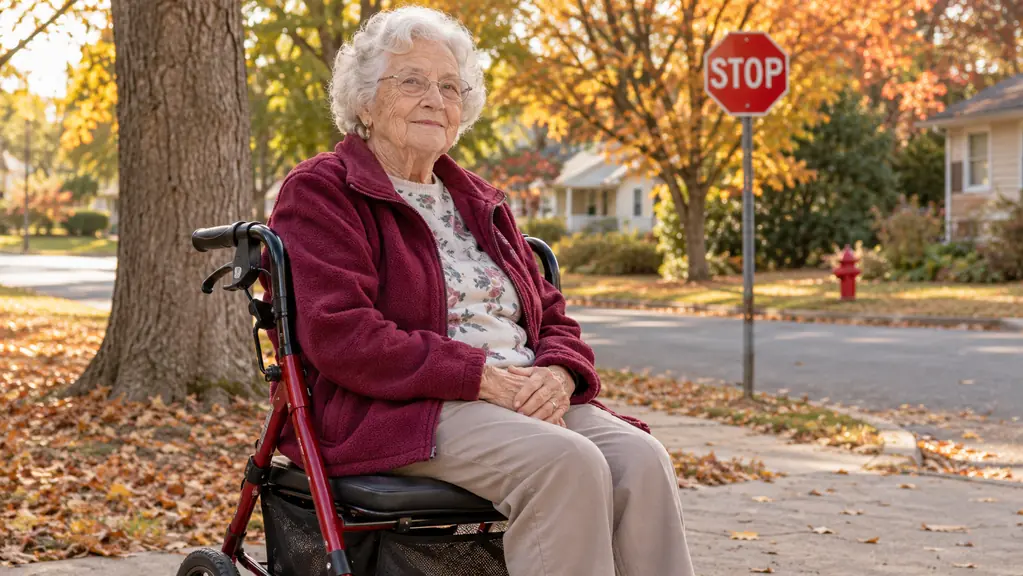
Then pick the resting place. Samira's is the corner with the blue spruce, about a third of the way along. The seat on a rollator is not a luxury and it is not for the end of the walk. It is for the middle, so the rest happens while she is still steady. Someone who sits down for the first time at the far end has already spent everything she had.
Step 3: Turn around before she is tired, not after
The rule I used with patients is the rule I use with Samira: walk out to a fixed landmark and come back, and let the landmark be closer than you think it should be. Around the corner and back took three weeks to earn. Now it is the end of the street, which is what she wanted on day one and what she could not have managed on day one.
Watch for the quiet. On the way out she talks. About two thirds of the way back she stops talking, and that is not rudeness, it is a person spending her attention on her feet. When the talking stops, the walk is over for that day, whatever the landmark says.
Distance builds unevenly. A good week does not mean next week should be longer, and a poor night of sleep shows up on the sidewalk. Twenty months in, Samira still has mornings when she goes to the mailbox and turns around, and I have learned not to make a project out of it.
Twenty months, one rollator, no falls. The changes were small: the handle height, the route, and where she stops to rest.
Step 4: Rehearse the three places people actually go down
Not the open sidewalk. Three places, in my experience: the front steps, the curb and the door threshold. Everything in between is just walking, which she already knows how to do.
Our house is a 1950s colonial with three front steps. A rollator does not go up or down steps, and it should not be carried by the person using it. The routine here is that one of us carries it down folded and sets it on the walk, then Samira comes down holding the railing with both hands, one step at a time, and takes the handles at the bottom. Coming home, it reverses. On Sundays my brother Karim does the carrying. When she is on her own, the walker waits by the door and the walk happens when somebody is there.
The curb is the one worth thinking about ahead of time. Find the ramp, even if it costs twenty extra feet, and never step off a curb with the walker in front of you. Doorways want patience more than technique: go through at a slight angle, slowly, with a hand on the frame, and let the door close behind you rather than holding it open with a foot while the wheels roll.
One word about the seat. On level ground, with the frame open and settled, it is a fine place to sit. On a slope, or half open, it is not. That sounds obvious until you are the tired one.
Step 5: Make leaving and coming home the easy part
The walk does not start at the sidewalk. It starts in the front hall, which is where gear goes to die. Ours lives folded beside the door and out of the walking path, because indoors Samira uses her quad cane and does not want a rollator in a tight hallway. Folding it takes a couple of seconds, and the back support comes off when a doorway is narrow.
It weighs 20 pounds. That is light enough for me to swing into the back of the Forester one-handed and heavy enough that Samira should not be lifting it. On errands to the pharmacy or church it goes in folded, and the removable back support buys a few inches when the cargo area is already holding groceries.
Wipe the wheels before it comes back inside. Grit, road salt and wet leaves ride in on the tires and end up on the hardwood, and a wheel carrying grit is a wheel that skids on a smooth floor. The frame is steel and the Drive Medical warranty is a limited lifetime one, which matters less than drying it off, but it is there.
What Else Helps
Shoes first. A closed heel, a firm thin sole, and a shoe she can feel the ground through. Slippers, backless sandals and anything with a soft foam heel are how people end up surprised by their own feet.
Carry the phone in a pocket, not in a bag slung over one shoulder. Split the phone and the keys between two pockets if you can, so she is never digging one-handed while the other hand holds a grip.
Walk beside her on her weaker side, half a step behind, with a hand hovering rather than gripping. Gripping makes people lean on you. Hovering does not.
Ask her physical therapist to watch her walk once with the walker she actually owns, in her own shoes, outdoors if they will. Fifteen minutes at the start saves a year of guessing. And if medication or blood pressure makes her lightheaded at certain hours, ask her doctor which time of day is steadiest and go then.
Keep the aids in their lanes. Outdoors is the rollator. The hallway, the bathroom and the bedroom belong to the cane and the rails. Swapping them because one is closer is how somebody ends up turning a rollator around in a narrow bathroom at night.
Weather ends the sidewalk for us. Ice does, and so does a wet layer of October leaves. On those days Samira walks the length of the downstairs hall twice with the quad cane, and we do not pretend it is the same. It is not the same, and it is still better than a fall.
A walker does not make a sidewalk safe. A route you walked yourself, handles set for her height, and a place to sit halfway does.
If her route is a sidewalk and not a hallway, this is the aid that matches it
Drive Medical rates the steel frame to 350 pounds, the handles adjust up to 35 inches, and the whole thing weighs 20 pounds folded into a car. The seat is the reason the walk has a halfway point at all.
Amazon Check Today's Price on Amazon →