

Most rollator reviews read as though the box wrote them. Comfortable seat. Easy to fold. Smooth rolling. All of that can be true and still leave you standing in an aisle with no idea whether it will work in your mother's front hall. What actually helps is knowing how the thing behaves on the fourth morning, when the novelty is gone and someone is deciding whether the walk to the end of the street is worth the effort. This is the review I would want to read if I were you, and it is not the one I could find when we were buying.
We bought the Drive Medical rollator walker with the seat about 20 months ago, a few months after my mother's hip replacement. She is 87. Her name is Samira, she is stubborn in the way that keeps people alive, and she hates anything that looks like it came from a hospital. I spent 31 years as a nurse in an outpatient clinic, so I have handed a great many walkers to a great many people and watched them come back. I still got a couple of things wrong with this one.
The Quick Verdict
A real daily tool, not a gadget. The handle height adjusts, the steel frame stays planted, and the seat changes what a walk costs her. Check the seat and the 59 inch minimum height recommendation against the person before you order, because those two things decide whether any of the rest matters.
Amazon Check Today's Price →This Is the One That Lives by Our Front Door
4.6 stars across more than 51,000 reviews, a 350 pound weight capacity, and a limited lifetime warranty on the frame. It has come through 20 months of daily sidewalk use without a wobble.
Amazon Check Today's Price on Amazon →Before this she had the two-wheel walker the hospital sent home. It was fine inside the house. On the sidewalk it was a punishment. You lift, you place, you lift, you place, and by the end of the block the whole business feels like a chore instead of a walk. The first afternoon she used the rollator she went twice as far as usual and did not notice she had done it. That is the honest case for a four-wheel rollator with a seat, and it is a strong one. Everything after this is the part the product page leaves out.
How It Actually Gets Used in a Week
The routine is not dramatic, which is the point. Most mornings she walks to the end of the street and back. It is maybe a quarter mile round trip, on a sidewalk that tilts toward the curb and has two cracks the town has been promising to fix since before she moved in. She stops at the corner, sits on the seat for a minute or two, and walks back. Saturdays it goes to the pharmacy. Sundays it goes to church, where it waits by the coat rack during the service and then carries her back out to the car.
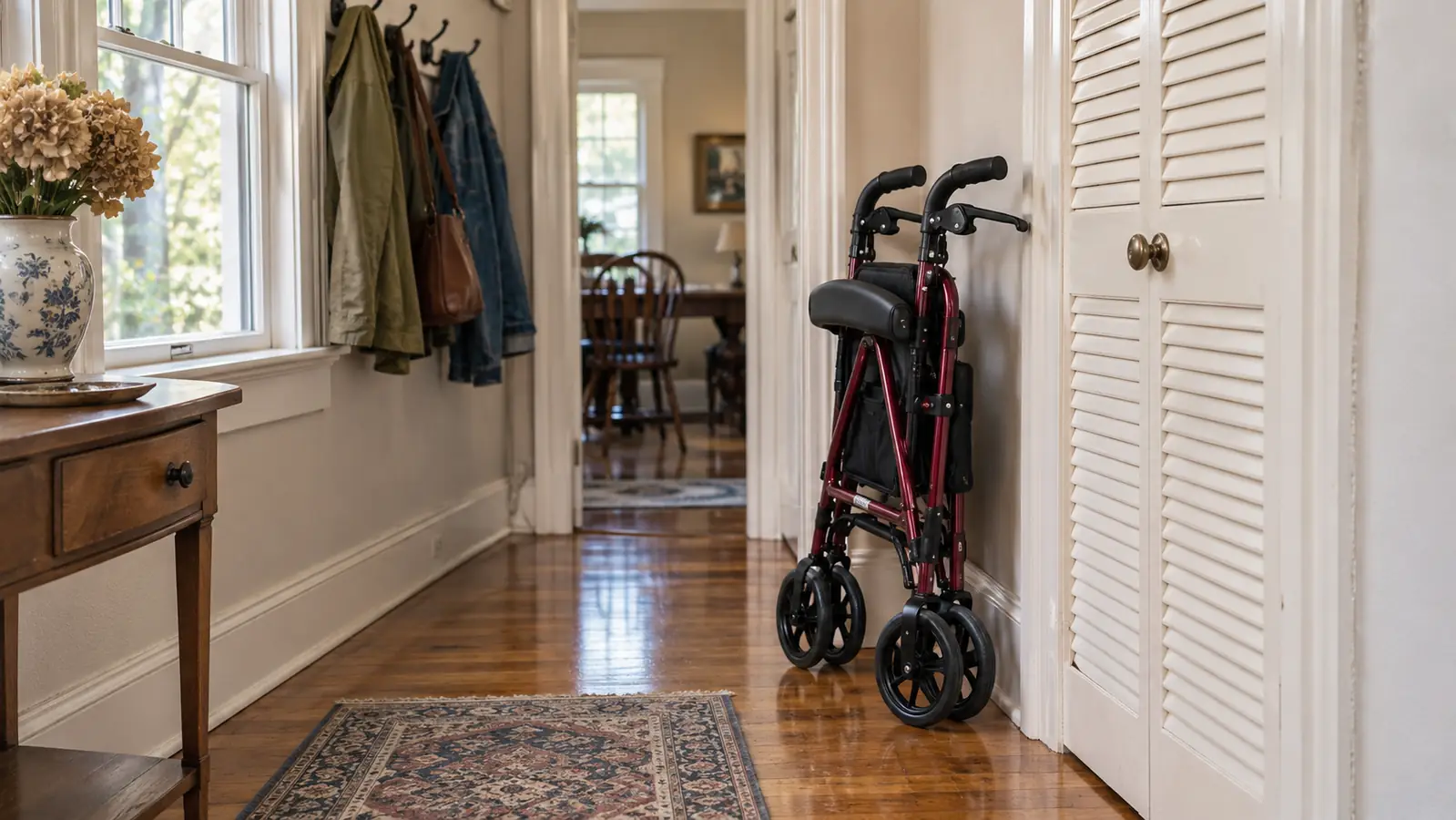
The rest of the week it lives folded in the front hall, standing on its edge against the wall by the closet door. That sounds like a small detail and it is not. A mobility aid that has to be unfolded, carried, or reassembled before every trip stops getting used somewhere around week three. This one folds flat, stands up out of the way, and is forgotten until morning. The fact that it can do that in a hallway the width of a hallway in a 1950s colonial is most of the reason it survived past the first month.
There is one more part of the routine I did not expect. Samira is proud, and proud in a specific way: she will not be seen being helped across a room. A rollator gives her something to do with her hands and something to lean on that is not a person. On Sundays she walks into church ahead of me, parks it by the coat rack herself, and sits down without looking around to see who noticed. You cannot put that on a spec sheet. It is the entire reason the thing works.
Indoors is a different story, and I want to be straight about it. The house has narrow doorways and one old area rug in the living room that catches a wheel if you are not paying attention. Inside, she uses a quad cane and always has. The rollator is an outdoor tool in this house. If you are picturing someone using one of these to move between the kitchen and the bedroom, picture a newer, wider house than ours, or plan on a smaller aid for indoors.

What Nobody Tells You About the Seat
The seat is the reason people buy this model and the reason some of them are disappointed, so it deserves an honest paragraph. It is not a chair. It is a place to put yourself down for ninety seconds without asking anyone for help. She sits, both feet flat, hands on the handles, and stands again before her legs have fully stopped moving. That is what it is built for and that is what it does, every single morning. What it is not built for is a long rest or a substitute for a bench. If the person you are buying for needs ten minutes off her feet, no rollator seat will do that comfortably, this one included.
The back support folds up and lifts off entirely, which reads like a marketing bullet until you watch somebody get on and off from the side. On the church hall floor, with the back folded, she can turn and sit without swinging her whole body around. With it up, she has something behind her and she sits back into it. Twenty months in, she uses it both ways depending on the day and how her hip is behaving. It takes a second to change, and it is one of the few genuinely thoughtful details on the frame.
Two blocks used to be the whole morning. Now it is the warm-up, and the only thing that changed is that she has somewhere to sit for ninety seconds.
Fit Is the Whole Ballgame, and the Listing Buries It
Here is the number that should be printed on the front of the box and is not: minimum height recommendation, 59 inches. That is just under five feet. If the person using it is shorter than that, the handles will not come down far enough to be safe, no matter where the lever sits. Samira clears it, but not by a wide margin, and I checked before we ordered. If you are buying for someone petite, measure her first. Standing height, no shoes, back against a wall. It takes a minute and it can save you a return.
The other end of the range matters too. Maximum handle height is 35 inches, set with the height adjustment lever. The general rule I was taught in the clinic is that the handles should land near the crease of the wrist when a person stands tall with her arms at her sides. I am not going to tell you that is the last word for your situation, because it is not, and I am not your clinician. Have a physical therapist or your doctor check the fit once it is assembled. It takes five minutes and it is worth more than any review, including this one.
What I can tell you is what the frame is made of and what it will carry. The Drive Medical frame is alloy steel, which is why it feels planted under her hands and why it weighs what it weighs. The listed weight capacity is 350 pounds, higher than most of what I have seen in this category, and the warranty is a limited lifetime on the frame. Nothing on this unit has bent, cracked, or loosened in 20 months of daily use on a bad sidewalk. I check the welds and the wheel mounts every couple of months out of old habit, and I have never found anything worth worrying about.
One note on the ratings, since I know people read them. This rollator sits at 4.6 out of 5 across more than 51,000 reviews, and after living with it I think that number is close to honest. What the angriest reviews tend to describe is not a defective product. It is a fit problem. Too tall for the user, too heavy for the person lifting it, would not go through a doorway. All three of those are things you can check before you order, and none of them are things the product can fix once it is in your hallway.
Twenty Pounds, and What That Means at Seven in the Morning
The listed weight is 20 pounds. Folded, the package measures 31.5 by 24.5 by 10.75 inches, roughly the footprint of a large suitcase and about as awkward to carry. It goes into the back of our Forester without drama. I lift it in with two hands, at 63 with a cranky right knee, and I would not want to do that four times a day. That is the honest tradeoff with a steel frame. The same weight that makes it feel steady on the sidewalk is weight somebody has to pick up.
Two things I would say to anyone worried about that. First, the fold is genuinely simple. There is nothing to line up and nothing to unscrew. Second, if the lifting is the real obstacle, the answer is not a rollator with a thinner frame. It is a second aid that stays in the car, or a lighter transport chair for the days that involve a lot of getting in and out. I would rather have a heavy rollator that feels solid under her than a light one that skates when she leans on it.
Where It Struggles
Surfaces. The 7.5 inch wheels handle sidewalk cracks, the lip of a curb cut, and the slight rise where the town patched the pavement. They do not handle grass, gravel, or the uneven brick apron outside the church side door. On those stretches I walk on the outside and she keeps to the pavement. If your daily route includes a gravel path or a stretch of lawn, plan around it, because no small-wheeled rollator is happy there.
Winter is its own chapter in Worcester. On a dry sidewalk it is fine and the wheels roll through cold without complaint. On ice it is exactly as helpful as any wheeled aid on ice, which is to say not at all, and we do not take it out on those mornings. That is not a design flaw, it is physics. I mention it because the first January after we bought it we learned the hard way on the sidewalk in front of the house, and I would rather you hear it from me than find out on your own.
And the front steps. We have three, and the rollator does not go up them. It gets folded, lifted, and carried in, which is a two-person job or a slow one-person job. That is true of every rollator I have ever handled, so it is not a knock on this one, but it is the sort of thing that surprises people who have only seen the photographs. An outdoor aid and an outdoor staircase are two separate problems, and you solve them separately.
What I Would Do Differently
Three things, and none of them are about the product itself. First, I would have bought it before the surgery instead of three months after. We spent those months doing the lift-and-place routine on the sidewalk when we did not have to, and her confidence took a hit in the meantime. Second, I would have had the handle height set by her physical therapist on day one instead of eyeballing it in the front hall and adjusting it twice in the first week while she waited.
Third, and this is the one I would tell anybody: decide where it lives before it arrives. Ours lives folded in the front hall because that is the only spot between the door and the sidewalk. If we had put it in the basement or the back of a closet, it would have been used twice and then become furniture with a warranty. The best thing you can do for a rollator is give it a permanent place by the door and never move it.
What I Liked
- Seat is genuinely useful on a route with a natural halfway point; ninety seconds there doubles what she can walk.
- 350 pound weight capacity and a limited lifetime warranty on the frame.
- Folds flat enough to stand in a narrow front hall and lift into a midsize SUV.
- Steel frame feels planted; nothing has bent or loosened in 20 months of daily sidewalk use.
- Back support folds up or lifts off, which makes getting on and off from the side much easier.
Where It Falls Short
- 20 pounds. It is a two-hand lift for most people and a real obstacle if the user cannot manage it.
- Minimum height recommendation of 59 inches rules out shorter users entirely.
- 7.5 inch wheels are unhappy on gravel, grass, and brick.
- Too long and too wide for a narrow hallway; it will not replace an indoor cane.
- It does not climb steps. Somebody has to carry it.
Who This Is For
This is for someone who can walk but cannot walk as far as she wants, who has a route with a natural resting point, and who has a spot by the door to keep it. It is for the person who has graduated from the hospital two-wheel walker and finds it slow, and for the family that wants her out on the sidewalk rather than circling the kitchen. It suits a user who clears 59 inches, whose daily route is pavement, and who has somebody nearby who can lift 20 pounds into a car now and then.
It is also for the grown children doing the buying, which in our family was me. If you are the one ordering, order it before the discharge date rather than after, measure the person's height, and have the handle height checked by a professional once it is together. The Drive Medical rollator has stood in our front hall for 20 months and I would buy it again tomorrow with the same caveats. It has not made her independent. It has made her independent on the sidewalk, which is where she wanted it.
Who Should Skip It
Skip it if the user is under 59 inches tall. Skip it if the daily route is gravel, grass, or brick. Skip it if nobody in the house can lift 20 pounds and the rollator has to travel by car, because it will end up staying home. Skip it if you are looking for something to move between the kitchen and the bedroom through narrow doors, since a cane or a smaller indoor aid does that better and with less furniture moved out of the way.
And skip it if the seat is the only reason you are shopping. Buy it because four wheels let somebody walk further than two. The seat is what makes the longer walk possible, not a chair you are in the market for. If what you actually need is a chair with wheels, say so out loud and shop for that instead, because this is not it and never claimed to be.
Twenty Months In, It Is Still the First Thing She Reaches For
Alloy steel frame, 350 pound weight capacity, limited lifetime warranty, and a seat that turns a one block walk into a real one. Check the 59 inch minimum height recommendation, then check today's price.
Amazon Check Today's Price on Amazon →