

The bathroom is the room I worry about most, and I say that as a retired outpatient nurse who spent thirty-one years watching people recover from hip and knee replacements. When my mother Samira moved into our house two years ago after her own hip surgery, the first thing I fixed was not the tub. It was the toilet. Sitting down and standing up is the move she makes ten or twelve times a day, and it was the move that had her reaching for a towel bar that was never built to hold a person's weight. We bought the Medline toilet safety rail the same week we bought her transfer bench. It has stood around that upstairs toilet ever since.
This is the honest version of that purchase, not the version where everything is wonderful and the star rating tells the whole story. The Medline rail has more than 25,000 ratings online and a 4.4 average, which is a lot of people agreeing it does something useful. But a rating cannot tell you whether it will fit your bathroom, whether it will get in the way of your cleaning, or whether it will still be steady in year two. Those are the things I want to cover, including the parts of the product page that I think oversell it.
Two years is long enough to actually know a piece of equipment. The novelty is gone, the early enthusiasm is gone with it, and what is left is the thing itself, standing in a bathroom, getting used every single day by a woman who has opinions about everything. Here is what I would tell a friend who asked me about it over coffee.
The Quick Verdict
A steady, height adjustable frame that made the toilet safe again for an eighty-seven year old with a new hip. It costs floor space, it will not replace a wall grab bar, and the listing states two different weight limits. Two years in, nothing has loosened.
Amazon Check Today's Price →The frame adjusts from 27.5 to 31.5 inches. Your floor is the other number that matters.
Height range, arm spacing and the full spec sheet are on the listing. Read the dimensions against your own bathroom before you order, not after.
Amazon Check Today's Price on Amazon →How We Actually Use It
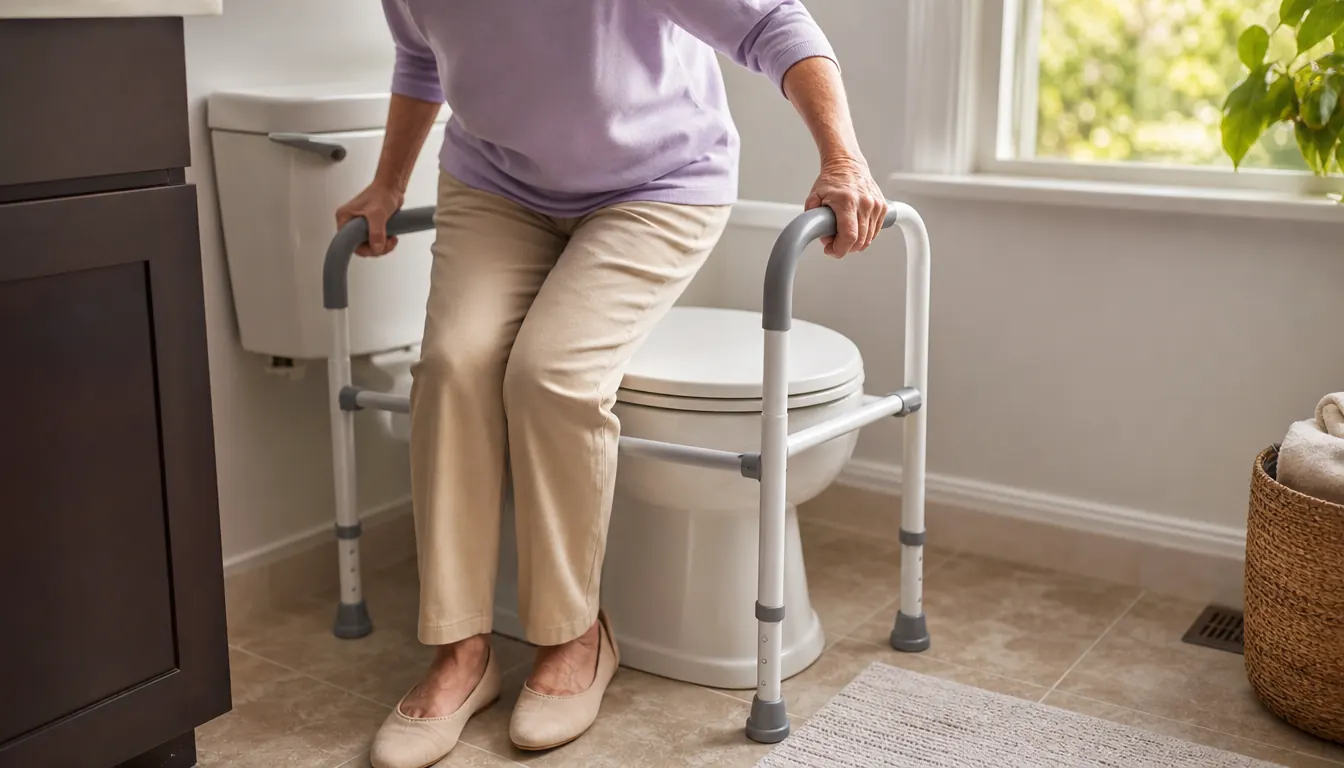
Samira is eighty-seven and sharp as a tack. She hates anything that looks like a hospital, and she has an opinion about every piece of equipment that has come through this house. The toilet rail survived her review, which is not nothing. She uses the arms the way you would use the arms of a sturdy dining chair: one hand on each side, lower herself down, push up to stand. That is the entire job. It does not lift her. It does not move. It simply gives her something at the right height on both sides so she is not twisting toward a wall or grabbing at a door frame on her way up.
The height adjustment is the part that mattered most for us. Samira is not tall, and a rail set too high turns into something you have to reach up for, which is worse than no rail at all. We set ours so the arms meet her hands at a height that lets her push straight down rather than pull herself up. It took two tries to find the right setting. Once we found it, we stopped thinking about it, which is the highest compliment I can pay a piece of bathroom equipment.
I use it too. I have arthritis in my right knee, and on a bad morning those arms are the difference between standing up in one motion and standing up in three. That was not the reason we bought it. It is the reason I would buy it again.
The frame also solved a problem I did not plan for, which is the middle of the night. Samira sleeps downstairs now, but she bathes upstairs, and on shower mornings she is only half awake when she reaches that bathroom. Having something at hand height on both sides of the toilet means she is not hunting for a wall in the dark. I leave the hallway light on a low setting on those mornings. The rail handles the rest.
The rail lives in the only full bathroom, the one upstairs with the tub and shower combination where her transfer bench sits permanently. She climbs those stairs once a day, slowly, with the banister and me behind her. The downstairs half bath has a wall grab bar instead and is not part of this story. I bring that up because the difference matters: a grab bar is anchored into studs, and this is a freestanding frame that stands around the bowl. They solve different problems, and mixing them up is how people get hurt.
What the Listing Does Not Tell You
The first thing nobody mentions is that the weight rating is stated two different ways on the same page. The product title says 250 pounds. The specification field says 300 pounds maximum. I cannot tell you which number is correct and I would not want to guess with my mother standing over a tile floor. If the person using it is anywhere near either figure, plan for the lower one, and ask your own doctor or physical therapist whether a frame like this is appropriate in the first place. That is not a question a product page can answer for you.
The second thing is that this is not a grab bar and it does not behave like one. You cannot lean your whole body sideways into it the way you can lean on something bolted to a wall. It is built for a two handed push, straight down, both arms, while you are squared up in front of the seat. That is exactly how Samira uses it and it has been entirely dependable. If someone in your house tends to pivot and haul themselves up on one side, this frame will not stop that and it is not designed to.
The third thing is floor space, and this is the one that decides whether the purchase works. The frame stands around the base of the toilet and it occupies room in front of it. In our upstairs bathroom that is fine. In a narrow powder room where the door swings inward and your knees already graze the wall, it would be miserable, and I have seen people buy one anyway because the reviews were good. Measure the floor around your toilet before you order. Not the toilet itself. The floor around it.
The fourth thing is cleaning. You now have a metal frame around your toilet, and it collects dust and the occasional stray hair where the parts meet. I wipe it down once a week with a disinfecting wipe, which takes about forty seconds. It is not a real burden, but it is a new chore that did not exist before, and it never appears in the reviews because nobody thinks to mention it.
A grab bar is anchored into the wall. This is a frame that stands around the bowl. They solve different problems, and confusing them is how people get hurt.
Fit: The Part That Decides Everything
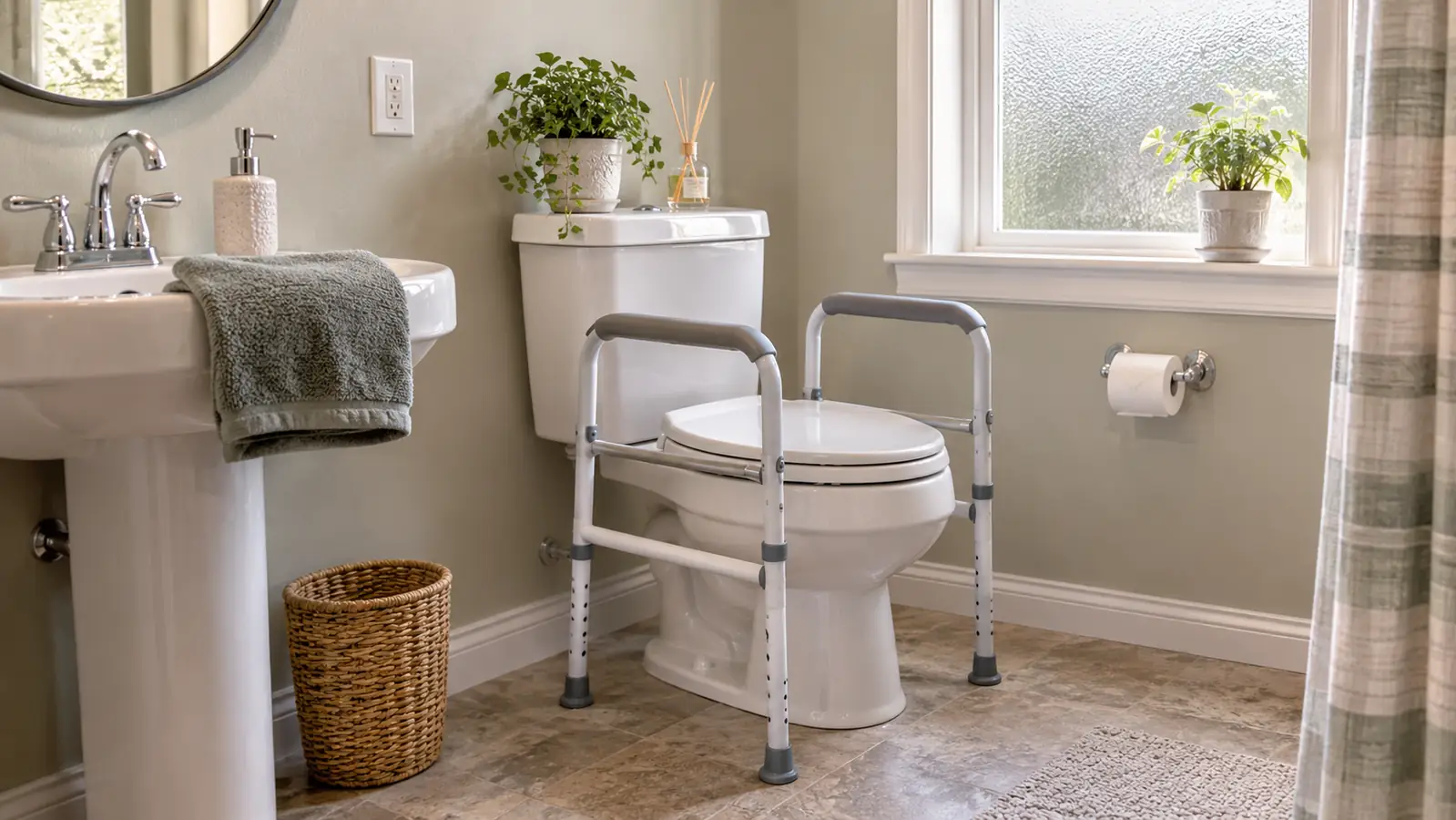
The listing gives the frame's range as 27.5 to 31.5 inches in length, 19 to 22 inches in width, and the same span in height, with 18 to 24 inches between the arms. In plain terms, the arms sit somewhere between a narrow chair and a wide one, and the frame is tall enough to clear a standard bowl. It fits most toilets. Most is the operative word in that sentence.
Ours sits around a standard height toilet without touching the tank. The width between the arms is what I would think about hardest. If the person using it is broad through the shoulders, or wears a heavy robe all winter, the narrow end of that range will feel tight. If they are small, the wide end puts the arms out where they have to reach for them. Set it, have them sit, and adjust again. Nobody gets this right on the first attempt, and a rail at the wrong width is only slightly better than no rail.
The frame weighs 4.4 pounds according to the listing, which means one person can shift it and one person can put it together. The aluminum frame carries a scratch resistant powder coating, and two years in it still looks like it did the week we bought it, which surprises me given how often it gets wiped down with bathroom cleaner.
One more fit note that cost us an hour: the old area rug in our living room is not the issue, but the bath mat was. A thick, spongy mat under the frame made the whole thing feel less settled on the tile. We swapped to a thinner mat and stopped noticing it. Anything that puts a soft layer between the frame and a hard floor is worth reconsidering.
What I Liked
- Height adjusts from 27.5 to 31.5 inches, so it can be set for a shorter person instead of forcing a reach
- Arms on both sides allow a two handed push, which is the steadiest way to rise from a seated position
- Aluminum frame with a powder coating has held up through two years of daily use and weekly wiping
- At 4.4 pounds, one person can move it out of the way or reposition it
- Stands around the toilet without drilling into the wall, which matters in a rental or a tiled bathroom
Where It Falls Short
- The listing states two different weight limits, 250 pounds in the title and 300 in the specifications, so plan for the lower one
- Takes up floor space in front of the toilet, which is a genuine problem in a narrow bathroom
- Does not replace a wall grab bar and will not hold up to sideways leaning or pulling
- Adds a frame you have to clean around every week
- The 18 to 24 inch span between the arms will feel tight for a broad shouldered person at the narrow setting
Two Years In: What Held Up and What Did Not
Nothing on this rail has broken, loosened or bent. That is the entire mechanical report, and it is a good one. The joints are still tight, the height setting has not slipped, and the coating has not rusted in a bathroom that fills with steam every other morning when Samira showers. I check the frame every few months the way I check everything else in that room, and I have never found anything to tighten.
What did not hold up was my assumption that a rail solves the bathroom. It solves the sitting and the standing. It does nothing about the step over the tub wall, which is why the transfer bench exists. It does nothing about the walk from the bedroom to the bathroom door at two in the morning, which is what the quad cane is for. I mention this because I have watched people buy one piece of equipment, feel safer, and then take a risk they would not have taken a month earlier. One rail handles one job.
The other thing that did not hold up was my assumption that Samira would find it undignified. She calls it the handlebars. She has shown it to two of her friends. The objection to equipment that looks like a hospital turned out to be about the equipment, not about needing help, and this frame does not read as hospital equipment. It reads as something that belongs in a bathroom. That mattered to her more than I expected it to.
Assembly, Cleaning and the Warranty
The frame arrived in a few pieces and went together without anything beyond what came in the box. I had it standing around the toilet inside fifteen minutes, and most of that was me reading the instructions twice because I did not want to discover a mistake at two in the morning. The height setting uses pins rather than a twist collar, so it either seats into the position or it does not. There is no slow creeping downward over a few weeks, which is the failure I have seen on cheaper frames.
Medline covers the frame with a limited warranty against defects in materials and workmanship. In two years I have had no reason to use it. I mention it because a warranty is one of the few things you can check before you buy that hints at how long the maker expects the thing to last. This one has outlasted my expectations regardless of what the paperwork says.
Cleaning is the unglamorous part and it deserves a sentence. Aluminum with a powder coating wipes down easily, and I do it once a week with a disinfecting wipe. The spots that need attention are where the arm meets the upright and where the frame meets the floor, because that is where bathroom dust and hair collect. Forty seconds, once a week. If that sounds like a deal breaker, you have never cleaned behind a shower chair.
The Raised Seat Question
People often ask me why we did not simply buy a raised toilet seat, which costs less and takes up no floor space. It is a fair question and the honest answer is that both have a place. A raised seat shortens the distance you have to travel going down and coming up, which helps a lot in the first weeks after surgery. What it does not give you is anything to hold with your hands. For Samira, the hands were the whole point.
A raised seat also changes the geometry of the toilet for everyone else in the house, and it has to come off and go back on if you share the bathroom. The frame stays put and does not interfere with anyone who does not need it. If the person using it is unsteady, the frame is the more useful of the two. If they are simply tired of a low seat and their balance is fine, the seat is cheaper and easier. Ask your physical therapist which one matches the actual problem. I am not going to pretend that decision belongs to a product page.
Who This Is For
This suits a household where someone has trouble getting down to a low seat and back up again, and where the bathroom has enough floor space around the toilet for a frame to stand. It fits a person recovering from hip or knee surgery, a person with arthritis in the hips or knees, and a person who is normally steady but does not trust their balance in that particular moment at three in the morning. It also suits the adult child doing the buying, because it is one of the few pieces of safety equipment that gets used every single day without anyone needing a reminder.
It is a good fit if the toilet itself is in a bathroom the person can reach safely in the first place. A rail around the bowl does nothing about a long hallway or a loose rug. In our house the rail, the cane and the transfer bench work as a set, and I would not want to rely on any one of them by itself.
Who Should Skip It
Skip it if the person using it needs to lean sideways or pull up with one arm to get out of the chair position. That calls for a different piece of equipment and a conversation with a physical therapist. Skip it if the bathroom is tight enough that the frame would block the door or crowd the person's knees, because a rail you have to climb around is worse than no rail. And skip it if the person's weight is at or above the 250 pound figure in the title, at least until you have confirmed the rating with the manufacturer and with your own clinician.
Skip it as well if what you want is something permanent. This is a freestanding frame. It sits on the floor around the bowl and it can be moved, which is convenient and also means it is not anchored to anything. If your bathroom has the wall space and the studs for a proper grab bar, a grab bar plus this frame is better than either one alone. If you rent, or the walls are tile over something you cannot drill into without a fight, the frame is the practical answer and it has been ours for two years.
If the frame fits your floor space, this is the simplest fix in the house.
Adjustable from 27.5 to 31.5 inches, 4.4 pounds, and it stands around the toilet without a single hole in the wall. Measure the floor around your toilet first, then check today's price.
Amazon Check Today's Price on Amazon →